.svg)



The downsides of the pandemic are easy to list. Challenges in managing distributed teams, a lack of employee integration, increased stress, and non-ergonomic workspaces during remote work… all of this is true, of course. But at the same time, it is precisely because of successive lockdowns and management during times of permanent crisis that employers have begun to pay exceptionally close attention to the mental and physical health of their staff. And rightly so. Both of these factors have a massive impact on work efficiency and function as a system of interconnected vessels.
Poor mental health
In 2021, the pharmaceutical brand STADA conducted a detailed study on the well-being of European employees. Unfortunately, the findings were not very optimistic for Polish employers. As many as 70% of respondents from our country admitted to having experienced signs of burnout at least once recently [1]. This gives us the dubious honor of first place among European countries. The same report shows that only half of us describe our mental state as good. This is confirmed by data from the Social Insurance Institution (ZUS). Mental and behavioral disorders have risen to become one of the main reasons for employee absenteeism—in 2021, this accounted for as many as 25.2 million days of sick leave [2].
Activity needs improvement
We also find no reason for satisfaction in the area of physical fitness. As the 2022 MultiSport Index report showed, the majority, nearly 60% of our fellow citizens, do not meet WHO recommendations regarding physical activity [3]. Let us recall: The World Health Organization emphasizes that people aged 18–64 should engage in at least 150 minutes of moderate-intensity physical activity per week or at least 75 minutes of vigorous-intensity activity. The 2016 recommendations from the Polish Cardiac Society are similar to the WHO guidelines above. They promote physical activity performed 3 to 5 training sessions per week, or ideally, every day [4].
Unfortunately, this translates into weight problems. The National Health Fund (NFZ) warns that three out of five Polish adults are overweight, and one in four is obese. And this problem has been steadily increasing in recent years [5].
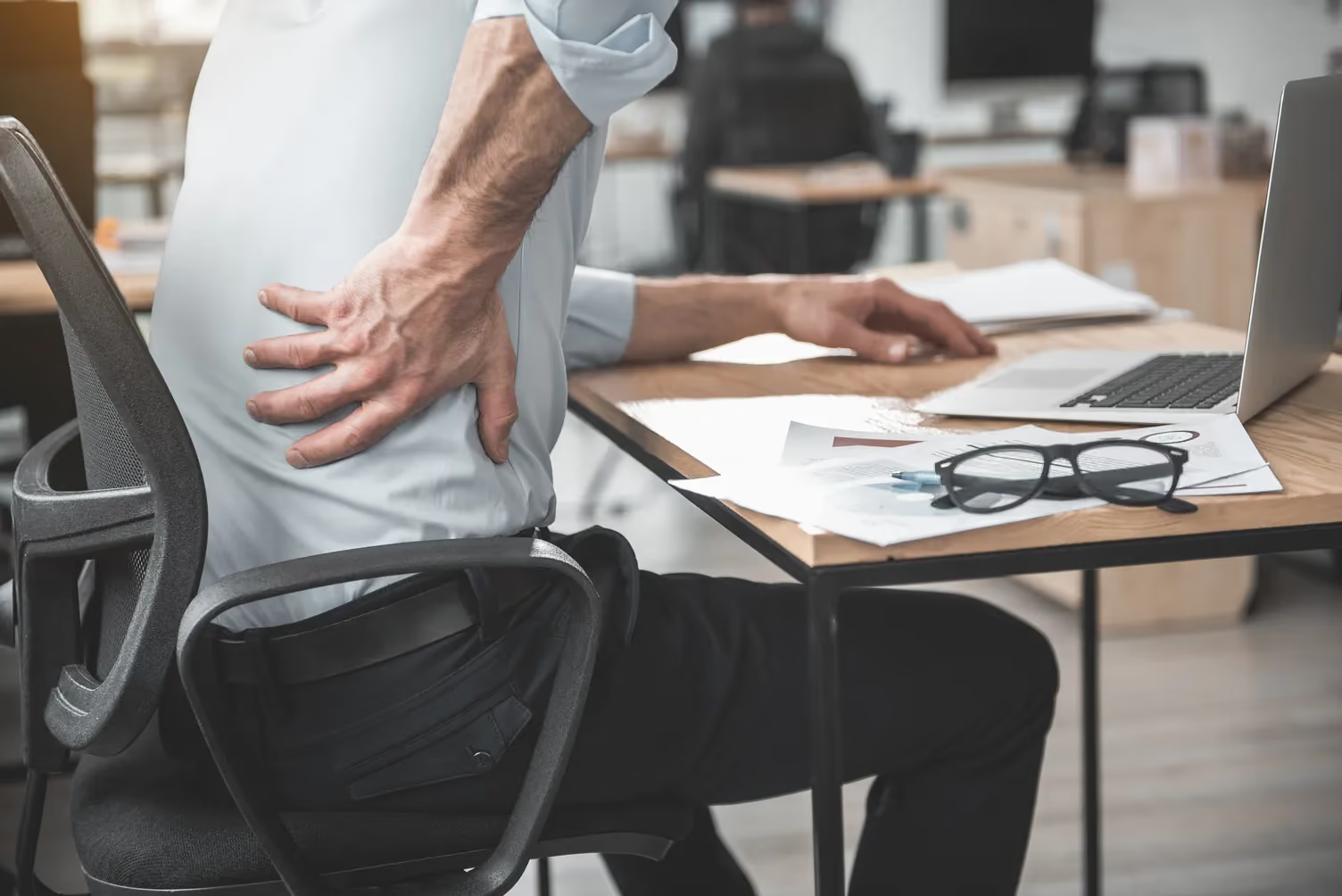
We also complain en masse about back pain—as many as 80% report such ailments people surveyed by Barbara Grabowska and Aleksandra Kwaśniewska from the Department of Population Health at the Wroclaw Medical University [6]. At the same time, half of the respondents emphasize that they take care of the ergonomics of their workstation. One of the reasons may therefore be activity. Or rather, the lack thereof.
Did you know that…? Polish employees have indicated that they have recently been experiencing a lack of energy, lower motivation, concentration problems, are isolating themselves from their teams, and are finding it difficult to make decisions [7].
What are the causes?
In 2021, the Employers of Poland organization, together with the ArteMis Group, conducted an extensive study among employees and employers. It focused primarily on mental well-being. And it quickly revealed enemy number one - too much stress. This was the reason for the mental health problems of people employed in Polish companies indicated by as many as 80.5% of employers. Respondents also blamed time pressure (74%), an excessive workload (66.5%), and too much pressure from supervisors (54%) [7]. Importantly, as many as 96% of those surveyed by the Employers of Poland actually notice and feel a drop in work productivity caused by stress.
Stress and a lack of mental comfort translate into a lack of energy, which in turn leads to an aversion to physical activity. This creates a disastrous vicious circle. Let us remember that it is activity that mitigates the impact of stress on health and provides protection against the devastation that stress can wreak on our psyche. The reason? Direct impact of activity on the central nervous system and the release of beta-endorphins. Daily exercise improves mood and increases self-esteem, as well as boosts energy levels [8].
Did you know that…? Sport promotes concentration and increases self-esteem [8]. Additionally, it has a real impact on the brain and its cognitive functions [9]. It is therefore ideal support for effective work – and not just physical, but also mental.
Employers to the rescue
The research leaves no illusions. Employees expect real help and commitment from their employers. The MultiSport Index 2022 report indicates that as many as 25% of professionally active adults believe that employers have an influence on improving physical activity, by offering benefits such as the MultiSport card [3]. In turn, a study by the Employers of Poland organization indicated that the vast majority of us (90% of respondents) see the need for employers to introduce a program that takes care of employees' mental health [7].
What do employers themselves think about this? They are in favor, too. The same study revealed that as many as 83% of employer respondents believe it is a good idea for companies to provide consultations with specialists, such as therapists. Meanwhile, 86.5% of the surveyed employers believe that employers should provide employees with valuable tips on how to manage stress [7].
To reduce stress, the following are recommended: [8] running, swimming, CrossFit, aerobics, dancing, Zumba, Nordic walking, Pilates, yoga, gym workouts, team sports, martial arts, and cycling.
What can an employer do?
First and foremost, prioritize physical activity. While it is important to take a broad view of mental well-being or even employee nutrition, remember that physical activity acts as a natural anti-stress agent and builds resilience to stress. Movement improves mood, helps combat overweight and obesity, boosts energy, and even prevents back pain, which is common in sedentary jobs. Of course, it is just one element of a company's health-promoting policy, but if you want your team to work efficiently, it is worth moving it to the top of the list.
It is worth remembering that diversity and synergy always yield the best results. A traditional gym is no longer enough today. More and more companies see the need to provide employees with extensive knowledge (for example, from trainers) so that they not only use the gym but know how to do it effectively. Additionally, it is worth diversifying the sports offering, for example by opting for remote yoga classes or even an entire app with home workouts – for some, this will complement the gym, while for others, it will be a nice change when the gym is not always on their way. Physical activity should always be accompanied by a healthy diet and this area is also worth examining by providing employees with, for example, consultations with a nutritionist as part of their benefits.
This way, every employee will approach physical activity in a healthy, effective manner. They won't get "bored" with sports and will choose the option that best suits their interests and time availability. The market has already noticed this need – from both employers and employees – and platforms like MultiLife have emerged, providing a range of services from specialist consultations to online training.
Did you know that...? People who do not engage in the physical activity recommended by the WHO complain not only about physical and mental health problems but also about difficulties with social functioning [6].
How to improve employee activity?
- Benefits
The majority, as many as 80% of Polish employees surveyed by the Employers of Poland organization, declarethat non-wage benefits influence their work motivation and engagement [7]. When it comes to promoting physical activity, the MultiSport card has this effect - 99% of its users are physically active at least once a month (a 34 percentage point lead over the general population) [3]. There are many solutions available on the market today – it is worth choosing the most proven ones. Keep in mind that the best option is to mix different solutions that complement each other perfectly, such as combining the MultiSport card with the Multilife suite of services. Both benefits can also be purchased as a package!
- Education
Employees need knowledge and are explicitly reporting a need for access to training, webinars, or workshops on wellbeing. They would also be happy to send their managers to such training sessions [7]. Time can be a problem here, however – remember that a lack of time is one of the most significant factors, second only to stress, that negatively impacts the mental health of Poles. A good solution is to use online platforms as intermediaries, such as MultiLife.
- Specialists
Over 84% of respondents in the Employers of Poland study agreed that employers should provide their staff with access to specialists [7]. A nutritionist or a trainer can have a real impact on the quality of physical activity, as well as motivation to exercise. Once again, it is worth facilitating such contact by providing the employee with an online service. An example of this is the ability to consult with these experts through MultiLife.
- Workouts
Relaxing yoga, invigorating cardio – whatever the employee feels like doing, it is worth meeting those expectations. Some companies opt for on-site classes and dedicate part of their office space to a room for group exercise or a gym. It is also worth looking into offers from external companies and providing professional online training. One such solution is provided by the Yes2Move platform, which is available in all MultiLife packages.
Traditionally, the best solutions are the comprehensive ones. Some employers are wary of complex, broad packages, fearing they won't be able to manage their employees' needs on their own. Fortunately, the market has already responded to these expectations and provides suitable services. Thanks to them, implementing proactive solutions will be much easier.
Sources:
- https://www.stada.com/media/7197/health-report-2022_final.pdf.
- https://www.zus.pl/documents/10182/39590/Absencja+chorobowa_raport_2021.pdf/8ca8025c-f6dc-b02c-a7e4-5aa99d28af9a?t=1652869131280.
- https://biuroprasowe.benefitsystems.pl/186355-badanie-multisport-index-2022-aktywnosc-fizyczna-polakow-po-dwoch-latach-pandemii.
- The impact of physical activity on mental health and cognitive functions, Barbara Gieroba, Medical University of Lublin https://www.monz.pl/pdf-112259-42310?filename=Wplyw%20aktywnosci.pdf.
- https://www.nfz.gov.pl/aktualnosci/aktualnosci-centrali/otylosc-choroba-wagi-ciezkiej,7355.html.
- https://www.monz.pl/pdf-142359-71040?filename=Dolegliwosci%20bolowe.pdf
- https://pracodawcyrp.pl/upload/files/2021/05/raport-zdrowie-psychiczne-w-srodowisku-pracy-25-05-2021.pdf.
- https://ncez.pzh.gov.pl/aktywnosc-fizyczna/systematyczny-ruch-lekiem-na-stres/.