.svg)


Celebrating birthdays together, company holiday parties, Easter breakfasts, or eating doughnuts on Fat Thursday – these traditions are so pleasant and popular that we usually see only the benefits. Including the financial ones. There are many publications on why and how to include things like Fat Thursday indulgences as business expenses, framed as a bonus that boosts employee loyalty [1]. You don't need special studies to see with the naked eye how a large dose of carbohydrates affects a team – after a brief burst of energy, drowsiness sets in, and work efficiency drops – often to zero. This is absolutely no reason to give up on nice, motivating traditions. But what if the problem happens more often? Or even every day?
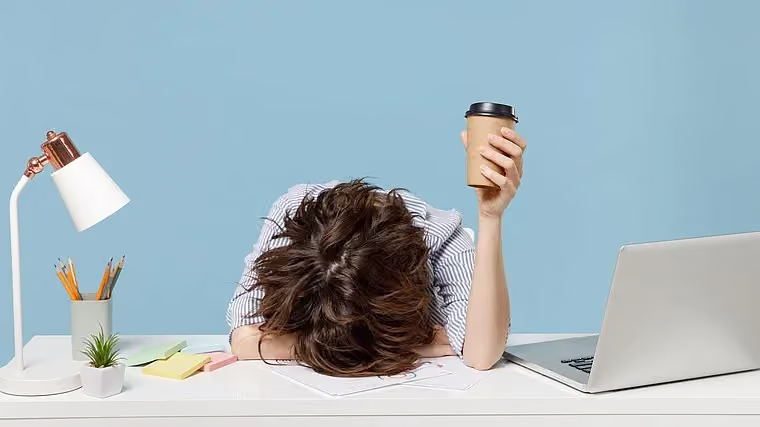
The "afternoon slump" is a term for a fairly common phenomenon. Efficiency, which is highest in the first part of the day, naturally drops between 1:00 PM and 3:00 PM. We feel a bit sleepy and, as a result, more distracted. The problem arises when this natural phenomenon intensifies and prevents us from working. Or when it happens every day with high intensity. What could be the reasons for this?
Fatigue isn't everything; during an afternoon slump, many people also experience headaches, muscle weakness, blurred vision, irritability, and sudden cravings for sweets. If these symptoms intensify, we can harm not only our work efficiency but also team relationships and our healthy diet [2].
Causes of excessive energy drops in the afternoon
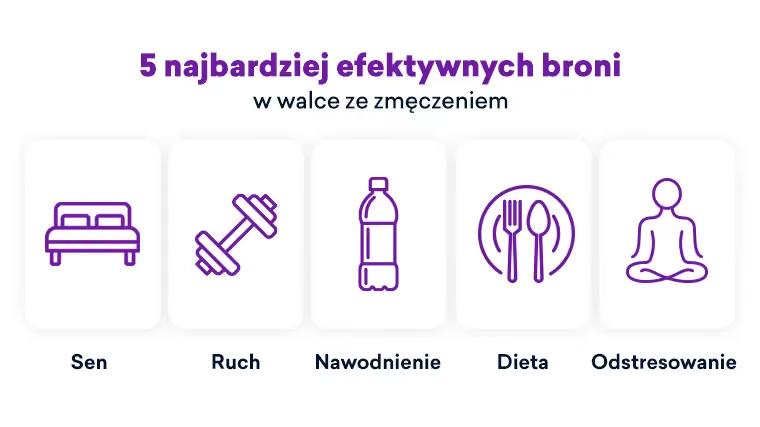
- Sleep deprivation
According to last year's STADA Health Report 57 percent of Poles use sleep aids [3]. The reason? The same report proves that nearly half of us (a staggering 47%!) worry about daily events instead of resting. Sleep disorders have a real impact on energy levels the next day, which in turn makes us worry about work problems – and so a vicious cycle of stress is created.
- Unhealthy diet
It’s no coincidence that we mentioned Fat Thursday – it’s a true festival of simple carbohydrates, which are also absorbed ad hoc, without proper intervals between meals. Meanwhile, nutritionists point directly to the correlation between a well-balanced menu (importantly, this balance also includes carbohydrates, but consumed in a rational way), and energy slumps during the workday. Research conducted by the Health Enhancement Research Organization shows that employees who regularly eat healthy meals achieve up to 25 percent higher productivity at work compared to those who do not eat healthily [4].
- Poorly chosen training plan
Exercise is healthy? Of course. But like everything else, it should be planned and executed wisely. It turns out, for example, that a morning workout can increase cortisol levels, and that stress will translate into lower work quality [5]. It is therefore better to discuss your exercise plan with a trainer after describing your individual daily schedule and the nature of your work.
- Insufficient hydration
For every kilogram of body weight, we should drink about 0.02 liters of water. This means from 1.5 to 2 liters of water per adult per day. During hot weather, this amount increases to as much as 5 liters [6]However, in the rush of daily responsibilities, we often forget about this. The effects of dehydration hit us in the afternoon in the form of poor concentration and fatigue.
- Excessive stress
Stress affects not only our sleep but also how we perform during the workday. We often focus on physical factors, blaming digestion for our sleepiness, when in fact our brain is craving a break from stressors [7].
Did you know that 15% of Poles don't eat at all during the workday, and over 50% don't drink enough fluids [8,9]? You can read more about the nutritional pitfalls of Polish employees and ways to support them in developing healthy habits HERE.
What can a company do to support its employees?
There are two types of solutions – education and providing opportunities. It will come as no surprise that the best approach is to combine both as part of a comprehensive health strategy.
What about coffee? Usually, the easiest solutions employees reach for are energy drinks and coffee. However, it is worth remembering that the daily limit for coffee should not exceed 4 cups [10]. Providing employees with a good coffee machine is not a magic solution to energy slumps. It is worth looking into other, healthier options.
- Manage fatigue
Prof. Christopher Barnes from Washington's Foster School of Business suggests in Forbes that you incorporate natural energy dips into your work schedule [11]. This prevents afternoon fatigue from reaching a point that jeopardizes task completion. For example, you can assign tasks requiring high focus, creativity, or physical energy in the morning. The natural afternoon slump is a good time for activities that don't require a creative approach or new ideas—you could suggest organizing documents or holding a meeting to summarize project progress.
- Introduce breaks
It is also worth introducing breaks, not necessarily ones that completely stop work, but rather those involving lighter tasks [7]. Ultimately, such a shift away from intense work will improve overall daily efficiency. Such a break could be as simple as preparing printouts or delivering documents to another department—this naturally forces you to step away from your tasks and get a little movement. Brainstorming sessions can also serve as a breather without stopping work entirely, especially if the team is primarily focused on analysis or other tasks requiring deep concentration.
- Share knowledge
Worried that you lack both the time and the expertise to provide your employees with proper support regarding a healthy lifestyle? You don't have to rely on internal resources. You have external services at your disposal, such as Kreator Diety, created by MultiLife. With this benefit, you can also provide employees with other solutions that improve their mental and physical well-being, such as access to inspiring books or development courses.
- Provide access to experts
Webinars with specialists, office massages, consultations with a trainer and nutritionist all of this will make employees more health-conscious and help them adopt habits (including nutritional ones) that translate into greater efficiency.
- Monitor your team
Experiencing a regular and excessive afternoon slump may be a sign of general fatigue. It is worth tracking the number of vacation days used by the team and ensuring that employees have time to rest [7].
- Create a friendly space
The reason for afternoon fatigue might also be the very room we work in. Noisy, crowded spaces can increase stress, and poor ventilation contributes to a rapid drop in efficiency. Sometimes, simply opening the windows and thoroughly airing out the room can help with the afternoon slump [7].
- Take care of the infrastructure
Introducing healthy eating habits will be easier if the company provides employees with a place where they can eat in peace and access to drinking water at multiple points throughout the office. Remember that hydration—even more so than a "rescue" cup of coffee—affects overall efficiency [12].
- Don't forget about movement
Exercise, both traditional and breathing exercises, is an excellent way to get a tired mind back up to speed. It is worth encouraging employees to take care of themselves in this way and, whenever possible, provide them with a separate space, such as exercise rooms or relaxation zones [12].
As you can see, there are many tools at our disposal to improve efficiency in the company, and they are practically within reach. However, let us remember that productivity is not, and will never be, constant throughout the day— so let's be understanding with ourselves and adapt our work to our natural rhythm. Then it will not only be efficient but also simply enjoyable.
Sources:
- https://bezprawnik.pl/paczki-dla-pracownikow-w-tlusty-czwartek/.
- https://www.liveabout.com/causes-of-afternoon-slump-3514765.
- https://www.stada.com/media/7248/20220810_stada_factsheet_sleep_engl_v02.pdf.
- https://zdrowie.pap.pl/dieta/dieta-ma-duzy-wplyw-na-wyniki-w-pracy.
- https://novumortopedia.pl/wydolnosc-w-roznych-porach-dnia/.
- https://pacjent.gov.pl/aktualnosc/pij-wiecej-wody.
- https://inewi.pl/Blog/spadek-energii-w-pracy-jak-z-nim-walczyc.
- https://www.portalspozywczy.pl/dookola-rynku/wiadomosci/badanie-co-polacy-jedza-w-pracy,143558.html.
- https://www.pulshr.pl/rynek-zdrowia/zdrowa-dieta-poprawia-produktywnosc-pracownicy-o-tym-zapominaja,77621.html.
- https://www.medonet.pl/zdrowie,organizm-daje-znac--ze-pijesz-za-duzo-kawy--nie-przegap-tych-sygnalow,artykul,10109285.html.
- https://www.forbes.pl/kariera/nie-unikniesz-spadkow-energii-zacznij-planowac/hmtzl6x.
- https://poradnikpracownika.pl/-spadek-energii-w-pracy-jak-go-pokonac.
- https://portal.abczdrowie.pl/wyniszcza-jelita-doprowadza-do-problemow-psychicznych-polacy-maja-ogromny-problem.
- https://analitykadietetyczna.pl/dlaczego-wystepuje-spadek-energii-po-poludniu/.