.svg)



Living in the spirit of work-life balance
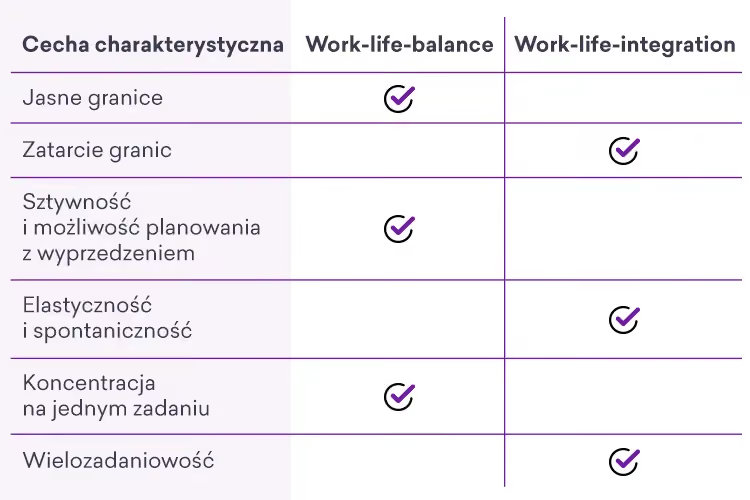
Work-life balance is about separating your private and professional life and giving them equal priority. Proponents of this method strive to leave work at the office. They finish all work-related tasks the moment they step out the door—whether literally or metaphorically when working remotely—and leave any unfinished business for the next day. The same applies to your private life, which should not be brought into the professional sphere. This way, we can fully dedicate ourselves to our work without being distracted by personal matters.
Practicing work-life integration
Work-life integration is essentially the opposite of the aforementioned method. This approach involves blurring the lines between your private and professional life rather than keeping these spheres separate. According to the principles of this integration, busy employees can find a compromise between these areas instead of viewing them as distinct entities. This will look different for everyone, but it might involve, for example, handling household chores while attending a conference call with colleagues or during a session of a professional development course. It can also involve bringing your child to the workplace when schools are closed.
Work-life balance or work-life integration? Which one to choose?
Each of us is different, with a unique set of commitments, priorities, and life philosophies. It is therefore difficult to speak of an ideal, universal way to manage all your responsibilities. However, we can identify specific pros and cons of both methods mentioned above. It is best for each employee to determine for themselves which one is better suited to their personal situation: the nature of their work and their lifestyle.

Pros and cons of work-life integration
The main advantage of work-life integration is definitely its flexibility. It is said that employees who have the freedom to coordinate their schedules and commitments are more likely to feel fulfilled on many levels. Thanks to work-life integration they simply have greater control over all areas of their lives.
However, there is also a flip side to this approach. Research shows that poorly managed blurring of boundaries between work and private life can have negative consequences, such as lower productivity and motivation, and consequently, less satisfaction in both areas.
Pros and cons of work-life balance
The work-life balance approach also has its pros and cons. An important element of this method is fixed working hours, which allow for planning well in advance. Professional duties that could not be completed are put off until the next day. In theory, this allows us to completely disconnect from them during our free time. Thanks to work-life balance both areas of our lives have the potential to coexist within clearly defined timeframes, allowing us to find equal fulfillment in both.
Unfortunately, theory isn't everything. Nowadays, as remote work becomes increasingly common, maintaining such clear boundaries can prove very difficult. Moreover, it is a rather rigidmethod, which may not work in practice due to various circumstances beyond our control. Implementing it can even be burdensome, for example, in a situation where extra working hours would be very helpful for a company project. Similarly, in the event of a birth or a move, an employee might need more time to dedicate to their family life.
How do you choose the right method for your team?
The most important thing when choosing between these two approaches is taking a close look at each employee's work style. It's about determining what helps and what hinders a person from performing their duties effectively.
Work-life balance will likely be more beneficial for those who are easily distracted and find it hard to get back into their rhythm. It will help establish detailed schedules for both areas of life, ensuring all obligations are met on time and to a satisfactory standard. This helps avoid misunderstandings or shortcomings, both at work and in private life. This method may prove beneficial for those who value clear boundaries, precise deadlines, and order.
However, some people do not thrive within rigid timeframes and struggle to focus on a single task for long periods. Such individuals often need constant mental stimulation and variety in their activities to maintain productivity. At the same time, they adapt easily to multitasking bit by bit. In such cases, work-life integration may prove to be the perfect solution. It will help maintain full focus and boost motivation and creativity at work. Thanks to work-life integration, such employees have the chance to secure the necessary space for breaks to perform various types of tasks and keep their productivity at a high level.
How can you put your chosen method into practice?
An essential element of implementing your chosen method is, above all, employer support. Allowing employees to work in a format and at a time that suits them is essential for achieving work-life integration. Similarly, clearly defining working hours and a set of tasks and commitments will help employees establish a work-life balance. This second model will also be supported by all kinds of mindfulness training that helps focus on the "here and now," such as a mindfulness course.
On the employee's side, it is important to set clear boundaries – communicating that contact outside of working hours is discouraged and that they will not be available during their personal time. It is worth encouraging everyone to have such open conversations about their needs to increase the efficiency of the entire organization.
Above all, remember that the chosen method should serve both the individual employee, and the entire company. It should not, however, create conflict, add extra duties, or cause frustration. It is there to make our daily lives easier by reducing stress (which is further aided by MultiLife psychology services), increasing productivity, and working to the benefit of every member of the team.
................
Bibliography:
- https://iaap-journals.onlinelibrary.wiley.com/doi/10.1111/apps.12335 - Work and home boundary violations during the COVID-19 pandemic: The role of segmentation preferences and unfinished tasks, Katja Kerman, Christian Korunka, Sara Tement, Applied Psychology 2021.
- https://www.businessnewsdaily.com/5244-improve-work-life-balance-today.html - How to Improve Your Work-Life Balance Today, Marisa Sanfilippo, Business News Daily.
- https://www.atlantis-press.com/proceedings/sores-18/55915337 - Millennials Engagement: Work-Life Balance VS Work-Life Integration, Muhammad Rizky Afif, SoRes 2018.