.svg)
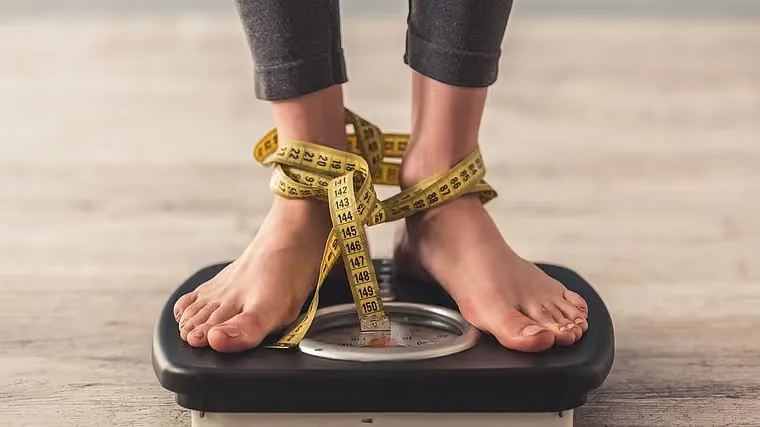


To lose excess body fat, you need to consume fewer kilocalories than your body burns throughout the day. The exact amount is an individual matter, as energy requirements are influenced by many factors, such as body weight, height, age, and physical activity level. While we cannot control some of these (like age or height), others can be modified. Physical activity level is certainly one of them.
Calories for exercise
Unfortunately, physical activity is the hardest element to assess objectively. Nevertheless, it is worth trying, as we burn the most calories during workouts and generate a significant amount of energy, which helps us maintain a caloric deficit. When estimating your activity level, you should also take into account spontaneous actions, such as taking the stairs or going for a walk. If your desire for such "spontaneous" movement has decreased while dieting, it may be the first sign that your diet is too low in calories.
Dietary lapses
What about your diet? Are you sure you are sticking to your established meal plan? Or are you tempted to snack between meals?
If so, your diet is likely too restrictive, or you are leaving too much time between meals. The hunger you feel is not a sign of effective calorie reduction. On the contrary, it can actually be an obstacle to shedding those extra pounds.
If your diet is properly balanced and rich in vegetables, fruits, and whole grains, you won't feel hungry as often, which will help you better control what you eat. Perhaps your plan needs a modification?
Caloric drinks and supplements
Another aspect to look at if you aren't losing weight is your fluid intake. Although they are usually not listed in a diet plan, they are quite significant. Of course, the best solution is to choose calorie-free drinks, such as water, tea, black coffee, or "zero" sodas. However, if you can't imagine your morning coffee without milk, or you always have a glass of orange juice with breakfast, remember to include their calories in your meal plan. This will allow you to control the number of calories you actually consume.
Also, take a look at the supplements you are taking. They also affect weight loss. For example, creatine can lead to water retention, and protein powder provides a significant dose of calories (about 100 kcal without milk).

Smart weighing
How do you track your weight loss? For many people, the bathroom scale is the only tool for monitoring progress. When it doesn't show a lower number than yesterday, or sometimes even shows a higher one, frustration often sets in. Take it easy!
Body weight is influenced by many factors, mainly the content of your digestive tract or water retention. Therefore, progress should be determined based on your average weekly body weight. To get an accurate reading, you should weigh yourself at the same time of day, on an empty stomach, after using the restroom, and at least one day after an intense workout. Only by recording results this way can you determine the effectiveness of your diet.
It is also worth noting that weight fluctuations during a diet are much more common in women. This is due to a series of hormonal changes occurring in their bodies, which depend on the phase of the menstrual cycle. Therefore, you should weigh yourself during the first phase of your cycle, preferably on days 4-7. It is also a good idea to take body measurements and perform a body composition analysis, which will provide information not only on your weight but also on components such as body fat, muscle tissue, and water content.
Sleep
This is a very important element in the weight loss process! Getting the right amount of high-quality sleep helps you achieve your dream physique.
What are the risks of sleep deprivation? It increases the concentration of ghrelin (the hormone responsible for hunger) and lowers the concentration of leptin (responsible for the feeling of satiety). Consequently, when we don't get enough sleep, we may feel hungrier than usual the next day. This increases the risk of snacking and, as a result, consuming too many calories. Furthermore, a sleepless night has a negative impact on carbohydrate metabolism, which can also make weight loss more difficult.
Remember that increased appetite is also affected by stress, or more specifically, by a rise in cortisol levels, which can hinder your weight loss efforts.
Give yourself time
Many factors can cause weight loss to stall, even while dieting. Your body may need a boost or some "de-stressing" by returning from a deficit to your maintenance calories (the caloric intake required to maintain your current body weight). After an initial self-analysis of aspects that might be hindering your progress, it is worth consulting a nutritionist to verify the caloric content of your meal plan.
Bibliography:
- Gawęcki J. (ed.): Human Nutrition, Fundamentals of Nutritional Science. PWN Scientific Publishers, Warsaw 2012
- Jarosz M., Rychlik E., Stoś K., Charzewska J. (eds.): Nutrition Standards for the Polish Population and Their Application. National Institute of Public Health - National Institute of Hygiene, 2020
- Spiegel K., Tasali E., Penev P., Van Cauter E.: Sleep curtailment in healthy young men is associated with decreased leptin levels, elevated ghrelin levels, and increased hunger and appetite. Ann Intern Med 2004; 141:846–50
- Leproult, Rachel & Van Cauter, Eve.: Role of Sleep and Sleep Loss in Hormonal Release and Metabolism. Endocrine development. 2010, 17. 11-21