.svg)



What is a variable interest rate?
This is the standard type of interest rate found on the Polish mortgage market. The rate consists of the bank's margin and WIBOR, which is the rate at which banks lend money to one another. A variable-rate loan is therefore based on current interest rates.
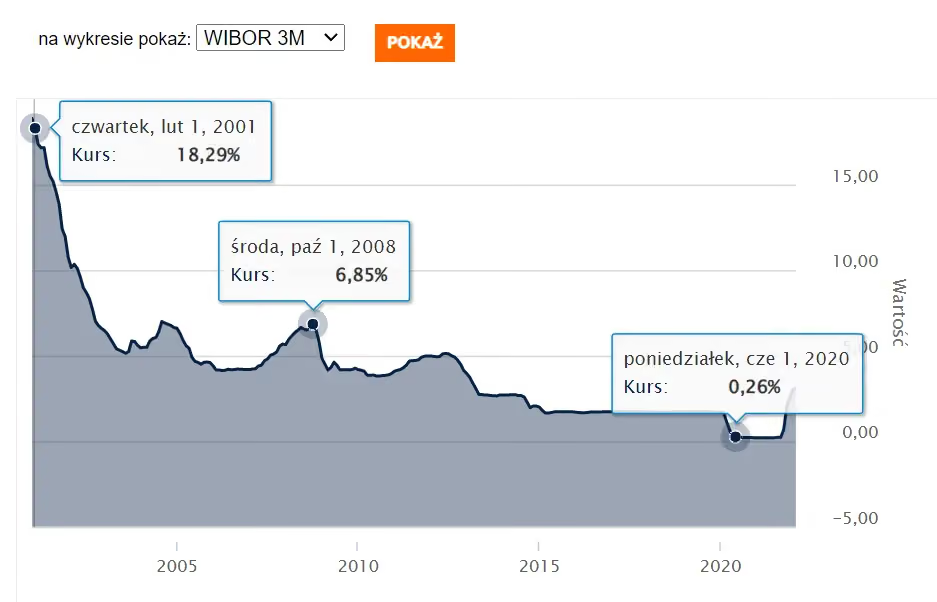
Interest rates depend on decisions made by the Monetary Policy Council, so when choosing a variable rate, the borrower bears all the risk. The installment amount can both decrease and increase. Before making an informed decision, it is worth reviewing the history of the WIBOR index.
Source: bankier.pl
At first glance, it is clear that taking out variable-rate mortgages has been profitable so far. Although you can see periodic increases in WIBOR on the chart, looking at a 20-year loan horizon, the interest rate has fallen significantly. This has been very beneficial for borrowers.
Exactly — it *was*. As the name suggests, variable interest rates are characterized by volatility. However, this does not mean that WIBOR will always go down. It can also rise, which in recent months has been a major source of stress for those who took out loans at historic lows.
Just a year ago, the 3M WIBOR was 0.21%, and as I write this article, it has climbed to 3.1%. What happens next? While further hikes can be expected in the near future as a way to combat inflation, it is impossible to predict in the long term.
A person taking out a loan in 2003 might have caught a WIBOR of 5.14%, which rose to 7% a year later, fell to 4.16% over the next 2 years, only to return to 6.85% two years after that, and then back to 4.18% a year later.
Quite a roller coaster.
Could that borrower have predicted such a turn of events by looking at the stable, or rather, massive drop in WIBOR before taking out the loan? Or did they expect further price cuts? Treat predicting the distant future like a carnival fortune teller's act, not something you should base your financial security on.
What is a fixed interest rate?
In this case, the interest rate also consists of WIBOR and the bank's margin, but the offer will be completely different. Although it is called a fixed-rate loan, this does not mean it is fixed for the entire term, as it is in other countries. In Poland, such offers practically do not exist — we only have periodically fixed interest rates. Therefore, current bank offers provide a fixed rate only for the first 5 years. Some financial institutions try to attract customers with 7-year offers, but that is still not a fully fixed interest rate.
Why will the offer be completely different from a variable interest rate?
By choosing a fixed interest rate, you completely remove the risk associated with interest rate changes from yourself for a certain period, which the bank must then take on. You know what installments you will pay for the next 5 years, but the bank feels it cannot be certain of its profit. Instead of taking risks, banks prefer to hedge. They do not want to end up in a situation where WIBOR is, for example, 10%, while you are still paying your 5%. That is why fixed-rate offers are always higher, which is meant to compensate for any potential losses for the bank. Looking at the WIBOR chart again, one might conclude that a fixed interest rate is completely unprofitable. However, you already know that it is impossible to predict the future, so WIBOR can both decrease and increase. While variable-rate loan holders have come out on top so far, those who took out a fixed-rate loan in mid-2021 have reason to be satisfied now.

*In the table, you see offers from the same bank. Remember, however, that these are just offers, and whoever took out a loan in August 2021 still has a 2.94% interest rate in February 2022. They will have it for 5 years and can be certain of their installment amount, which is something a variable-rate borrower cannot say.
Is it more profitable? Looking back six months — yes, but we do not know what WIBOR will look like in 3 years. The situation may reverse again, although it does not have to.
What happens after the first five years? Once this period ends, depending on your agreement, the bank will offer you the option to switch to a variable or fixed interest rate (again for 5 years) based on the current terms.
Which interest rate should you choose?
You are surely wondering about this and expecting a definitive answer from me, but you won't get one. Claiming that one option is clearly superior to the other is as arrogant as it is foolish. It is impossible to predict, and history is full of thousands of self-proclaimed financial market prophets. Just because someone got lucky once and guessed right doesn't mean you can trust them. I once guessed what my wife was thinking, but that doesn't qualify me to write relationship advice columns.
You have to choose for yourself.
Are you worried about a significant rise in interest rates and, consequently, your monthly payment becoming unaffordable? Choose a fixed interest rate and don't worry about market fluctuations.
Are you willing to take the risk that things might be cheaper or stay the same, and are you prepared to handle potentially higher costs? You know what to choose.
Both solutions have their pros and cons. You should be the one to decide which one works best for you.