.svg)


Money should be easily accessible and plentiful, as it is ultimately just a means to an end—a tool. With the rise in real estate values, a multitude of financial "gurus" have emerged who repeat the same talking points regardless of whether the property is intended for personal use or investment.
- "A mortgage is the cheapest money on the market—borrow the maximum amount available."
- "Use financial leverage."
- "Take out a loan for a longer term—it means a lower monthly payment, so why pay more?"
- "Don't worry about the monthly payment; you'll earn more over time, and inflation will lower the cost of the loan."
Unfortunately, in most cases I encounter, these are not seasoned real estate experts, but rather course sellers clumsily trying to apply American advice to our local market. They fail, however, to adapt it to the specifics of our banking system.
While a typical American author of a real estate investing guide might recommend a 30-year mortgage as a fairly safe use of capital, doing so here carries incomparably higher risk.
In Poland, mortgages are not granted with a fixed interest rate for the entire term of the agreement, but only for the first few years, which makes it difficult for us to easily predict future monthly payments. From my previous article, you know that WIBOR can fluctuate significantly, which can have a major impact on your payments. And we are not talking about a small loan, but hundreds of thousands of zlotys over more than twenty years!
On top of that, there is a general aversion to change, which results in people sticking with the same loan until the very end. Few people refinance their loans to get better terms, which means a loan taken out when WIBOR is at a record low will carry a high margin until the end of the contract.
Another point is that you are not guaranteed to earn more in the future. You might, but you don't have to. Let's set aside the ups and downs of business or career changes. Even if your salary increases every year, will the adjustment beat inflation? Will it keep up with rising interest rates and WIBOR? Will it be enough to proportionally cover the increase in daily living costs associated with a growing family? That is pure guesswork.
Is it really worth extending the duration of this risk?
Maximum borrower age
The length of the mortgage you can afford also depends on your age. The maximum loan term allowed by banks depends on their individual policies. There are offers where the final installment can be paid off even before your 80th birthday, though this is rare, and the criterion is usually 67 years of age.
However, given that you have the option—do you really want to be paying off a loan for many years after you retire just because you can? Wouldn't it be better to handle a higher monthly payment while you are still working and have peace of mind in your old age?
Is it worth taking out a mortgage for a shorter term?
Let's return to a more common scenario. You still have a lot of life ahead of you. Let's assume you planned to buy a property for your thirtieth birthday and even have a down payment saved up, so all that remains is choosing a mortgage. Let's assume you are buying a property costing half a million zlotys and have a 20% down payment. You are therefore applying for a 400,000 PLN loan with an interest rate of 5.5%.
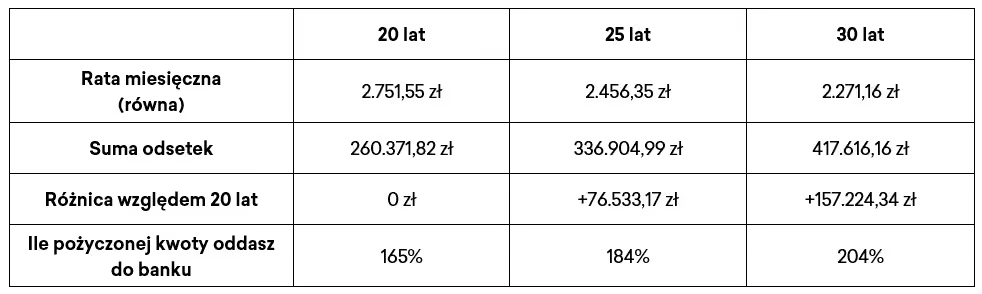
It is true that the mortgage installment for 20 years is higher than the others, but is it really that significant? Between a 20-year and a 30-year mortgage, the difference is barely 480 PLN, yet the discrepancy in the total interest cost is almost 160,000 PLN! Where does this difference come from?
With a 30-year mortgage, you are paying off only 437.82 PLN of your debt. As much as 80.7% of the installment consists of interest. Meanwhile, with a 20-year mortgage, your debt after the first installment is 918.12 PLN lower.What does this mean? In each subsequent installment, the interest value will be lower because it is calculated on a smaller balance. The same happens the following month, and so on, and so on... This works the same way for 20, 25, and 30-year mortgages. However, the shorter the mortgage, the sooner you will notice the effects.
What does the situation look like after 20 years? The 20-year mortgage is, of course, already paid off. However, with the 30-year mortgage, not only have you paid almost 94,000 PLN more in interest, but you still have over 209,000 PLN left to pay.
Let's summarize this information briefly — how does the comparison between a 20-year and a 30-year mortgage look?
- For 20 years, you pay an installment that is 480 PLN higher;
- you save over 157,000 PLN in interest;
- after 20 years, you have peace of mind — you are debt-free.
Or, in the 30-year version:
- for 20 years, you pay an installment that is 480 PLN lower;
- after 20 years, you still have over 209,000 PLN left to pay;
- for the next 10 years, you are exposed to WIBOR fluctuations.
Of course, many people might be indignant, arguing that it is better to have a lower installment and that a little discipline is enough to regularly overpay the mortgage with the saved difference. However, I think we all know how it goes with that discipline. People talk about it a lot, but few actually have it. There is always an expense that seems more important at the moment. If you believe that you will definitely overpay your mortgage for a dozen years or more, ask yourself honestly how many New Year's resolutions you have actually kept so far.