.svg)
.avif)


"Boss, I'm not feeling well" – when a statement like this refers to something like a stomach ache, most of us know how to offer support. But what if it involves mental health?
How should a leader react to provide genuine support to an employee?
Is it possible to anticipate such a situation within a team?
And finally, how do you create an environment that fosters trust and open conversation?
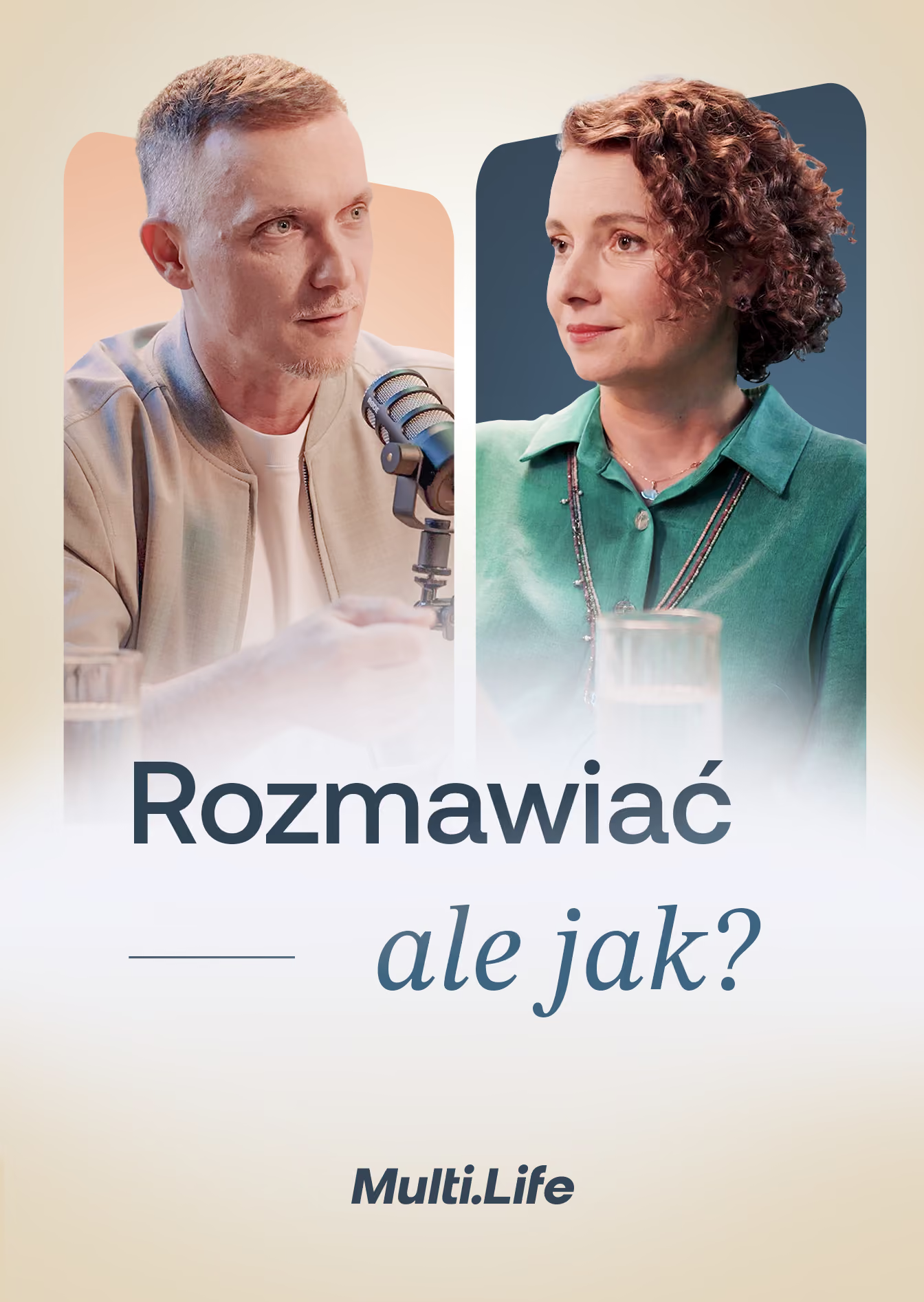
In today's episode of the Supportive Company series Dr. Ewa Hartman speaks with Andrzej Silczuk, a psychiatrist, habilitated doctor at the Medical University of Warsaw, and Head of Mental Care at Multi.Life.
- 00:00:00 Introduction
- 00:01:02 Psychiatry and addiction
- 00:04:15 The line between addiction and healthy behavior
- 00:07:46 New addictions – phones, gaming, social media
- 00:11:09 Mechanisms of addiction and the reward system
- 00:15:22 Behavioral addictions vs. substance abuse
- 00:20:05 The role of stress and emotions in developing addictions
- 00:24:33 Work, burnout, and addiction in organizations
- 00:29:41 Workplace culture and the risk of abuse
- 00:34:57 Prevention – what employers can do
- 00:39:20 Treatment and returning to work
- 00:44:48 Building mental resilience and digital hygiene
- 00:49:36 The role of family and loved ones in the recovery process
Transcript
Dr. Ewa Hartman: My guest today is a psychiatrist, a habilitated doctor at the Medical University of Warsaw, and Head of Mental Care at Benefit Systems. He is someone who speaks with great care about topics often left unspoken in companies: mental health, emotions, and burnout. Andrzej Silczuk.
Dr. Andrzej Silczuk: Hi Ewa, thanks for having me.
Dr. Ewa Hartman: Thank you so much for joining the "Company That Supports" series, where we’ll be discussing how a company can provide support in the area of mental health.
Dr. Andrzej Silczuk: Wonderful.
Dr. Ewa Hartman: I’d like to start right off with the "big picture," specifically red flags. Tell me, what behaviors should managers look for in their employees that signal something is wrong and that it’s worth paying attention to, especially in the context of teams?
Dr. Andrzej Silczuk: I love that question because it automatically puts us in a mindset of mindfulness, meaning we assume that we want all managers to pay attention to the people they work with. That’s beautiful. If that part is fulfilled, we have a great chance that these signals—sometimes very subtle—will be noticed quickly, which will allow for appropriate action to be taken.
Among these signals can be a simple change in behavior. We notice certain patterns in the people around us. And these patterns have a tendency to become a kind of background noise for us. We get used to the fact that we have specific people in our environment who function in a certain way.
We are accustomed to their emotional tone, their reactions to various things, their patterns of behavior, and the pace at which they complete tasks—whether fully or partially—but we know what to expect from them, and certain behaviors we have observed before become typical for them.
Dr Ewa Hartman: So, let me rephrase this as I’ve understood it, and tell me if I’ve got it right. I have someone who reacts quite quickly, responds to emails promptly, asks questions when they don't know something, and enjoys chatting with me in the kitchen. They often crack a joke during team meetings, and then suddenly, that stops.
Assoc. Prof. Andrzej Silczuk: Something changes. It emerges from the background. Suddenly, we notice that the person for whom a certain pattern, a set of typical communication tools, or behavioral habits were standard, becomes less predictable. We start to be surprised by their reactions, their way of communicating, or even their withdrawal from communication—gradual isolation, avoiding meetings, avoiding social interactions, those small talks you mentioned. For example, we meet in the break area where we usually all make coffee or heat up our meals, and suddenly it turns out that this person has completely, or at least partially, changed their established pattern. That is already one of the signals.
Dr Ewa Hartman: And what are the others?
Assoc. Prof. Andrzej Silczuk: Of course, there are the ones you might think of first. I specifically focus on those less obvious, more subtle changes. They are, of course, a product of mindfulness. Because the very obvious ones—the ones we usually read about in the press or hear about in stories between organizations—are those where a sudden, drastic change in behavior has occurred.
This is when we are dealing with symptoms of an intense emotional crisis. For example, someone who has functioned in a characteristic way, but suddenly becomes agitated, nervous, or starts shouting. These things don't happen in organizations very often, but when they do, we are likely dealing with an event that may carry the risk of a mental health crisis.
Dr Ewa Hartman: So, change. Change can be subtle, but it can also be very pronounced. And what should definitely concern us is this emotional scaling. Do I understand that correctly?
Associate Professor Andrzej Silczuk: I think that is an interesting word. If we were to try to measure, or rather, apply a measure to emotional contact, it would be a kind of atypicality—or, to put it in a very pejorative way, a sense of alienation.
It is not typical for that person. Even if it doesn't happen abruptly or violently, but rather slowly and gradually, we suddenly realize that we are starting to learn how to relate to this person all over again. But in a way, it feels counterintuitive, and we don't quite know how to navigate it. There is also a third layer. This is a change that occurs in an extremely insidious way. We might not even find out about it.
Dr. Ewa Hartman: Unless we are very attentive.
Associate Professor Andrzej Silczuk: Very attentive, but it’s not just about attentiveness. To be able to realize that something is happening, mutual trust is also necessary. You see, the change progresses; this is what is known as smiling depression, a smiling mental health crisis.
So, we are dealing with a person who is suffering, but suffering on the inside. However, when they go to work, they put on a kind of mask—a Gombrowicz-esque "face"—and with that mask, they reach a place where they maintain a facade of their usual functioning. Underneath, as it is poetically described, they have "tears on the other side of their eyelids."
Dr. Ewa Hartman: OK, tell me, can this be caught? Assuming we have that trust—which, as we know, is hard to achieve, not always, but can it be spotted?
Associate Professor Andrzej Silczuk: It can, it can. It’s all in the nuances. These are nuances that, you know, when we step into roles, we can't maintain all the time. Again, attentiveness is of huge importance here.
If we notice such nuances that might indicate that this person, when they are alone, for example, becomes extremely somber. Because when we are alone and in a crisis, we no longer have to pretend in front of anyone.
Dr. Ewa Hartman: Exactly, we don't have to act.
Associate Professor Andrzej Silczuk: No pretending or playing games. So, when we notice those subtle changes, trust plays a key role. As managers and leaders, do we feel trusted enough by our employees to ask: "Listen, is everything okay with you? I want to help you." Not "How can I help you?", but "I am offering you my help." That is very important.
We have a linguistic pattern we use regularly: "How can I help you?". This is a burden for someone in crisis because it shifts the responsibility onto them to identify the solution they need. But by communicating "I want to help you. I want to support you. I want to be a resource for you," we create the space to build trust in that interaction.
Dr. Ewa Hartman: I see. And you’ve just pointed out a very concrete, operational element, which is very important. Because I often hear "How can I help you," and now that you’ve provided the context that it can be too burdensome for someone who is already suffering—that it’s an additional load—it makes sense. Because now, am I supposed to write you a program or a plan on how to help me? I don't have the strength for that, right? I don't have the mental space for it. So, once again—not "How can I help you?", but "I want to help."
Dr. hab. Andrzej Silczuk: "I want to be a resource for you. I want to support you. I am here for you."
Dr. Ewa Hartman: And what else?
Dr. hab. Andrzej Silczuk: I think quite a lot. When we start that dialogue and someone trusts us enough to open up—even just through those nuances, those small cracks in their professional persona—a whole space for discussion can emerge. Let’s remember that by asking the question, we must also be ready to handle the answer.
Dr. Ewa Hartman: And that brings us to the next question. If we hear "Help me," what can we do?
Dr. hab. Andrzej Silczuk: That is an existential and very important question. On one hand, I would like to emphasize that each of us, in all the roles we play in life, is the sum of our experiences and our emotional state at any given moment. So, the moment you intervene with a colleague or ask a question, you are entering that role carrying the entire baggage of what you feel and what you have experienced. In a way, this can mean that the reaction to your question might also become a burden for you.
Dr. Ewa Hartman: Exactly, right?
PhD, DSc Andrzej Silczuk: We must remember this, because I am very keen on showing a fully humanistic and transparent perspective of a leader, but also of an employee. Above all, both. This means it is a meeting of one human being with another. Professor Kępiński, a well-known thinker from the Krakow school of psychiatry, once said that the meeting between a therapist and a patient is precisely a meeting of one human being with another.
There are no differences here. In all relationships, it is very important to recognize this human element within yourself as well, never forgetting it. Because if we start from the perspective of our humanity and our limitations, it will also allow us to remain authentic. So, when we ask a question, offer something, or show our readiness to help, we are aware that there are certain things we cannot take on. We are outstanding specialists in our fields, but we are not people who practice psychotherapy, and certainly not within the workplace or our own team.
We are not psychologists or crisis intervention specialists. That is what professionals are for. We need to remember that this line of intervention might sometimes simply involve pointing someone toward the right direction for further help.
Dr. Ewa Hartman: Exactly, and that brings up two questions for me: where is the line—if we can even define it—between what a manager can do, who is not a therapist and, as you mentioned, might not be able to handle the situation? They have the right to that. It is not their profession to be able to react appropriately. That is the first thing. And the second is: is there anything that can actually be done? Something universal—does such a thing even exist?
PhD, DSc Andrzej Silczuk: I think so. Let’s start with the fundamental trait of a good relationship: interest. Interest builds a mutual relationship by showing curiosity about the other person, but not nosiness. And that is the thing that must serve as the boundary. If I show interest in another person and do it from humanistic, relational motives—also feeling an obligation, as someone managing a team, to look after the broadly defined "well-being" of my colleagues and professional partners—then, and this is a universal truth that I think applies to all other relationships, when I ask questions, I am not driven by nosiness or that hint of seeking out a series of details...
Dr. Ewa Hartman: Or even sensationalism, perhaps?
PhD, DSc Andrzej Silczuk: Sensationalism, hmm. Because certain details are not at all important for understanding the essence of the matter, yet they can be exposing for the other person and cause embarrassment.
In my view, ideal organizations are those where team management is based on a very flat structure, with one person who is clearly understood to carry the responsibility for managing the team. This means they shoulder the burden of the others by coordinating everyone's work, while maintaining excellent, flat communication.
However, by design, we know that organizational structures are inherently hierarchical. When a manager or team leader asks a colleague an intimate question about their health, they may be crossing a very important line regarding labor law. Formally, an employer has no right to manage information about an employee's health status.
This is the boundary we must draw. As managers, we do not ask, "Are you seeing someone?" We do not ask, "What is your diagnosis? What medications are you taking? Are you in therapy?" Why do we say "as an employer"? Because as a leader, you are formally the extended arm of the employer.
You represent the organization, and at the same time, to the people working on your team, you represent the leadership side of the organization. This means that if we were to force someone to share such information, we would be breaking rules that should not be broken.
Dr. Ewa Hartman: Let's clarify this again, because I feel it's very important. I can certainly ask, but I cannot ask you, "Are you seeing a psychiatrist?", right? I can't, I understand that, correct?
Dr. hab. Andrzej Silczuk: You have no right to do so.
Dr. Ewa Hartman: Correct me if I'm wrong. "Are you taking any medication for depression?"
Dr. hab. Andrzej Silczuk: We do not ask that.
Dr. Ewa Hartman: We can't, but I can ask, "How are you feeling?" Can I do that?
Dr. hab. Andrzej Silczuk: Definitely. It’s actually beautiful if we are able to show such interest in one another. Beyond just "How are you?", there is also the question, "How can I help you?" There is also the common question, "What's good with you?" I really dislike that one.
Dr. Ewa Hartman: Because it feels forced?
Dr. hab. Andrzej Silczuk: It forces a perspective. "What's good with you?" is a specific question—share only the good things with me. I'm not ready to take on what's difficult.
But returning to the thread of the demarcation line between taking an interest in a person and curiosity—the kind in quotation marks, meaning "nosiness." As representatives of our organization, we can be guided by all sorts of humanistic attitudes, focusing on a desire to help, but we cannot expect others to share with us. Perhaps a situation will arise where the person we work with, having built a relationship based on mutual trust, will spontaneously share that information on their own.
It is beautiful when someone wants to and feels safe enough to share that information. Still, it is not information to be processed. Furthermore, we can assume that we have been entrusted with knowledge about the health status of a colleague only under the most exceptional circumstances of deep trust.
If that happens, I think the safest way to respond when a colleague shares that they are undergoing treatment—whether it's psychotherapy or any other form of care—is to ask: "Is there any way I can support you in this process? I'm glad you're doing this. I'm glad you're taking care of yourself."
Because how else should we react? If we are trying to destigmatize psychotherapy and psychiatry by giving them the same value—which is only right—as any other health-related life difficulty, then if we heard a colleague say, "Listen, I'm a bit down because my back hurts. I'm going to physical therapy, but you know, it's quite painful," everyone would say, "It's great that you're going to physical therapy. When is your next appointment? Do you need to leave work early?"
We, as psychiatrists, psychotherapists, and mental health experts, want to reach that same level of response. We shouldn't look askance and wonder, "Aha, so what kind of trouble is this person going to cause in the organization now?" Instead, we should look at it from the perspective of: "I am so glad you are taking care of yourself."
Dr. Ewa Hartman: That’s a big deal, isn't it? There is still a lot of work to be done, because I am in companies, and you are in companies. We hear various voices through different channels because we deal with different topics, but—if I were to say, "Actually, I hurt my hand. You know, I'm going to physical therapy," the response is, "I had the same thing. Come, sit down, let's talk. I'll tell you who to see and who to avoid." Sharing physical health challenges can build bonds and strengthen relationships, but sharing mental health challenges can be a bombshell, right?
Dr. hab. Andrzej Silczuk: Listen, we just created a slogan—"Mental health is just health." I’ve been thinking about that. There was a beautiful campaign many years ago that used a comic-strip format to illustrate common general health ailments.
But in the speech bubbles, they showed people suffering for some reason, with very concerned people standing over them. Instead of communicating with someone sitting over a toilet bowl looking green—where we assume it's some kind of food poisoning—by asking, "Can I hold your hair back so nothing unpleasant happens to you?", the bubbles contained the phrases most often directed at people with mental health disorders like depression or anxiety, which are offered as a form of "support" that isn't really support at all. So, the person with the green face sitting over the porcelain throne hears: "Try not to think about it." Or someone with a broken leg in a cast hears: "If you just go for a run, it'll go away."
Dr. Ewa Hartman: Or: "Pull yourself together."
Dr. hab. Andrzej Silczuk: It was an incredible dissonance. Why did we, as a society, create a perspective that allows for this kind of treatment of people who are suffering—in quotes—"exactly the same way," except that this suffering isn't on the surface? It’s not the kind of suffering that is obvious. If someone is sitting at work today clutching their stomach and curling up into a proverbial pretzel, most people will look at them and say, "Oh dear, do you need anything? I have some medicine, or some other remedy," right?
Dr. Ewa Hartman: True, help is immediate here; we might even rush, sometimes a bit too much.
Associate Professor Andrzej Silczuk: Exactly. "Maybe you should go home, you don't seem to be feeling well?" – that’s full permission. But we can imagine someone sitting at the desk next to us, suffering in silence, with "tears behind their eyelids," who won't come over and say "I'm in pain," even though everything hurts inside.
The morning hurts when they have to get out of bed, the morning routine hurts, eating breakfast hurts, and just preparing it was an effort in itself. They come to work because they know that coming to work is one of the last lifelines keeping them functioning; if it weren't for that, there would be no reason to get out of bed.
Dr. Ewa Hartman: You know, what comes to mind for me is that, on one hand, we make such a distinction between helping with physical discomfort and, let's call it, psychological discomfort, because with physical discomfort, I know what to do. You know, I often just know; I have the knowledge, I feel competent, even at a very basic level.
If you cut your finger, I have a bandage, I can cover it – I know what to do. But in that other situation, besides asking, I don't know what to do. Besides asking or saying "I want to help you," I don't know what to do. And I also don't know how I will react. Let's help managers somehow. Let's give them something more, two or three more tools.
Associate Professor Andrzej Silczuk: I think that when you talked about that cut, it’s true that each of us has our own little set of operating instructions for ourselves. More or less effective. Let's imagine a situation where it's not a stomach ache or a cut, but we are quite stressed on a given day and are looking for a way to help ourselves, to find relief, to make it pass.
We have a whole range of tools here, more or less effective. Some are dysfunctional tools; for example, some people try to regulate emotions by using psychoactive substances. Here, the most common substance is some form of alcohol. Other people look for behavioral ways to reduce tension, for example, through physical exercise. Someone might come up with a great idea: "I'll read a book, go for a walk, listen to or watch a podcast, something that gives me a chance to calm down." Or I'll turn to meditation, the healthiest methods, which are the least invasive and provide immediate reduction, can influence synchronization, alpha waves, and lead to deep brain relaxation, meaning they can allow for lowering at least that level of terrible cortisol to a tolerable level or one that allows us to function.
These are our operating instructions. Naturally, when meeting another person in crisis, we automatically trigger the need to take out our own instruction manual; we pull it out of our jackets, bags, or other places where we keep these instructions, and we look at that person and, trying to fit them into our format, we look at what we would do to make life...
Dr. Ewa Hartman: I’m pulling out my set of bandages.
Prof. Andrzej Silczuk: I pull out my own set of band-aids. Because if you were to look at me as someone in a crisis, as someone suffering from depression, you would automatically start interpreting my condition through the lens of your own experiences. It’s a natural reaction. We all do it. There’s nothing wrong with that. The problem is that taking out our own set of band-aids and saying, "Listen: two straight, one diagonal, and a little dot. That will make it better," would probably only be effective under one condition.
Dr. Ewa Hartman: That it would be me.
Prof. Andrzej Silczuk: Exactly.
Dr. Ewa Hartman: For myself.
Prof. Andrzej Silczuk: Exactly. So, we are essentially forcing the person we’re focusing on to "walk in our shoes," which doesn't necessarily mean it will be effective. It might help, but not necessarily. That’s because our band-aids might be a bit off-target—for example, they might sound like: "Try not to think about it. Because that’s what I do, and it helps me."
Dr. Ewa Hartman: Sorry to interrupt, but situations immediately come to mind, and I think our listeners have these experiences too. These are the pieces of advice we don't want.
Prof. Andrzej Silczuk: Yes.
Dr. Ewa Hartman: Right? You hear it so often: "You know, if I had kids, I wouldn't allow that," for example, right? Or: "If I were in your shoes, I definitely wouldn't have agreed." But the thing is, you aren't in my shoes. And those specific meanings of yours, those bandages of yours might be colorful, but... that's not the point.
Prof. Andrzej Silczuk: That's not the point. "If you have a loan, pay it off as soon as possible." That's a piece of golden advice that is completely impractical and doesn't fit someone who might be receiving it from a completely different life position, moment, or emotional attitude toward that burden. Exactly, I fully agree with you. Therefore, I'm immediately introducing the second tool.
The individual solutions you use every day apply only to your own history and your own set of experiences. Again, we start from a humanistic perspective. A meeting of one person with another, like two clasped hands. This is a meeting where you, entering into an intervention—let's call it an intervention with a lowercase "i," because it's not a crisis intervention, but a relational one, tied to the beautiful, humanistic need to show interest in another person who is important to us—you approach this intervention, this role, with the entire baggage of everything that has happened to you in life.
Therefore, you refrain from suggesting a solution, because that will be the most effective approach. Because if you suggest a solution to someone, it's a bit like asking again: "How can I help you?" In other words—how can I steer you toward a goal? But what you can do, which will be the most beautiful and effective way, is to offer your presence, that is, companionship.
Because we all know today that ailments related to psychological suffering—and not just psychological suffering, but any form of suffering—are not isolated incidents. It is a process. If something is a process, it is subject to the passage of time. So, if we are talking about something that won't just be the domain of this relationship today, but will likely continue for perhaps a few weeks or even months, then our offer of companionship in this process is already leading to a perfect qualitative change for the person who is suffering.
Dr. Ewa Hartman: Andrzej, but how? Because look...
Prof. Andrzej Silczuk: It's very simple, I'll explain it in a moment.
Dr. Ewa Hartman: Right, because I immediately hear what I take away from the training room: "But I don't have time."
Prof. Andrzej Silczuk: Very powerful.
Dr. Ewa Hartman: Really? You know, it's not that people don't want to, it's that in an organization, they often genuinely don't have the time.
Prof. Andrzej Silczuk: You're a manager, you're a leader, I'm a leader. What else should I have time for? That's the fundamental answer. Ask yourself: "Does being a captain on a boat with no crew make you a captain? Does it keep you in a leadership role?"
Dr. Ewa Hartman: Exactly... And that is perfect.
Prof. Andrzej Silczuk: Human resources. The people we work with. And if, you know, it's another one of those things. I'm in a meme-like world today. Like fifteen guys getting into a boat with steering wheels, but nobody brought an oar. That means everyone will be rowing with their hands. In other words, we are in a position of conscious leadership today, which means that if we don't make time for people, we won't be able to get anything done.
Dr. Ewa Hartman: Then we won't be able to do anything.
Prof. Andrzej Silczuk: Then we aren't leaders. Being a leader means that the person I work with is my top priority for this team, and everything else is secondary. So, starting with that, I'm not surprised, because that's very important information. We don't have time because we all feel overwhelmed. Look at the meta-level message here.
As a manager, when my first thought is, "I'm afraid to offer someone support with their problems because I don't have time for anything," it answers your question about what's happening in the team. We don't have time, and neither does that person. It means something is happening around us that is causing us all to lose touch with our humanity. This means that, again, as someone in a management position, you can be the change you want to see in the world—that is, by starting to re-evaluate your work hygiene and how you manage your time and your relationship with yourself, you can also influence the other people on that team.
And that support doesn't mean you have to take on any responsibility at that moment, because the next thing we need to address is definitely the sense of responsibility for an employee's recovery and well-being.
Before we get to that, it's super important to understand that this commitment to someone's recovery, to someone's process of fighting for themselves, doesn't have to involve massive amounts of our energy or consume our own sense of well-being. That's not true. First, we identify our own emotional part. Second, we are able to see what tools we have at our disposal. Besides asking if something is going on with that person or showing interest and building trust, we offer our availability, but...
Dr Ewa Hartman: So, to put it simply: "If you need me, I'm here."
Prof. Andrzej Silczuk: Exactly.
Dr Ewa Hartman: Yes? Like that?
Prof. Andrzej Silczuk: Exactly. And the "but" that makes this sentence the most interesting part is that we shouldn't do this at our own personal expense. In other words, we cannot be in a position of altruistically sinking ourselves. We cannot be people who, in trying to help someone, start to lose out personally to the point where we fall from that position of the "super-helper" into trouble ourselves.
Dr Ewa Hartman: When are we at risk of this? What kind of behaviors can lead us to that point?
Prof. Andrzej Silczuk: When we start failing to draw a clear line of responsibility. In other words, when we don't see that there are certain things within our reach and other things that we simply cannot take on ourselves.
Dr Ewa Hartman: Shall we try to draw that line?
Prof. Andrzej Silczuk: First of all, we already drew one of those lines earlier—namely, that information regarding the health status of our employee or the person we work with is their private property. We have no right to expect them to share that with us in any way.
Even after an intervention, when someone mentions they are in a mental health crisis and we say, "You know, there is an option available. You can consult with a specialist. As an employer, we have ensured you have access to support from a psychotherapist, psychiatrist, psychologist, or crisis intervention specialist—someone who deals with this softer side of things, which is also highly scaled in the context of neurobiology." If we offer someone that possibility and remind them that these solutions are available, we cannot ask for a follow-up.
Dr. Ewa Hartman: We cannot ask.
Dr. hab. Andrzej Silczuk: Let's not ask.
Dr. Ewa Hartman: Exactly. That’s what was on my mind.
Dr. hab. Andrzej Silczuk: Because we are once again asking about the sensitive area of someone's health status. Remember that asking someone, "Have you sought support from a psychiatrist?" is the same as asking, "Have you seen an oncologist?", "Have you been to an endocrinologist?", or "Have you seen a gynecologist?"—someone dealing with fertility. These are very intimate matters. Therefore, we do not ask for a follow-up. Let's not do that.
Dr. Ewa Hartman: But "How are things?" is perfectly fine, right?
Dr. hab. Andrzej Silczuk: We can ask questions like: "Is everything okay with you?", "Has anything changed?", "Is there anything else I can do to help?", "Do you need me to help you with anything today?", "I am at your disposal," or "Just a reminder, I am here." Sometimes that is enough.
Dr. Ewa Hartman: So, to be perfectly clear: I can ask, "How are you doing?" or "How are you feeling?" but I cannot ask, "Did you go to the psychiatrist I recommended?"
Associate Professor Andrzej Silczuk: For several reasons. The first is legal, related to labor law, and the second is purely, again, humanistic. We are not people who should, under any circumstances, take responsibility for another person's recovery.
Constitutional law states that every person must be guaranteed access to medical care without exclusion. That is a constitutional right. Patients' rights state that every individual has the sole right to decide whether to seek treatment, which, by extension, includes the right not to seek it.
If we are in a situation where we have suggested that someone use available resources—or even if we don't necessarily suggest it, but just mention, "You have this in your benefits package"—or if it's not in the package because the organization hasn't made that decision yet, we can say, "Listen, there are a number of options available. If you'd like, I can accompany you and help you. We can look together for the best place for you, considering location, cost, and availability."
This is also a process we can participate in, provided someone knows how to ask the right question: "If you want, I can be there with you. If you don't need that help, I accept and respect that." It’s a bit like the perspective of Queen Elizabeth II—a beautiful biographical story where she said that the most important and difficult thing in life is simply to be there. Meaning, not always to take action.
Not always. There are circumstances where we cannot afford not to take action, and we can get to those in a moment. However, generally speaking, if we have decided we are interested and have offered our presence, our availability, and operational support—because for someone with depression, for example, it might be difficult to book that first appointment with a specialist—that is enough.
But if we reach a point where all that information has been shared, the real challenge is refraining from pushing further. You know, this isn't a project; we aren't project managers here. We aren't responsible for "delivering" this outcome. We are dealing with a partner—a colleague who has been given a tool and has the right not to use it.
Dr. Ewa Hartman: You know, when I recall comments from training sessions—like the idea of having a 15-minute coffee break once a week just to talk, not about business, but about what's going on in life—people say it's too much. And hearing what you're saying, I see that in some organizations, it's practically impossible. Because you're talking about a level of leader self-awareness that I would love to see, because I know it's necessary. I know people are suffering, and I know that the smallest bit of help and reaching out—just that presence, you know, you're having tea and I sit down and have one with you—could change someone's day, or even more, change their life. But then I hear, "Why should I meet for coffee once a week? We used to do that, but we stopped because, well..."
Associate Professor Andrzej Silczuk: Because it's a waste of time.
Dr. Ewa Hartman: "Because it's a waste..." And, see? We're back to that again.
Associate Professor Andrzej Silczuk: For now. And I keep thinking... It’s organic work, because I’m a positivist. I don’t know if I mentioned that? I didn’t. I think about the fact that there are things we are capable of building ourselves, for example, within our own small parts of an organization.
I don’t have to be a leader to try and create that kind of atmosphere within my own team. Being among colleagues, perhaps in the same room where I work and collaborate, I will try to foster an atmosphere of greater acceptance—meaning non-judgment and avoiding mockery. Notice that our language often hides subtle barbs, like when someone tells a joke about someone else’s mental health struggles, or when someone says, "Did you hear? Someone did something weird over there," and it turns into an anecdotal, often mocking story. If there is even one person in your group who is suffering from a similar issue—it doesn’t have to be the same thing, but perhaps they are on a very similar path—they will automatically shut themselves off from that group.
They will seal themselves off, isolate themselves, put on another layer of that mask, and things will head toward tragedy. However, what is very important is that I believe everyone listening to us today, each one of us, is on some developmental path in their career. Perhaps you aren’t managing teams yet, but you will be in the future.
Perhaps you are already managing teams and can try to change something within your groups. You can experiment on your immediate team. "Experiment" in a positive sense, of course, not a pejorative one.
Dr. Ewa Hartman: Try.
Dr. hab. Andrzej Silczuk: Of course. And my point is that if the world were to go in the direction of "We don't have time," I can tell you that we’ve already been there. The frantic organizational life of the 90s and early 2000s, before the market perception shifted to recognize that an employee—a human being—has immense value (and I’ll add that until then, only numbers had significant value), was precisely linked to the fact that organizations saw even more sudden mental health crises.
A sudden mental health crisis involving someone in an organization is a brutal disruption of routine. It makes the organization suddenly start wondering: "What could we do differently?", "How could we have avoided this?", "How can we address the problems of others so this doesn't happen again?", "How do we take care of the team that has just experienced trauma, anxiety, or fear?"
You know, these are things that trigger a reactive experience. We aren't proactively prepared for such an event, so we reactively try to do something about it. Of course, I hope it’s not just one webinar on the topic.
That won't solve it. I hope it’s not a situation where we try to adopt the role of a "toxic" parent who says, "It won't happen again. It was an accident. It wasn't us." Because it will happen again; if it happened once, it’s likely to happen again. This brings up the context of an experience that forces an organization to focus on the human being again and consider what needs to be done to prevent another situation that could lead to tragedy.
One of the elements here is preparing for a so-called "mental break"—a situation where we see a sudden deterioration in the mental state of someone we work with. We weren't prepared for it; we talked about this a bit at the beginning. We weren't prepared in the company for someone suddenly behaving in that rapid, escalating, strange way that triggers anxiety, fear, and a sense of helplessness among those around them.
And now, when such a situation occurs, it once again puts us—not just leaders, but everyone in the organization—in the same position as being a witness to a car accident. That is, we have a duty to ensure safety. First, our own; just like in emergency response protocols, the rescuer first ensures their own safety.
If we see an agitated person, for example, with a sharp object that could hurt someone, no one is going to give anyone a medal for getting hurt. We first take care of our own sense of safety, find a place that allows us to take shelter safely, and then immediately inform the services responsible for handling the problem. This is not security.
Dr. Ewa Hartman: So this is a situation where we have to act in the sense of...
Dr. hab. Andrzej Silczuk: We have a duty.
Dr Ewa Hartman: Should I protect myself, potentially others, or just myself?
Assoc. Prof. Andrzej Silczuk: First and foremost, you protect yourself.
Dr Ewa Hartman: Then I inform others.
Assoc. Prof. Andrzej Silczuk: Exactly, because as a manager, your ability to protect others is quite limited. Your fundamental human duty is to inform those around you—for example: "Find a safe place to take shelter." Meanwhile, you should immediately contact emergency services to request help.
Dr Ewa Hartman: Emergency services?
Assoc. Prof. Andrzej Silczuk: First, call 112 to report the situation. Let the dispatcher decide whether to send an ambulance, a police patrol, or likely both, so that the services trained, equipped, and capable of providing the necessary follow-up after the intervention can step in to help.
If you have support from a security company that is also obligated to protect staff—since I have seen places where security was focused solely on property—you can ask them for immediate assistance, but you must still contact emergency services right away to request help.
This is our duty, and not just as leaders. Any bystanders witnessing such an event are obligated to notify the appropriate services. Just as we are required to provide assistance at the scene of a traffic accident—such as performing CPR, a legal obligation we accepted when we obtained our driver's licenses—we must act here as well.
In this case, we don't necessarily have to provide direct assistance if we are at risk ourselves due to an agitated individual, but we must ensure we do not escalate the situation and notify the responsible authorities as quickly as possible.
Dr Ewa Hartman: I think we have covered how and when we need to act. Just a reminder: protect yourself first, then call 112 to report the incident if, for example, someone with a sharp object is moving through the office in a highly emotional state.
PhD Andrzej Silczuk: There may also be a situation where someone informs you or a colleague that they intend to harm themselves and then leaves the office. This can happen. If it does, inform emergency services that at a specific time, a person—provide their name and phone number if you have it—left the premises after expressing an intent to harm themselves. Always identify yourself by name when calling.
Dr Ewa Hartman: And provide all the information you have at that point.
PhD Andrzej Silczuk: Everything you have available right here and now, because this is an exceptional situation where saving a human life is the priority.
Dr Ewa Hartman: I understand. That’s a big deal. I’d like to go back to the beginning, though. The way I see it, if I don’t just talk to people—day-to-day, human-to-human—I won’t be able to manage, because I probably won’t pick up on those subtle signals. The big things are obvious, sure. But even if I ask, “How are you? What’s going on?”, I might not get a real answer. No matter how you look at leadership, mental health, or well-being, you always come back to square one: mindfulness. And that’s actually how you started our conversation.
That everyday mindfulness, kindness, and a warm word. If that’s missing, then everything else will be too, at least in my experience. Maybe that’s how you behave in an extreme crisis, because I was told in health and safety training that...
Assoc. Prof. Andrzej Silczuk: …we are capable of handling it when it comes to tasks. You summed that up nicely, because these really are virtues worth cultivating. So, I have to ask: if someone doesn’t feel competent in these areas of mindfulness, how can they improve? How can they build those skills?
Dr Ewa Hartman: You know, I talk about this quite often. If you don’t understand people, you have the right not to. Our social brain works the way it works. It’s a matter of training. It’s a matter of developing mentalization. And it’s as simple as: “Read books.”
Assoc. Prof. Andrzej Silczuk: Keep learning?
Dr Ewa Hartman: Yes, read books. And not business books, but literature. See what the protagonist is struggling with. How does that character cope? Because if you don't like it—and I meet people like that too, who say, "But you know, I don't like talking. I prefer to be alone. I don't know how to talk. Being close to someone isn't something I can handle, but I have to because I've just been promoted"—then start by simply reading. Read books, fall asleep at night with a story about a character.
Associate Professor Andrzej Silczuk: With some kind of narrative.
Dr Ewa Hartman: With some kind of narrative. In a way that is comfortable and completely non-invasive for you. Your mind will start to absorb different perspectives, meaning you'll have a few extra sets of bandages in your carry-on or laptop bag—not just the one you always use for blisters, but others as well. Just read.
And later, try starting with a question that doesn't carry any weight, like: "Could you recommend a book?" or "What interesting things have you seen at the cinema lately?" or "Where could one go for the weekend, not far from Warsaw?" Just to build that trust, openness, and curiosity in small, slow, comfortable steps. Because I agree—I hear this often—that a question like "How are you feeling?" is just too difficult for many people.
Associate Professor Andrzej Silczuk: Too intense.
Dr Ewa Hartman: Too intense.
Associate Professor Andrzej Silczuk: Actually, as you were talking about that, I imagined communication as a ball of yarn or string that you keep winding, but it has no end. You can keep winding and winding and winding, building and refining it all the time.
I buy that 100%. Right? So how else can you ask how someone is feeling? Because for me, it's obvious since I've been working as a psychiatrist for over two decades, so "What's up?" is also a very simple question. How else could one address that? The same meaning, but with a different choice of words?
Dr Ewa Hartman: That is a very good question. We already know "How are you?". "What have you been up to lately?".
Assoc. Prof. Andrzej Silczuk: That's a good one, "What have you been up to?". Someone might say, "I haven't done anything lately," and there you have an opening.
Dr Ewa Hartman: That's already some information, right?
Assoc. Prof. Andrzej Silczuk: Aha, OK. "How was your weekend?"
Dr Ewa Hartman: "What are your plans?"
Dr hab. Andrzej Silczuk: It’s amazing how much perspective curiosity gives you, right? I think our viewers could try working on some questions like these themselves right now. It would probably be interesting to see them drop some suggestions in the comments.
Dr Ewa Hartman: Oh, definitely, definitely. Exactly, what kind of questions can build curiosity and help us open up to each other without feeling overwhelmed by the question itself?
Dr hab. Andrzej Silczuk: How do you start a conversation?
Dr Ewa Hartman: Because I’m not a fan of the question "What’s good with you?", you know?
Dr hab. Andrzej Silczuk: Neither do I. I mean, I already said I didn't. I'm actually glad, because it's such a narrowing question. Sometimes you just want to complain a little, but nobody gave you the chance.
Dr Ewa Hartman: Like my leg hurts, or my arm, or my back, and you hit me with, "What's good?"
Assoc. Prof. Andrzej Silczuk: But on the other hand, I thought that maybe sometimes we feel obligated to make small talk, but we really don't have the capacity today to carry someone else's burdens.
Dr Ewa Hartman: You know, it still resonates with me a bit, but that’s probably because of meeting you, another one – multiculturalism. Sometimes we adopt things from British or American culture…
Assoc. Prof. Andrzej Silczuk: "How are you?"
Dr Ewa Hartman:…which is, especially the American one, very smiley. It’s not smiling on the inside, it’s smiling on the outside. It’s a way of playing the game, and we’re adopting it. Maybe, you know, we don't like it because it’s not authentic to us, that someone immediately asks, "What's good?" "How are things?" is better, but: "What have you been reading?", "Where are you going?", "Any good movies or shows? Listen, I just want to sit in peace and binge-watch Netflix all night. Give me a recommendation."
Assoc. Prof. Andrzej Silczuk: I really like that, because you’ve added an entire narrative structure to it. I get the impression, especially with the younger generation, that things are a bit less narrative-driven because social media builds communication in a completely different way. The 40+ generation, at least, is still very much narrative-focused, given how their communication skills were built through books.
And I think it might make sense to show that whole path—that you can start by asking, "Do you like movies?" And then, based on that entry point, try to ask later on, in a less direct way after some back-and-forth, "Listen, is something difficult going on with you lately? Because I feel like something has changed."
Or, it’s not about judging; it’s about communicating gently. Sometimes we need to add a preamble to that, you know: "Please don't take this the wrong way. I don't have any expectations, and I'm not judging. I'm just concerned." And that can help lower the pressure to feel like, "Right here, right now, I have to meet your expectation of immediately answering the question: 'Is everything okay?'"
Dr Ewa Hartman: OK, so it’s about creating that extra safe space: "But if you don't feel like answering, don't—it's no problem, it's OK." I had a boss once whom I valued very highly, and he introduced this element of openness in a very simple way. Every day, at every meeting we had—and we had meetings, so that’s another piece of it—he would ask everyone, "How are things?" And he also framed it by saying, "Listen, we deal with very difficult topics here, and if any of you aren't in the right mental or physical state today to handle these difficult topics, that's fine. We'll take over your duties for the day. You can go rest, take care of yourself, and come back when you're ready."
And that showed two things—or rather, it didn't show, it opened up two things. One, we started actually saying how we were doing. Two, we started being more willing to help each other. Because suddenly it turned out that, "You know, I'm in a bit of a bad spot today, but my colleague has a bit less work, so they can do it, and no problem, I'll help them out later." Another thing that happened: you know, nobody ever actually took him up on the offer to go home? Because our collaboration had developed so beautifully...
Assoc. Prof. Andrzej Silczuk: …that you just wanted to be part of that team.
Dr Ewa Hartman: That you wanted to be there and we wanted to help each other, because everyone could lend a hand to anyone else. And it was all just from that one question asked every day.
Assoc. Prof. Andrzej Silczuk: And how long did that process of building it take?
Dr. Ewa Hartman: You know, it took a few months.
Prof. Andrzej Silczuk: It’s important to emphasize that this isn't something you can do in two weeks; it’s a process.
Dr. Ewa Hartman: Yes, exactly, it took a few months. At first, there was obviously some resistance and surprise. People wondered why the question was even being asked. This was a manager who had taken over from someone else, and the previous person didn't have that habit, so the team was completely unprepared for it.
Prof. Andrzej Silczuk: It had to be built from the ground up.
Dr. Ewa Hartman: At first, the question caused some confusion, but over time, it opened up a wonderful space for collaboration—truly wonderful.
Prof. Andrzej Silczuk: That’s a great story. I once co-facilitated a workshop for leaders at a large organization with another trainer. It was a very interesting experience. Right at the start, we used a three-light system. We had red, yellow, and green circular cards, just like traffic lights.
The message was: "We aren't asking you how you are in an intrusive way, but you can signal how open you are to interaction, and we’ll approach you accordingly—that’s the green light. If you’re feeling a bit uneasy, but might be open to being drawn out, please use yellow. If you want to be left alone today—if you really don't feel ready for interaction—keep the red card on top. And, of course, you can change your lights at any time." Listen, it was a beautiful experience. At the beginning of the workshops—which were a series of meetings spread out over time focused on building awareness about psychology for leaders.
After starting with a sea of red lights, by the end of the day, the whole group had "opened up," and in subsequent meetings, they felt increasingly at ease. This can be built. Even among leaders. I truly believe that building this awareness is a virtue—if you want to become a conscious leader, don't be afraid of psychology.
Dr. Ewa Hartman: And at the same time, it’s possible – don’t be afraid of a psychologist. That’s actually what I wanted to ask you about. Because often, a leader—look at how much time we’ve already spent on what a leader should do to help others—but how are they supposed to help themselves if they need it?
Dr. hab. Andrzej Silczuk: I think that’s a really well-put question. So, I invite you to my channel, to a program where this very topic will be covered in quite some detail by my expert.
Dr. Ewa Hartman: I don’t want to give any spoilers, but give me one thing.
Dr. hab. Andrzej Silczuk: How to stop being afraid of a psychologist?
Dr. Ewa Hartman: You know, how to help yourself, right? Help yourself as a leader. I’m responsible for people, but I’m falling apart.
Dr. hab. Andrzej Silczuk: That’s a beautiful thing—you managed, as an individual, to recognize a certain vulnerability in yourself. I have great news for you. A psychologist, a psychiatrist—every person who is a mental health professional is just a human being. They struggle too. They suffer, they experience joy, and they have their good days and bad days. On the other side of the room, there isn’t a perfect person. But you do have someone who has dedicated their professional life to the process of honing the skills needed to focus entirely on you. And that is a beautiful thing, because when you seek that support—even if you approach it in your own way, task-oriented, focusing on a specific goal—that goal will be achieved, just not immediately. It will, however, be a goal based on a process. If something is long-term and difficult, it is most likely important. And that is what I wish for you.
Dr Ewa Hartman: I wish for that as well. You know, I hope for more courage and self-awareness among those who manage teams. We all know the oxygen mask metaphor from airplanes. And it’s not just a metaphor. It’s an instruction we hear every time we board a plane.
When something happens, you put your own mask on first, and then you help the person next to you. Even though we’ve spent a lot of time discussing what a manager or leader can do for their team, I want to emphasize that if you’re falling apart inside, you need to take care of yourself first, dear leader. Because only then will you be truly capable of helping others. You’ll be drawing from a new set of experiences—a new set of bandages in your kit—which might just prove to be better than the ones you had before.
And now, Andrzej, to wrap things up, I’d like to summarize. So, we shouldn’t ask, "Have you been to that psychiatrist I recommended yet?"—that’s a no. But can we ask, "How are things going?" Can we?
PhD, DSc Andrzej Silczuk: We can.
Dr Ewa Hartman: If there is a situation where there is a risk to someone’s health or life due to their behavior, we must protect ourselves and call 112.
PhD, DSc Andrzej Silczuk: In other words, we intervene. If there is a risk, we intervene.
Dr Ewa Hartman: Either way, we build curiosity and openness through conversation.
Assoc. Prof. Andrzej Silczuk: Based on interest, but also on "non-judgmental" attitudes—meaning we don't judge, we don't mock, and we build an atmosphere of acceptance.
Dr Ewa Hartman: Not the "I would have done it this way" approach, right?
Assoc. Prof. Andrzej Silczuk: For example. I think we also build a principle in organizational culture: "We don't joke about things that exclude others." Looking at it broadly, we don't mock people for their disabilities or dysfunctions, and we don't mock them for illnesses, because, mind you, any of these could one day become a part of our own lives. And then we wouldn't find it funny. We wouldn't want people around us who turn our greatest pain into a joke.
Dr. Ewa Hartman: And we put our own oxygen mask on the moment we realize we're starting to run out of air. Now, let's imagine a hypothetical situation to wrap up our conversation. There's a competition, and you're a judge. The competition is called "The Supportive Company." Your task as a judge is to set a few criteria for this competition, starting with the phrase: "A company that supports the mental health of its employees is a company that..."
Assoc. Prof. Andrzej Silczuk: Is conscious, respects humanity with all its traits, and is willing to learn.
Dr Ewa Hartman: Beautiful.
Prof. Andrzej Silczuk: Because people change, and circumstances change. We know that perfectly well from the last five years—how quickly everything can turn upside down—and we were learning as hard as we could back then.
Dr Ewa Hartman: So let’s keep learning, let’s learn about health, which consists of both mental and physical components, because we are going to need it. We need it now, and we will continue to need it. Andrzej, thank you very much.
Prof. Andrzej Silczuk: The pleasure is all mine.
Dr Ewa Hartman: See you soon.