At a glance
Published:
23.10.26
Updated:
23.10.26
The times we live in are not easy for many reasons. In the last decade, we have been dealing, on the one hand, with increasing uncertainty about the stability of the world around us, as evidenced by the times of pandemic, war and global economic problems, and, on the other hand, with a huge crisis of people's mental health.
- Employers and the mental health crisis
- The consequences of failing to support employees
- How can you help your employees?
- It is not just worth it, it is necessary
According to the World Health Organization, we are particularly vulnerable to stress and its consequences due to being overwhelmed by digital information and stimuli, fearing for our safety while living in the immediate vicinity of a war-torn country, and witnessing a decline in economic stability amid accelerating inflation. Unfortunately, as scientific data shows, all of this takes a toll on our physical and mental well-being.
Employers and the mental health crisis
This situation has a direct impact on the labor market in terms of efficiency, workplace safety, and economics. A WHO study estimates that common mental disorders cost the world $1 trillion annually. This amount includes not only expenditure on health institutions, but also costs incurred by employers who employ people affected by this problem.
The fact that this is a global situation must be faced here. Taking into account the calculations of the World Health Organization, there are currently as many as 970 million people in the world with personality disorders and other mental ailments. Most of them are also active on the labor market. According to these statistics, we can safely assume that every enterprise, company or organization employs people who are overloaded with stress. This, of course, carries a number of consequences not only for their personal lives, but also for the interests of the employer. It is estimated that a company employing 10,000 employees and generating revenues of USD 70 million will lose as much as USD 17.2 million due to problems resulting from their depression, including as many as 10 million due to absences and reduced productivity related to mental health problems. [1]
The above data show how important the role of employers' involvement in the quality of employees' mental health is, because by investing in the mental well-being of our staff, we are simultaneously safeguarding our business interests. It can therefore be said that organizational support for employee mental health prevention is a win-win solution. As a result of such initiatives, people gain access to resources they might not otherwise have reached without their employer's involvement. They improve their quality of life, while the company can more effectively achieve its business goals.
The consequences of failing to support employees
The conclusions drawn from observing the labor market and the global mental health crisis are clear: you must invest in the mental well-being of your employees. But what happens if, as employers, we ignore this problem? Which professional areas are affected by excessive stress and employee burnout? What exactly can happen if we fail to address these issues? Here are some potential consequences:
- Decreased productivity
If a person's mental health problems are not properly taken care of, it becomes difficult for him or her to be productive and engage in daily work responsibilities. This condition may slow him down and cause chaotic thinking and action. It definitely affects the effectiveness and quality of his professional work. - Reduced occupational health and safety
Being overwhelmed by stress or preoccupied with personal or health-related problems affects the brain's cognitive processes. These cognitive processes include thinking, memory, connecting facts, reaction speed, and concentration. This state can increase workplace hazards and contribute to a higher number of accidents. - Increased employee turnover
Working in an environment of constant tension is difficult. Workplaces that fail to address stress-inducing factors often experience high staff turnover. Given that the recruitment and onboarding process for new employees is often costly for employers, investing in improving this situation will help reduce those expenses. - Higher absenteeism
Leave for mental health repairs can last from several weeks to several months. Depression, like the flu, is not enough to spend a few days lying in bed. A longer absence of a sick employee has a number of costly consequences: overtime work by other team members, the need to bring in replacement people and train them, as well as postponement of project completion dates. Taking into account the fact that for the first 33 days of an employee's illness in a calendar year, the costs of sick pay are borne by the employer, this may also be very unfavorable for the employer from an economic point of view.

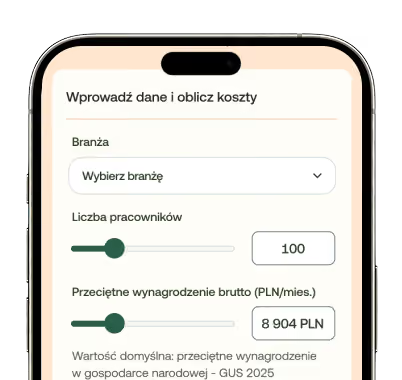
Check how much absences cost your company
Mental health leave can be long. Estimate how much absenteeism costs your organization.
Calculate the costs of absenteeism
Calculate the costs of absenteeism
How can you help your employees?
Despite understanding how important it is in today's world for employers to get involved in reducing stress and helping employees cope with ongoing mental health crises, it is often difficult to systematically integrate these changes into an organization's culture.
This may be due to reasons such as:
- the belief that one should not delve into the mental health of employees, as it is a private matter—which can lead to awkwardness when addressing the topic, even in conversation.
- the awareness among HR professionals that they are often not prepared or properly trained in mental health issues, which are the domain of psychology or psychiatry, not business.
To date, there has been no requirement for HR staff to also be psychologists. However, in the world we live in today, there is an increasing need for psychological competencies, which can be intimidating or cause uncertainty when taking steps to support employees in their mental health journey.
This can be remedied by using external support from people who have appropriate competences and a number of tools that have been developed by specialists.
Available options include:
- meetings with mental health experts, stress reduction workshops or face-to-face consultation with a psychologist, which can be made more accessible to employees through the reimbursement of costs incurred.
- tools that support self-understanding and designed to counteract mental health crises or facilitate their conscious passage, and to educate - what forms of help can be used in the event of a long-term decline in well-being. They play this role, for example psychoeducational courses, which you can use not only in the ongoing crisis, but above all to naturally build your mental immunity and prevent the decline of mental health.
- educating employees by organizing mental health meetings with experts and initiating conversations about the importance of psycho-physical well-being. All this to dispel the belief, still prevalent in many social spheres, that mental health problems are a source of shame.
- widely communicating the importance of not only quality working time but also quality leisure time for professional performance. Educating about the role of rest and its impact on well-being and supporting a variety of ways of spending time after work, through benefits such as MultiSport cards or access to relaxing sounds of nature.
It is not just worth it, it is necessary
The deepening global mental health crisis means that strategies for its protection should become a permanent element of corporate social responsibility. These goals can be achieved in many ways. The range of options is as vast as the number of alarming reports on the scale of diagnosed depression, mental disorders, and the rising number of suicide attempts among people. For this reason, business involvement in mental health prevention has long since moved beyond being a trend and should be viewed as an ethical and economic duty for every organization.
Sources