.svg)



Taking on a financial commitment worth hundreds of thousands of zlotys for several decades is a serious decision, especially since you are liable for it with all your assets. That is why I believe it is worth understanding how a mortgage works and what its parameters are. This basic information will help you understand why, even if your neighbor in the same building took out a mortgage for the same amount as you, one of you might end up paying the bank over a hundred thousand zlotys more.
What is a mortgage?
Simply put, a mortgage is a financial tool that allows you to achieve your goal—purchasing a property such as a house or an apartment. Because of this, it is often referred to as a housing loan.
The name of the mortgage is linked to the mortgage lien, a limited property right that allows the creditor (in your case, the bank) to secure the property, which they can exercise if you fail to fulfill the agreement. However, rather than focusing on legal technicalities, I suggest you focus on choosing the most favorable offer for you and making your repayments diligently.
What makes up the interest rate on a loan?
The interest rate on a mortgage consists of two important factors:
- Loan margin — Fixed and unchanging throughout the entire loan term. For the bank, this is the portion that constitutes its direct profit.
- WIBOR — The rate at which banks "borrow" money from each other. Unlike the margin, it changes over time. Currently, most mortgages are granted with a variable interest rate, and even offers with a fixed interest rate are not truly fixed. Usually, the WIBOR is frozen for a 5-year period, after which you can lock in its value again at the current rate for another 5 years or choose a variable rate, such as WIBOR 3M, which is updated every three months.
Interest rate = Margin + WIBOR
For example, if the WIBOR is 3% and the bank's margin is 2%, the loan interest rate is 5%. In the opposite scenario, where the WIBOR is 2% and the bank's margin is 3%, the interest rate is also 5%.
And although the interest rate is 5% in both cases, the second situation is much worse. You will be left with a higher margin that remains in effect until the loan is fully repaid.
Are the margin and the commission the same thing?
Although both the margin and the commission are sources of profit for the bank, they are not the same. The commission is paid as a one-time fee when the loan is disbursed and amounts to, for example, 2% of the total loan amount, whereas the margin, as you already know, is a component of the interest rate that applies throughout the entire repayment period.
You may encounter bank offers where you find a standard margin or a lower margin if you pay a commission. A one-time fee of several thousand zlotys can be painful, and saving it might seem more profitable than a commission that is only 0.2% lower, but that is not necessarily true.
You need to calculate these parameters yourself, as there is no simple way to say that one solution is always better than another. Take a look at the example below.
Property price: 750,000 PLN
Loan amount: 600,000 PLN (20% down payment)
Loan term: 25 years
Installment type: fixed
WIBOR: 3%
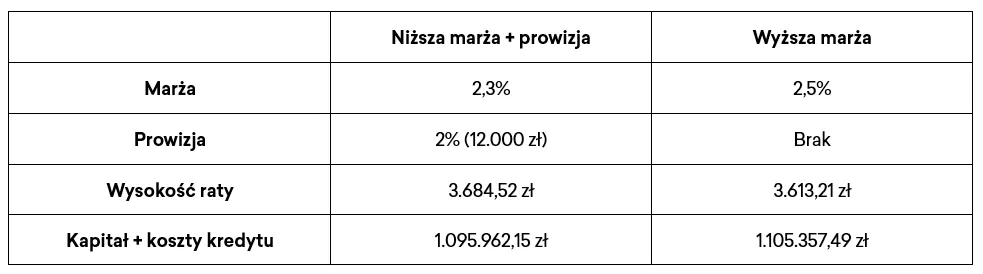
Even after paying a 12,000 PLN commission, the lower margin makes the total cost of the loan 9,395.34 PLN lower.
Can you negotiate mortgage terms?
You can always try to negotiate, though it won't always be successful. Remember that when entering negotiations, you need to have strong arguments to support your position. This could be a very high creditworthiness, but by far the most effective approach is to present a loan commitment from a competing bank.
Depending on the offer and the lender's flexibility, you may be able to lower the commission or margin, or shift the costs of insurance or property appraisal onto the bank. Even if these are small amounts, it is definitely worth keeping that money for yourself to spend on furnishing your home rather than paying off loan costs. If it doesn't work out, the worst-case scenario is that you simply accept the bank's offer, so you have nothing to lose.
How do you choose the best mortgage?
A mortgage is one major expense made up of many smaller factors. These are exactly what determine whether the commitment you are making is profitable or not. That is why you shouldn't rely on the opinions of friends, family, or anonymous internet users who tell you that a certain bank is "okay" because they are happy with their own loan. They might be, or they might not be, and they may not even realize it because they signed the first offer put in front of them, even though they spend hours hunting for a new coat.
This is a decision with huge consequences, and small percentages and fees can add up to tens of thousands of extra zlotys. That is why, in upcoming articles, I would like to explain how a mortgage works so that you know what you are getting into and are aware of these subtle differences. Remember that you are liable for this debt with all your assets. The "keys for debt" option works great in American movies, where you slam the door and your problem is solved. Unfortunately, such a solution is unheard of here.