.svg)
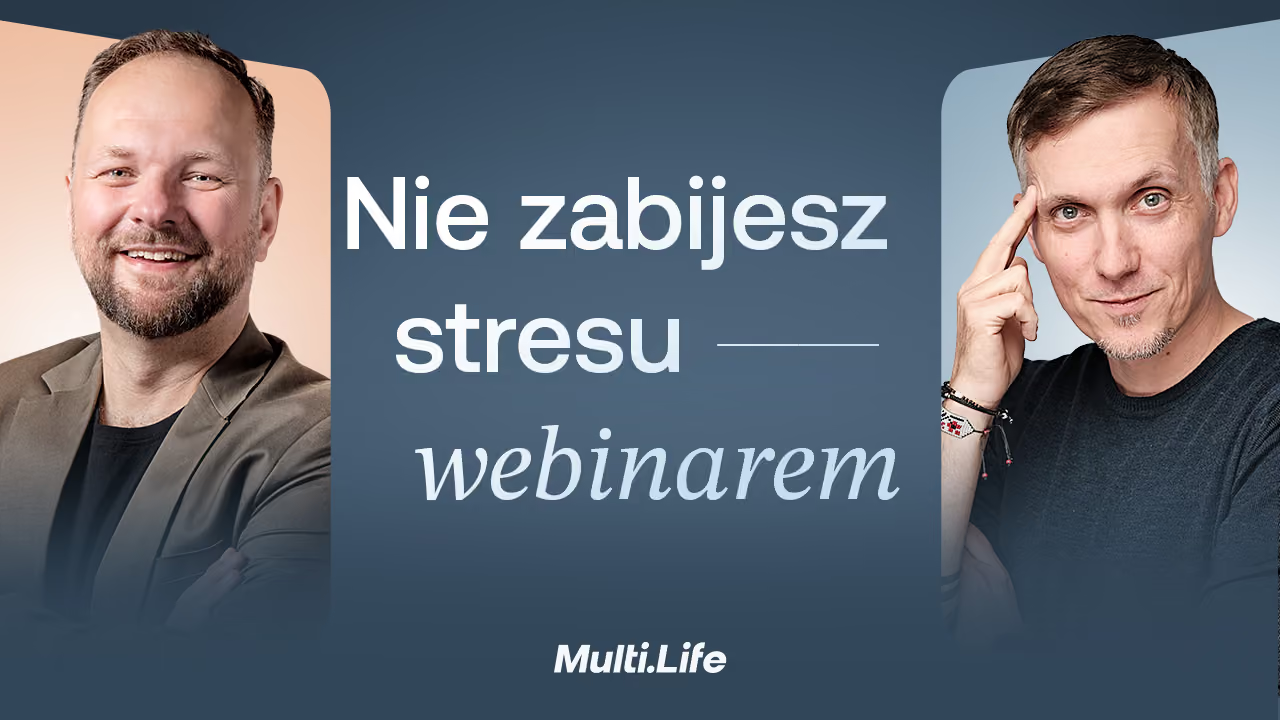


You read about the massive costs generated by burnout, you create a wellbeing strategy, you invest in webinars… and it doesn't achieve much. If you have already been through a similar scenario, or are afraid of it happening in your organization, this conversation is for you. How can you look after wellbeing so that it delivers real results? What mistakes do even experienced managers make? What can you do to ensure your team appreciates your efforts? Maciej Żylewicz, an experienced business consultant and trainer specializing in wellbeing and technology, answers these and many other questions in a conversation with Dr. Andrzej Silczuk.
- 00:00:00 Introduction
- 00:01:13 What are wellness and wellbeing
- 00:03:04 Expectations of leaders and employees
- 00:05:04 Career sacrifices and leader wellbeing
- 00:06:10 What is wellbeing from an organizational perspective
- 00:08:59 Reactive vs. proactive wellbeing initiatives
- 00:11:51 The role of top leadership and organizational culture
- 00:14:35 Why it is better not to use the word "wellbeing"
- 00:19:42 Where not to start with wellbeing initiatives
- 00:22:22 How to assess employee needs
- 00:30:16 Where does low employee engagement come from
- 00:33:02 Communication and building trust in an organization
- 00:42:10 Designing wellbeing at work
- 00:51:50 How to manage energy
Transcript
Dr. Andrzej Silczuk: Welcome to the Multi.Life space and the "Well Said" program. My guest today is Maciej Żylewicz, an experienced business consultant supporting HR departments and a trainer specializing in employee wellbeing and technology. For over 20 years, he has been working with companies across various sectors, translating complex technological issues into accessible, human language.
He has hosted podcasts such as "Happiness at Work." He designs workshops on wellbeing strategies and combines coaching with strategic games to increase team effectiveness. I value Maciej not only for his wisdom but also for his great sense of humor. Here is Maciej Żylewicz.
Maciej ŻylewiczThank you so much. I think I might be blushing a little, though you probably can't tell under the makeup.
Dr. Andrzej Silczuk: I hope I haven't embarrassed you, as I’d like to start with a strong point. You’ve been working with companies for many years, supporting them through crises and helping them care for their employees. But first, I’d like to ask you, as an employee yourself: what does well-being mean to you? How do you define it?
Maciej Żylewicz: It’s interesting that you use both terms, because the word "well-being"—and this might be our first controversial point today—is a term that carries a lot of baggage, not all of it positive. Some people roll their eyes when they hear it, while others think, "Sure, that sounds good."
I think the Polish term "dobrostan" is closer to what I mean when I talk about well-being. For me, it comes down to three things. First, you are healthy, both physically and, metaphorically speaking, in spirit. Second—and I have to use the English word here—you are "sustainable." This means your career trajectory is such that you aren't losing energy or motivation with each passing year; instead, you are either maintaining your level or continuing to grow.
The third thing, which is super important in this context, is that you feel safe. You don't treat coming to work like a game where you constantly have to wonder whether to make a move because of the potential consequences. This applies to physical safety, if you work in a factory, but for most of us, it’s about psychological safety—knowing that what you say won't come back to haunt you months later and cause you trouble.
Dr. Andrzej Silczuk: Fantastic. So, if I understand you correctly, you’ve defined "well-being" as a sense of health, sustainable growth, and safety.
Maciej Żylewicz: Exactly.
Dr. Andrzej Silczuk: So that’s what an employee needs to feel properly cared for. But what about from the perspective of a leader or an employer?
Maciej Żylewicz: That’s where things get a bit complicated. We can distinguish between a leader and an employer, because often, on a superficial level, their goals might seem contradictory. Someone who prioritizes their health might work less, or someone focused on their well-being might set firmer boundaries at work. But that’s a very basic level of analysis. Unfortunately, I get the impression that from a leadership perspective, we rarely move beyond that. There’s a bit of a disconnect: if you’re a successful leader today, having climbed the ladder from expert to manager, you’ve likely made sacrifices along the way. Those sacrifices might have cost you in terms of family relationships or health, and when people tell you, "Let's look after our employees' well-being," you might think, "Well, I already paid my dues."
Even if you don't say it out loud, you often think it, living with the belief that your world should be like the world of your employees. But it isn't, and I think that’s where most of the challenges in understanding well-being arise. Because leaders have chosen to invest so heavily in their careers, they’ve often sacrificed something. I’m still looking for leaders who can say, after years of success, with a clear conscience and complete peace of mind, that they didn't sacrifice anything.
Dr. Andrzej Silczuk: Exactly, because the word "sacrifice" resonates strongly here. It’s a form of investment that involves a loss. Is it true that to be a fulfilled person or a leader, you always have to leave a piece of yourself behind?
Maciej Żylewicz: I feel that way, yes. I don't know of any businesses today that allow you to climb that vertical ladder without requiring you to sacrifice areas that are deeply connected to your health.
This includes your physical health, sleep quality, and what’s going on in your head—how quickly you can clear your mind of all the thoughts swirling around at the end of the day. It also includes your relationships with family and friends, and your relationship with time itself—how often you find yourself saying, "I don't have time."
So, when you make those kinds of sacrifices as a leader, you automatically start viewing the whole world through that lens, thinking, "Well, if I could do it, why can't others?" And that, I think, is the biggest trap when it comes to talking about wellbeing in organizations.
PhD, DSc Andrzej Silczuk: Exactly. Now I wanted to ask you from an organizational perspective: what does wellbeing mean for an organization? What does it mean for an organization to focus on wellbeing?
Maciej Żylewicz: It should be exactly what it is for the employee, just interpreted through action. We want our people to be healthy, both in body and mind, because that’s when they work well and aren't burdened by extra problems weighing on them.
We want them to feel safe so they don't hold back their ideas but instead speak up about them. Even if some don't make much sense, one of them might turn out to be the next breakthrough.
PhD, DSc Andrzej Silczuk: Without fear of judgment.
Maciej Żylewicz: Without fear of judgment—or rather, judgment itself might be okay, but not judgment that leads to problems within the organization.
For example, if someone sees that something isn't working in the organization, they should have the space to say, "Hey, listen, this solution isn't working," without being met with feedback like, "You're always complaining," or "You probably shouldn't say that, someone might get offended." So, we have these two aspects: health and safety. And then we have what should be most important from a company's perspective: sustainable growth—ensuring our people don't burn out.
And you know, we could just throw millions of data points at this. For instance, there’s a study from the American Journal of Preventive Medicine released in April of this year, which calculated that for non-managerial positions, burnout costs about 4,000 dollars per employee who goes through it. But I get the impression that in business, we have an obsession with talking about return on investment whenever we try to convince our managers and leaders.
And with wellbeing, I feel it’s not as simple as a one-to-one calculation where you show the numbers and everyone says, "Fair enough, let's do it."
Dr. Andrzej Silczuk: Although it has been calculated how much it costs. How much the lack of employee well-being costs.
Maciej Żylewicz: Yes.
Dr. Andrzej Silczuk: We have such studies in Poland. We know that the core group of people experiencing professional burnout falls within the 35 to 44 age range.
So, essentially the backbone of employees in modern organizations, or those who will be there shortly and may be at risk of burnout. However, my experience working with organizations, much like yours, is that I most often notice that pro-well-being initiatives in Polish organizations are more reactive than proactive.
This means they usually happen as a result of specific events. What is your take on this?
Maciej Żylewicz: Yes, I agree.
Dr. Andrzej Silczuk: You agree with me.
Maciej Żylewicz: Well, to get into the details, I’ll refer back to what you said about that group. It’s very interesting because we might think that other groups should be the focus of our well-being efforts, whether it’s Gen Z, who talk about it a lot and want it, or perhaps people approaching retirement age. Meanwhile, it is precisely this group, those from age 35 onwards, that should be our main point of interest, because these are people who are starting to face more and more life challenges. Family, children, a mortgage, aging parents who also need care sometimes—so it really is a very, very difficult space. But, returning to the point, regarding reactivity, I fully agree. And this reactivity stems mainly from the fact that business today likes to act like a firefighter with an extinguisher, testing how far we can go without certain investments. Because this mindset is very short-term.
Dr. Andrzej Silczuk: What does that stem from?
Maciej Żylewicz: It stems partly from the short-term nature of business, that if you are constantly in a rhythm of meeting quarterly or monthly goals, whether you are in sales, marketing, or reporting to your investors, we think about these activities in the same way and say, "Okay. Since we managed to close this quarter without any major crisis, let's see what happens in the next one. And maybe then we'll take action."
Dr. Andrzej Silczuk: Maybe we got lucky again.
Maciej Żylewicz: That’s not a complaint against business, because business naturally operates on a rhythm of meeting targets, and wellbeing often gets categorized in that same way.
Associate Professor Andrzej Silczuk: Can’t you set objective OKRs for that?
Maciej Żylewicz: You can, because we can certainly talk about the numbers. But I always have serious doubts about whether setting specific actions within OKRs actually leads to real change. For example, I know of an organization that implemented a textbook wellbeing strategy—everything was in place—but it had zero adoption and gained no traction. The people in that organization had such deeply ingrained anti-wellbeing work habits that the program was just a reactive band-aid on a wound.
Associate Professor Andrzej Silczuk: So it was a result of the organizational culture, despite the solutions being implemented. What kind of solutions can actually be effectively implemented in a company?
Maciej Żylewicz: The first and most important thing—the starting point without which you shouldn't even begin—is looking at what’s happening with our leadership. If our leaders, starting from the very top, are either resistant or just giving a silent "Fine, let's just do it," then those wellbeing programs don't stand a chance.
So, educating and working with top leadership is key. This is probably the hardest task HR has, because it often requires them to rethink the very path they took themselves. They sacrificed a lot and often weren't focused on wellbeing. Of course, everyone has different priorities, but there was a lot of sacrifice involved.
If there isn't a shift in their mindset toward wanting their people to be healthy and ensuring their trajectory in the organization is stable or even upward, then there's really no point in introducing other measures. If you start at the top and work through these issues with managers, you can then move on to specific tools and avoid the things that have gained a negative reputation—all those wellbeing stunts that get mocked online—and instead move toward deep, genuine action.
A one-day stress management workshop won't change your employees' stress levels. It might be the start of a journey for them, but we need to present wellbeing as something all-encompassing that is accessible to them every day, in whatever way they choose to engage with it.
Associate Professor Andrzej Silczuk: I was just thinking—a catchy topic immediately came to mind—you can't solve this with a single webinar that pops up every now and then. It really resonates with my earlier question about reactivity. Something happens that disrupts the organization's usual harmony, it becomes a major event, and it forces action. But based on what I’ve heard from you, if you don't start at the very top by building a mindset among the highest leadership, that might be the only event that ever happens. Why are we so prone to taking these kinds of actions and focusing on single-event solutions?
Maciej Żylewicz: We’re human, and we love a celebration. If we’re going to celebrate, we do it once a year. If we’re going to nurture a relationship, we do it on our anniversary. If we’re going to honor those who have passed, we do it on All Saints' Day. We love these festivals that give us something to photograph and post on LinkedIn. I don’t want to sound cynical, but it’s much harder to do things quietly and consistently than it is to put on these festivals—these wellbeing events, if you will.
In fact, when I work on strategies, I strongly recommend that, first of all, you don’t use the word "wellbeing." You should be more like a submarine that doesn't surface at all.
Dr. Andrzej Silczuk: What word should we use instead?
Maciej Żylewicz: Health.
Dr. Andrzej Silczuk: OK.
Maciej Żylewicz: Caring for others. Simplify the vocabulary and get back to the absolute basics.
Dr. Andrzej Silczuk: De-psychologize it?
Maciej Żylewicz: De-psychologize it, exactly. Look, if you go into a factory and say, "We’re going to give you wellbeing now," you’ll most likely be met with laughter. But if you say, "Listen, we want you to have better working conditions. We want you to leave work more relaxed, with less physical strain. We want to reduce the risk of injuries," then you’re speaking the language of the people who will actually benefit from these solutions. But that often doesn't happen, because then you have to admit there’s a problem you’re trying to solve.
If you say, "We’re giving you wellbeing," it’s so vague that you don’t have to acknowledge that a problem existed in the first place. And it just keeps spinning. We often have this magical thinking in organizations that if a manager has driven their team to high levels of stress, they can all just go to a stress management workshop together, and after one day, everything will suddenly disappear. But we love that kind of magical thinking because it’s more pleasant, easier, and more exciting.
Dr. Andrzej Silczuk: Aren't we also trapped in a vision of our own knowledge, where we assume our intuition always points us to the best solution, only to find out later that it didn't actually work?
Maciej Żylewicz: Right. So, what was that about intentions, paving, and hell?
Dr. Andrzej Silczuk: I'm listening.
Maciej Żylewicz: Well, exactly. Like the saying goes, the road to hell is paved with good intentions. And that’s often the case. Again, I frequently see initiatives in organizations that truly stem from the heart, from a high level of empathy. After all, these solutions are usually introduced by HR departments, where people with a high level of understanding of others work—people with backgrounds in psychology.
Dr. Andrzej Silczuk: Human-centric.
Maciej Żylewicz: Human-centric, and they do a lot of things that come from a pure, human need.
At the same time, these actions can have the exact opposite effect. For example, there’s a lot of talk about how if you start doing one-off, hour-long resilience training sessions, the effect can be counterproductive because people start wondering why it’s happening in the first place. Is the company preparing for something?
Dr. Andrzej Silczuk: Where did it come from, right?
Maciej Żylewicz: Where it came from.
Dr. Andrzej Silczuk: Is something bad waiting for us?
Maciej Żylewicz: Are we heading for trouble? That’s why, if you integrate wellbeing into the absolute fabric of everyday life—where it’s just there, and we know it’s there—and I know a few organizations like that, then we don’t need to slap labels on everything, hold grand celebrations, or host "wellbeing weeks." Instead, we are well-equipped with great tools that support us, whether for prevention or intervention. We have managers who are excellently prepared, and most importantly, we have leadership teams that understand this isn't just a whim.
Dr. Andrzej Silczuk: That they are aware.
Maciej Żylewicz: That they are aware. I get the impression that we are in a slightly worse place for wellbeing than we were a few years ago.
Dr. Andrzej Silczuk: We’ll come back to that in a moment, because as I understand it, wellbeing—which we don’t want to call "wellbeing"—should be a quiet companion in the background of an organization, woven into its DNA. Because then I know it’s so deeply rooted in the organizational culture that you don’t need to talk about it; you just live it without having to label it. That’s what I took from your point. I have a tough question for you.
Maciej Żylewicz: Thank you.
Dr. Andrzej Silczuk: What should we avoid starting with, then? Suppose I’m an organization that is gaining awareness. We have leaders who have recognized the need. We’ve always been focused on our employees, but until now, we didn’t know how to go about it. We’d like to start. What should we not start with?
Maciej Żylewicz: Don’t start by over-communicating slogans. It’s often said that communication is crucial for any strategy. However, in this case, I feel that the quieter these actions are, the better it is for the project as a whole. Why? Because if you announce, "We’re going to start focusing on wellbeing now," you immediately get pushback from people who ask, "Why didn’t you care before?" or "Okay, but do you really think this will do anything for me?"
Dr. Andrzej Silczuk: I have a different question: "When?" We already have so many responsibilities.
Maciej Żylewicz: And that’s another thing, right? We end up in a vicious cycle where they say, "We’re too busy to attend these things." Then, the first-quarter data goes to the board, and they say, "Look, the participation rate for these initiatives is only 3%... so, project over." That’s the first issue. It’s a communication problem.
The second thing is moving away from this obsession with calculating how every single action translates into dollars. In the realm of wellbeing, there are so many things we simply cannot quantify. I don’t want this to sound too grim, but how do you calculate the value of an initiative that, without anyone even realizing it, might have saved someone’s life?
How do you calculate the ripple effect on immediate colleagues and beyond if that hadn't happened? How do you calculate the drop in productivity—to put it bluntly—or the human emotional toll and the burnout we’re getting closer to if these things keep happening? So, let’s move away from this obsession with reporting wellbeing metrics every single week.
Let’s start looking at this from a longer-term perspective. It’s a bit like, I don’t know, trying to lose a few pounds and stepping on the scale every half hour, saying, "Oh, success! I’m down 100 grams."
Dr. Andrzej Silczuk: Don’t drink any water then, right?
Maciej Żylewicz: Exactly, you start gaming the system immediately. You see how to manipulate the results—if I don’t drink water now, it’s a huge success because the number went down a bit. So, let’s move away from that. It goes against the intuition of organizations that love to measure everything and want to be "data-driven." But I encourage measuring things very thoughtfully. Measure slowly, and definitely don’t measure in short intervals.
Dr. Andrzej Silczuk: So, I understand that an organization, knowing itself best, can adapt scalable tools to its own needs? That it’s an individualized process?
Maciej Żylewicz: If it knows itself.
Dr. Andrzej Silczuk: If it knows itself. And if it doesn’t, what should it do?
Maciej Żylewicz: If it doesn’t, it needs to start by asking the people who will be the primary beneficiaries. Look at the trap here. If you design wellbeing initiatives at the HR level—which is much more aware of how humans function due to their psychological expertise—and you design it for the decision-makers who are ultimately paying for it, you suddenly end up with a project that isn't actually for 90% of the organization.
So, the first thing that should happen is a solid understanding of what people actually need. As in the examples mentioned earlier, if you determine that people need more physical health initiatives, great, let’s do something in that area. If stress levels are stemming from the management culture, let’s not even call it "wellbeing"—let’s focus on examining what’s actually happening within that management culture and how people are being led.
If this is happening in several areas of the organization that are generating a lot of tension, let's take a closer look at those. There is no single universal solution. And there is no single universal blueprint that we can just apply and say, "There you go."
PhD, DSc. Andrzej Silczuk: In a way, you've added another component to how to do this, or, by not doing it, how to do it wrong. If we introduce our secret participant of organizational culture, which is well-being, and we do it right, we must simultaneously examine how our population of employees is changing. How they are functioning with it, how they feel about it, and react to various things—meaning the implementation of this project is subject to continuous iteration and observation.
Maciej Żylewicz: We approach it in a very agile way.
PhD, DSc. Andrzej Silczuk: I think that's a good approach. It shows that we are familiar with these methods from implementing other processes in our organizations.
Maciej Żylewicz: Yes. To do that, you obviously need to equip yourself with the right tools, meaning you need the ability to check the pulse. If your organization does a survey once a year titled "How are you?", what you do in December 2025 tells you absolutely nothing about what happened in January 2025.
So, if you have the ability to measure this—and it can be done in a very intelligent, non-invasive way, even on a bi-weekly basis…
PhD, DSc. Andrzej Silczuk: Pulse checks like that?
Maciej Żylewicz: Pulse checks like that, yes, then you know a bit more and see a bit more. What is extremely important is that we sometimes feel it's a waste of time, or we lack the time, to have real, deep conversations about how you are doing in the organization. How are you feeling? What is going on?
What do they require? Trust, of course, because you have to realize that the entire area of wellbeing involves data that is either medical or health-related. And if you don't have that trust, it's certainly very intimate. The paradox here is that the organizations that need these wellbeing initiatives the least will benefit from them the most, because that is the most fertile ground for things to happen. Organizations that need these initiatives the most will have the highest percentage of failed projects.
Andrzej Silczuk, PhD, DSc: Why is that?
Maciej Żylewicz: Because if you sow those seeds on completely barren ground, if there are no conditions for anything to grow, nothing will come of it.
PhD, DSc Andrzej Silczuk: I have a hypothesis. Wellbeing-focused initiatives fall within a fairly broad margin of interpretation as psychological interventions. Psychology can trigger anxiety. Among other reasons, because it serves to raise awareness, and awareness can be the primary substrate for initiating change. And in organizations, we may fear that these changes won't go the way we want, and we are all, in some way, goal-oriented. So the question is, won't introducing these solutions eventually be interpreted as a threat?
Maciej Żylewicz: It will, because it might get in the way of business as understood in the spirit of the 80s and 90s. I’ve heard it many times: "Okay, fine. Go ahead and assess us, just don't dig too deep."
PhD, DSc Andrzej Silczuk: Because we want the "numbers."
Maciej Żylewicz: Because we want the "numbers," but not so much that you start touching on certain topics that might be troublesome.
Because if we tell our people that there are high levels of stress in our organization, then we've lost. It's also a bit of a cat-and-mouse game. Pretending that people don't know what's going on. But again, we're talking about magical thinking here. In magical thinking, very often, when you name something, it happens.
So, as long as we don't name the fact that, for example, we have a poor management culture or an environment that generates high levels of stress, then there is no problem; we just walk it off.
PhD, DSc Andrzej Silczuk: Right, but this is all happening under the surface.
Maciej Żylewicz: It’s a bit like that old-school mentality where people say, "I don't go to the doctor because you know, if you go, they’ll always find something, and then you’ll have to get treated."
And it’s similar in an organization. We think, "Let’s not touch this wellbeing stuff. Let’s just apply some band-aid solutions. Let’s not let the people who really understand this and can give us a blueprint get too deep, because if they do, it might turn out we aren't as great as we thought. People will fall apart, stop working, and we’ll have to shut the company down."
PhD, DSc Andrzej Silczuk: Incredible, isn't it? We’re afraid of these things. You’ve redefined wellbeing again, as I heard that this wellbeing diagnosis is focused on prevention. The fact that you find out—that someone tells you, "Hey, listen, people are stressed"—doesn't change the situation. They didn't become stressed because of that; it was simply brought to light. However, your organization might avoid the massive turnover looming in the next six months.
Maciej Żylewicz: Yes. The question is, is everyone in business capable of drawing a straight line from one event to another? Because I get the feeling that this quarterly mindset, the way business thinks in terms of terms, often avoids connecting the dots that are several quarters apart. It requires a great deal of awareness and maturity.
I know businesses like that. Maybe not many, but I know companies that can see a dot in some month of 2025 and say, "Okay, let’s start doing something about this," because here we return to prevention versus reactivity, because in 2027 it will cost us. It’s human nature that 2027 feels so far away that you might not want to do anything about it yet, because you still have 2026 to get through. And that’s why these actions are so often just band-aid solutions.
PhD, DSc Andrzej Silczuk: We introduced wellbeing in the organization. Let’s say it doesn't even work in the shadows. We did it "old school." We told everyone, "We have what you asked for because we managed to identify what the employees need."
We introduced great solutions. We try to ensure they are comprehensive, but it turns out that employee engagement metrics are minimal. It’s disappointing because we were counting on at least half of them using it, but only a few percent do. Is that bad from your perspective?
Maciej Żylewicz: It’s not bad, because when you implement these actions—building this entire wellbeing ecosystem, which means securing people by strengthening the culture and giving them access to tools that help them take care of their health, both physical and mental—if you give them that, the fact that they don't use it directly is often a sign that their sense of security is already at a high level. We shouldn't look for false correlations here. You have to approach this data very carefully.
I often see that wellbeing data is a bit like reading tea leaves—you lay out these five cards and say, "Okay, what story does this tell about us?" And actually, several stories could fit at once. So, I encourage everyone to keep it a "data-driven experience," but don't let the data tell us the story we want to hear, rather than the story that is actually happening.
What’s more… Let’s not compare data from other parts of our business to how wellbeing is working. Or from other organizations, either—though, working with good experts, benchmarks can help you with something. Because if you are in the financial industry and it turns out your metrics are truly the lowest of all the banks, and you start connecting that to the fact that, for example, people are leaving, then you have somewhat of an answer as to what happened.
Prof. Andrzej Silczuk: You might have an organization where, for example, the structure includes a much higher proportion of manual workers than office staff, and their time—even just for accessing digital solutions—might be limited. I understand that you need to reach them too and offer solutions that are tailored to their specific needs and time constraints.
Maciej Żylewicz: Yes, let's break this down into two levels. First, the channels. It’s not like we can just create a channel—a wellbeing channel where we communicate and do things—and expect people to just show up. No. We have to take wellbeing to the channels where people already are.
So, if the break room in a factory is where people spend the most time away from their direct tasks, that’s where we should be with our initiatives, rather than on a Teams channel that, for instance, only the office staff uses. In my opinion, that is a very, very significant difference in approach.
Prof. Andrzej Silczuk: We are individualizing it again, tailored to your own organization.
Maciej Żylewicz: Yes, we individualize it very strongly and tell stories about what has worked, rather than just presenting a catalog of solutions.
Prof. Andrzej Silczuk: You’ve actually just provided the method for how this should be implemented: communication.
Maciej Żylewicz: Communication. And success stories really help here. Organizational stories in general are also very helpful because we need to build a sense of trust that these are genuine initiatives, coming from good intentions, and that these aren't actions meant to monitor what is happening with the employees.
This is a common experience for many organizations that use various types of wellbeing platforms and so on. So, how do you do it to extinguish the anxiety that the employer is monitoring the state of my health?
PhD, DSc Andrzej Silczuk: I work in HR. Here’s the situation: we introduced some solutions last year, but leadership isn't impressed. Engagement stats are poor. We’re trying to explain that "it's okay, we provided access, we provided opportunities." But there’s this looming interpretation that it’s a failure—an implementation failure—that it didn't work. Is this a sign that we should pull back from this strategy? Is it a sign that we should stop?
Maciej Żylewicz: That’s a good question. My first response is to take a step back and ask ourselves if we sold the story of what we’re doing to leadership effectively. Stakeholder management is absolutely key here, as it is with any transformation. Now, should we shut it down or not? There’s no single right answer. Sometimes closing it, resetting, and drawing conclusions—not in the sense of "we failed," but by doing a full retrospective, looking at where we fell short, and so on—is the way to go. And then telling people, "Listen, we’re coming back to you with a new approach." It’s like when shops put up a sign saying they’re closed for renovations.
PhD, DSc Andrzej Silczuk: "We’ve heard you."
Maciej Żylewicz: Yes, "we’ve heard you." And admitting that is, again, a huge element of psychological safety. My organization is capable of saying that something didn't work out and drawing conclusions from it because we, as people, had an influence on it. So sometimes that’s a very good solution. But sometimes you need to continue and push forward because perhaps a small course correction or changing a few parameters will yield better results.
All of this requires a very objective analysis of what happened, how it happened, and conducting a full retrospective. You can't allow narratives to form that are sometimes easy to fall back on, like "It didn't work because we were busy with other transformations." And that’s why it didn't work this time.
PhD, DSc Andrzej Silczuk: Maciej, I have a question for you, looking at it from the perspective of a typical employee. They are given opportunities to use various support tools, including psychological support. What might make an employee feel uncomfortable or unwilling to use these services?
Maciej Żylewicz: They won't see the value, they won't have trust, and they won't have the time. A lack of perceived value is very often due to not communicating why we’re actually doing this and what it will give us. Leaving things at a high-level definition, especially in areas like psychology, is a problem. The second thing is not having the time—meaning, on one hand, we introduce a solution, but then you have to constantly fight with managers to carve out time to actually use it.
I’ve run many workshops, both online and in person, and I see how people struggle to get away for them. Besides, managers often say, "Sure, okay, we’re buying this workshop," but then, during the workshop, they try to actively pull people out because there’s a client waiting.
And what does that do? It shows: "You know what? Business comes first. Way, way, way down the line... then there’s wellbeing." And that’s the problem. And the third thing, which we’ve already talked about a lot, is trust. A lack of trust. Again, you have to take a few steps back and wonder why there’s no trust in the organization. Why, even when we outsource these activities to external partners who hold our data and so on, do we still have this fear that my employer, for example, knows I spoke to a psychologist—ergo, something is wrong in my life, something needs a course correction? There are also a lot of myths. We are still, Andrzej, in a culture that—while it’s getting better—is perhaps still a big-city perspective. A culture where a visit to a psychologist, and heaven forbid a visit to a psychiatrist, is something very stigmatizing.
PhD, DSc Andrzej Silczuk: I was thinking that the webinar title itself might be stigmatizing. I remember an experience where an organization announced a meeting on the prevention of psychoactive substance use, and it caused discomfort: if I attend as an employee, does that mean I have a problem? Or that someone close to me does? Why else would I be interested?
Maciej Żylewicz: But that is exactly the game we were talking about—if you are constantly thinking, "Will my actions be misinterpreted?", that is a lack of psychological safety. I completely agree, and I have seen cases where a poorly titled webinar meant people didn't want to be seen attending it.
Associate Professor Andrzej Silczuk: How do you do it right?
Maciej Żylewicz: How do you do it right? Again, before you title a webinar, you should establish an agreement with your people on how to use these resources. Why they exist, but also how to demystify and normalize things. In other words, move away from terms that are confusing to everyone. My favorite buzzword is "resilience." Sure, it’s "hot." But what does it actually mean? To the average employee, it sounds like a medical condition. Why would they sign up for that webinar? If you put it in more human terms, if you title it closer to the work they actually do, I think you’ll get more sign-ups and less anxiety about showing up.
Associate Professor Andrzej Silczuk: So, what? Something more like, "How to cope with change?" or "How to bounce back from a crisis?"
Maciej Żylewicz: I would go even further toward being specific—naming the change itself. I wouldn't even frame it as a question, because you see, webinars often have questions in the title. We should be making statements, presenting a thesis, like "Let's handle [name of change] better." These are micro-details, and people are very sensitive to words. But we have to think about how things might potentially be interpreted.
Associate Professor Andrzej Silczuk: So we always need to step into the shoes of the recipient—the employee—who might be interested, but could also get scared off and avoid participating. I understand that by explaining what the meeting is about and anchoring it to specific events, we also prevent the fear that if we start talking about "change," we are signaling major organizational shifts and preparing the workforce for the worst. Because that little hamster in the back of their head starts running on the wheel, worrying that something big is about to happen.
Maciej Żylewicz: I had a case just yesterday where I was talking to a team manager who said, "Let's prepare our people because there's going to be an acquisition. There will be a change in management, and someone else will be stepping into the shoes of the current manager. Let's use this as an opportunity for training on how to prepare for change."
I said, "Okay. You're sending a signal that basically says: man the barricades, lock the doors, board up the windows, and wait for the wave to hit." That one sentence is enough to trigger a defensive reaction, and that’s the last thing we want. You made a very important point: wellbeing initiatives should be designed with the end-user at the absolute center. In approaches like design thinking, when we start a conversation with the primary beneficiary of a solution, we don't think "What?", we think "Why?" and then "How?".
PhD, DSc Andrzej Silczuk: You are a business consultant supporting HR departments. You're in a company that approaches you and says, "Maciej, I want to do something about wellbeing." What are the first questions you ask them?
Maciej Żylewicz: What is that first question?
PhD, DSc Andrzej Silczuk: How do you identify those needs?
Maciej Żylewicz: The first question is: who among your employees can I talk to?
PhD, DSc Andrzej Silczuk: So you conduct qualitative research?
Maciej Żylewicz: Qualitative, yes. I know it's not the best time for qualitative research because companies are trying to cut costs in that area. But for me, qualitative research—even if it lacks scale—will always be much more informative than simply selling a narrative that comes from the more centralized parts of the organization.
PhD, DSc Andrzej Silczuk: So, you want to talk to an employee?
Maciej Żylewicz: I want to talk to an employee.
PhD, DSc Andrzej Silczuk: So you need to immerse yourself in the role of an employee at this organization before you move on to the demo version.
Maciej Żylewicz: Exactly. And again, you mentioned "doing something" about wellbeing—I know you're joking a bit, but that already sets off alarm bells for me. Because usually, after a conversation like that, the suggestion comes up: "So, what? Should we do a webinar on stress management?" And that’s where the initiatives end.
If we want to approach this seriously, we should invest a bit in the discovery phase. What is actually going on before we move to the tool design phase? In wellbeing, you shouldn't shop for tools—it’s not a catalog where you say, "I'll take this, I'll take that, and I'll take that." Instead, you should consider where your need is actually coming from.
Of course, there are things that should always be in an organization, such as psychological support and access to psychologists. Those are essentials; there isn't an organization where that wouldn't be useful. That should be there. But many things are highly variable and depend on what the organization needs at a given moment.
PhD, DSc Andrzej Silczuk: It might have specific needs at a given moment, which doesn't mean that new ones won't appear in six months. So, I understand we are looking for more holistic, wide-angle solutions. Do you remember any implementation that "didn't go well"? Perhaps the first one you experienced yourself? Wellbeing solutions were implemented in an organization, but it went very, very poorly. What would you have done differently? What would you propose as a better solution today, with your current knowledge?
Maciej Żylewicz: First of all, I would say: listen, failed implementations are very often the best data we can have for doing things better next time. The first thing I would definitely do, even thinking about one very specific case, is that I wouldn't allow for a quiet "Yes" from the management level. I would work much harder on how those people understand wellbeing and whether they are 100% on board with us. Because if they just watch from the sidelines—as with any transformation—if leadership watches from the sidelines, even without expressing disagreement, 9 out of 10 such transformations fail.
PhD, DSc Andrzej Silczuk: So, does the principle of "it doesn't matter what you do, as long as you do something" apply here?
Maciej Żylewicz: Unfortunately not, because you could end up doing more harm than good. And again, it comes down to perspective: do we really want to help people, or do we just have specific targets to meet? Remember that wellbeing initiatives are theoretically part of ESG. Organizations very often have to report on ESG, so if your documents show that "Okay, we did this, that, and the other," you immediately get points for ESG. It’s not like good intentions are enough to fix everything. In fact, doing something just for the sake of it can open a Pandora's box. I always suggest that such actions should be preceded by a longer conversation with the team: "What do you want?" "What do you need?" We’re afraid of that question because what if they say, "We want less work"?
Prof. Andrzej Silczuk: That would be wonderful. The question is, can we afford it?
Maciej Żylewicz: Well, that is a serious, serious challenge. No, I wouldn't just do things for the sake of it, like for International Wellbeing Day or World Mental Health Day.
Prof. Andrzej Silczuk: So, no one-off events?
Maciej Żylewicz: No, I would talk to experts who can tell me what to avoid and so on. These things aren't always intuitive.
Prof. Andrzej Silczuk: From my professional perspective, when I hear the answer to "What do you need?" being "I want less work," I would have a series of follow-up questions. I’d want to dig deeper, because perhaps behind those requests lies the answer to what can actually be done. It might just be a "low-hanging fruit"—a matter of minor reorganization that could significantly improve how a large group of people functions.
Maciej Żylewicz: Tools, tools for real change, processes—there’s a lot to it. A lot of wellbeing isn't just about psychology; sometimes it’s about space management, architecture, or IT solutions. So, it’s not like we’re limiting ourselves here to just the work of a psychologist or psychiatrist.
Associate Professor Andrzej Silczuk: You mentioned the great value of "celebrating failures"—that is, finding joy in them through the opportunity to gain insights, learn, and draw conclusions. But every once in a while, we want a small celebration of success. Let’s assume a wellbeing solution has been thoughtfully implemented across the entire organization and its structure. Can we brag about that?
Maciej Żylewicz: We can brag about it. We can, and the best way is to hand the microphone to the people and ask, "Do you want to share this?" If they want to share, that’s the best gift we can give ourselves as people implementing wellbeing. As we know, we’re entering the territory of highly confidential data, so forcing these stories out makes no sense, but let’s give people the microphone.
And it’s interesting that cross-organizational and cross-level initiatives should be included here, because it’s crucial—especially in the early stages—for managers to be the ones sharing these topics. Modeling behavior at the level of my direct manager is key.
There are many studies showing that if my direct manager isn't wellbeing-oriented, comes to work tired, has a negative mindset, or has poor relationships with their loved ones, it will be very difficult for me to be wellbeing-oriented in my own work. So, if we can find those inspiring stories and show that it’s possible to work in this organization—perhaps a lot, but without the sacrifices that destroy our wellbeing—that can be much more inspiring than anything else we do.
Associate Professor Andrzej Silczuk: Does this communication carry any risks, such as "wellbeing washing"?
Maciej Żylewicz: It can, but again, we come back to what has actually been achieved. If my success report is just that a certain number of people showed up to a webinar, or taking photos in the office to show off... those are nice activities, and I don't want to demotivate anyone. But the question arises: "So what? What has actually changed?"
Associate Professor Andrzej Silczuk: Whose success is it?
Maciej Żylewicz: Whose success is it? We know whose success it is, because success always has many fathers, but I feel we need to seriously consider how to avoid the moment when people say, "You only did this to brag about it on the market, to use it for employer branding," and so on.
Associate Professor Andrzej Silczuk: So, are we consistent? We are. We ensure that we don't just communicate incidental events, but rather build a genuine commitment to well-being that functions—even in the background—as part of the organization's permanent DNA. Can this translate into a person's daily life outside of work?
Maciej Żylewicz: Absolutely. Today, work influences our well-being much more than anything else we do outside of it. Of course, there are professions where people can leave their work at the office, clear their heads, and move on. They face different types of burdens, but for most of us, work rarely ends the moment we figuratively "log off" or walk out the door. So, we do this primarily to ensure there isn't such a drastic difference between our work cycle and our life after work.
Very often—and I think there is a lot of common wisdom in this—if you hear people in an organization saying, "Thank goodness it's Friday," or "It's only Monday and I'm already living for the weekend," that is the best sign that something is wrong. If you're already thinking about the weekend on a Monday, it means things aren't set up correctly.
PhD, DSc Andrzej Silczuk: So, I understand that we are aiming for people to simply enjoy a normal workday, after which they also have fun things to look forward to, while maintaining a healthy perspective, of course?
Maciej Żylewicz: Yes, so they don't end their day in such a state of exhaustion that they can't do anything afterward. And you know, going back to managers—I lead various types of management meetings, and sometimes I'm struck by the realization that you're sitting with people who have achieved a great deal externally, but when they start to open up in a trusted circle, it often turns out that they go home and have absolutely no energy left for anything.
They do the bare minimum, and then at 9:00 PM, they wonder, "What am I supposed to do with myself now? Should I turn on the TV or not? Should I read or not?" And very often, they don't know how to do anything with that time. I don't think any of us want that.
PhD, DSc Andrzej Silczuk: Maciej, could you share what you think are three things that help us better manage our energy?
Maciej Żylewicz: Well, certainly any form of physical activity. There are no miracles here. We can't talk about well-being as if it's only something that happens in our heads. If you don't have your routines set up well—and we're not talking about running marathons here, just that some form of activity is necessary—it generates energy and helps us function better.
The second thing I would suggest is finding and understanding your own rhythm of operation. We don't all work the same way, and because we approach our calendars a bit differently post-pandemic, employers should understand that too. Sometimes a person will have much higher energy if they start work at 11:00 AM and finish later, rather than forcing other people's energy levels onto them.
That’s the second thing. And the third thing is to have regular rituals for regulating your relationship with work, which means the ability to set certain boundaries. There is a lot of talk about how resilience will largely depend on how well we set those boundaries, and consequently, what happens energetically in our lives. This is something we often struggle to do.
Prof. Andrzej Silczuk: If I understand correctly, these are traits and competencies that can also be acquired by employees through properly implemented organizational wellbeing procedures. Maciej, thank you very much. This was an incredibly insightful conversation.
Maciej Żylewicz: Thank you.
Prof. Andrzej Silczuk: This was the "Well Said" program. My name is Andrzej Silczuk, and our guest was Maciej Żylewicz, a business coach and HR support specialist.
Maciej Żylewicz: Thank you. Thank you for having me. Thanks.