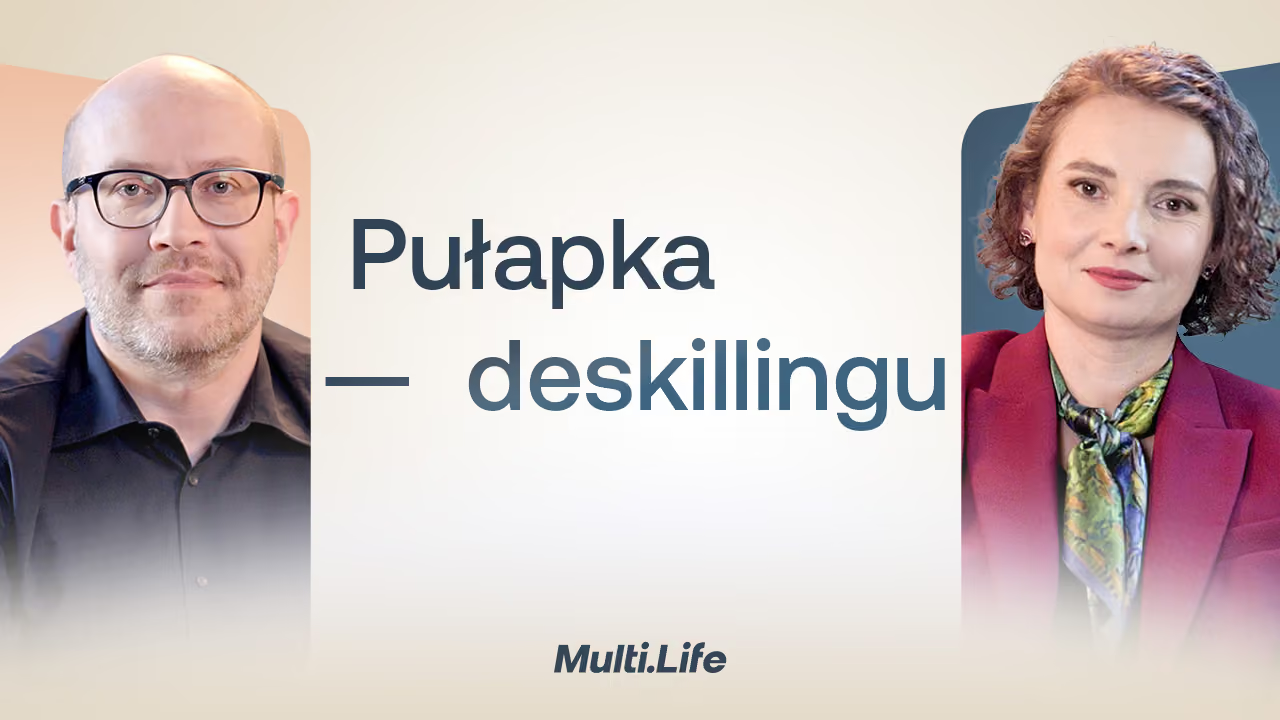
Reading, writing, memorizing, and perhaps even… thinking—are we at risk of slowly "delegating" all these skills to increasingly advanced technologies? And if so, what comes next? How can we protect ourselves from losing fundamental competencies? Or perhaps we can let go of some of them without regret, acquiring new ones instead? We raise all these questions today with the sense that change is inevitable, but its direction is not necessarily known. In the next episode of the "Company that Supports" series on development in the age of AI, the risks of deskilling, and the technological revolution, Dr. Ewa Hartman talks to Dr. hab. Bartosz Żukowski, professor at the University of Łódź, a philosopher, cognitive scientist, and researcher of the human mind.

  1. 00:00:00 Introduction
  2. 00:03:30 Upskilling and deskilling
  3. 00:06:30 Deskilling - not such a new phenomenon
  4. 00:09:00 AI and soft vs. hard deskilling
  5. 00:13:30 Risks of hard deskilling
  6. 00:15:15 Challenges of soft deskilling
  7. 00:20:30 How is AI changing our thinking about work?
  8. 00:25:00 AI, learning, and understanding
  9. 00:34:50 Motivation for development
  10. 00:39:20 Educators in a new role
  11. 00:50:20 How will AI change the hierarchy of competencies?

More at https://multi.life/rozwoj-zespolu

Published:
19/8/2026 22:35
See also
'Scroll, analyze, panic. The new era of digital health' part 2 video cover
'Scroll, analyze, panic. The new era of digital health' part 2 video cover'Scroll, analyze, panic. The new era of digital health' part 2 video cover
Scroll, analyze, panic. The new era of digital health - Damian Parol part 2

Information about healthy eating is at our fingertips today – yet we often still feel lost. Choosing what, how, and when to eat can be more difficult than ever. This is where AI technology and apps come to the rescue.

404: Wellbeing not found
'Best and worst practices in onboarding' video cover
'Best and worst practices in onboarding' video cover'Best and worst practices in onboarding' video cover
Best and worst practices in onboarding

In the first episode of our new series, The Supportive Company, Dr. Ewa Hartman discusses proven methods for effective onboarding. Her guest is Maja Gojtowska, an HR trend observer, consultant, trainer, webinar host, and author of two bestselling HR books.

finances
'Your brain decides before you do. What business doesn't know about people' video cover
'Your brain decides before you do. What business doesn't know about people' video cover'Your brain decides before you do. What business doesn't know about people' video cover
Your brain decides before you do. What business doesn't know about people

In this episode of our "Company That Supports" series, Dr. Ewa Hartman speaks with Dr. Wojciech Glac—a neurobiologist, lecturer at the University of Gdańsk, and popularizer of brain science—about why what we think we know about our own minds often misses the mark on how they actually function. We discuss: why the belief that "I am rational" is only true under certain circumstances, and what really drives our choices; how stress changes the way we think and at what point it stops helping us and starts sabotaging our actions; what the reward system actually is and why dopamine is not a "pleasure hormone," but rather a motor for motivation; whether multitasking is real or if we just like to believe it is; how neuroplasticity works throughout our entire lives and what that means for mature employees in the job market; and why sleep is the foundation—and how a lack of it strips us of exactly what we need most at work. The brain's potential is immense. The question is: do we know the user manual that allows us to make the most of it?

finances
'The Conductor-Leader: Management Through Talent' video cover
'The Conductor-Leader: Management Through Talent' video cover'The Conductor-Leader: Management Through Talent' video cover
The Conductor-Leader: Management Through Talent

In this episode of the "Well Said" series, Andrzej Silczuk speaks with Tina Sobocińska—an HR advisor, university lecturer, and long-time HR director in international organizations—about why the future of leadership requires diversity, what holds women back from promotion, and how organizations can drive change here and now. We discuss: - why diversity in leadership is not just a matter of fairness, but a hard business imperative—and what the data says about it, - what defines a female leader—and why the metaphor of an orchestra conductor describes modern leadership better than that of a charismatic soloist, - how female perfectionism—understood as a fear of judgment—becomes one of the biggest traps on the path to promotion, - why a culture of learning from mistakes builds trust better than any perk, and how to implement it in practice, - where imposter syndrome comes from and why women often decline promotions that men would accept without a second thought, - how socialization into gender roles begins at home and what we can do about it as parents, leaders, and colleagues, - where women disappear from organizational hierarchies—and why this most often happens after maternity leave, - the difference between a mentor and a sponsor—and why we need the latter more than ever today, - how to prepare for the second half of your career before change becomes a necessity rather than a choice. One hundred and thirty-two years to full equality of opportunity—that is the estimate from the World Economic Forum. What can organizations do today to accelerate this change instead of waiting for future generations? This recording is from the Multi.Life channel—a wellbeing platform for companies. Check it out: https://bit.ly/42Lvf7J | Demo for HR: https://multi.life/#formularz

Well said
Show more