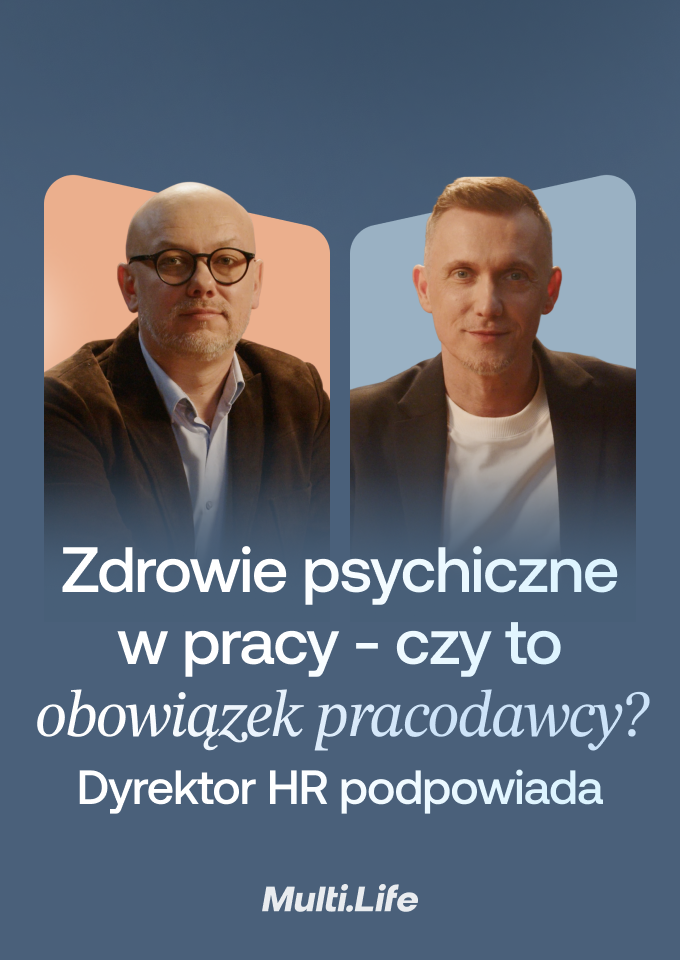
In this episode of the "Well Said" series, Andrzej Silczuk speaks with Piotr Sokół, HR Director at Michelin Polska and an HR management practitioner with over 23 years of experience in an organization employing nearly 5,000 people, about how to systematically build employee wellbeing in a manufacturing company. We discuss: - why psychosocial risk is becoming as important a part of strategy as physical safety or compensation - and what this means for employers today, - how COVID accelerated the decision to implement systemic solutions and what lessons have remained, - what the ISO 45003 standard is, why Michelin was one of the first companies in Poland to implement it - and why a 93% compliance score is just the starting point, - how to measure workload in conversations with employees and why subjective assessment is key here, - where an employer's responsibility for an employee's mental health ends - and whether it should have a limit at all. The journey from the first preventive campaigns to a certified system took nearly a decade. The question is: where do you start if you are just taking your first steps? The recording is from the Multi.Life channel - a wellbeing platform for companies.

Check it out: https://bit.ly/42Lvf7J | Demo for HR: https://bit.ly/48Kn6nE

Multi.Life is a data-driven wellbeing platform that supports employee health and development. Courses, online consultations, partner services, analytics, and an AI assistant in one platform for HR.

“
Published:
5/8/2026 13:46
See also
'AI technology in psychotherapy: support or obstacle?' part 1 video cover
'AI technology in psychotherapy: support or obstacle?' part 1 video cover'AI technology in psychotherapy: support or obstacle?' part 1 video cover
AI technology in psychotherapy: support or obstacle? - Andrzej Silczuk & Paweł Szczesny part 1

Will AI soon replace your therapist? Or is it a fast track to disaster? Artur Kurasiński discusses whether and how technology can support well-being and mental health with psychiatrist Andrzej Silczuk and Dr. Paweł Szczesny, a specialist in bioinformatics and the psychology of artificial intelligence systems. 

404: Wellbeing not found
'Human 2.0 – will technology really heal us?' part 2 video cover
'Human 2.0 – will technology really heal us?' part 2 video cover'Human 2.0 – will technology really heal us?' part 2 video cover
Human 2.0 – will technology really heal us? - Crazy Nauka & Łukasz Sobkowiak part 2

For centuries, humanity has dreamed of a long—or better yet, eternal—life. Will technology help us get closer to this dream? What would such a life look like? Is the key biohacking, human-machine hybrids, or perhaps something else entirely? And finally, how can we take care of our health today by leveraging the latest medical advancements and AI technology? In the second part of this conversation, Artur Kurasiński’s guests—molecular biologist Dr. Łukasz Sobkowiak and science communicators Ola and Piotr Stanisławscy, creators of the Crazy Nauka blog—discuss how to live longer and better in the latest episode of 404: Well-being Not Found. Watch the first part of the conversation with Crazy Nauka & Łukasz Sobkowiak here: https://www.youtube.com/watch?v=1sv0RnyWUNg

404: Wellbeing not found
'Your brain decides before you do. What business doesn't know about people' video cover
'Your brain decides before you do. What business doesn't know about people' video cover'Your brain decides before you do. What business doesn't know about people' video cover
Your brain decides before you do. What business doesn't know about people

In this episode of our "Company That Supports" series, Dr. Ewa Hartman speaks with Dr. Wojciech Glac—a neurobiologist, lecturer at the University of Gdańsk, and popularizer of brain science—about why what we think we know about our own minds often misses the mark on how they actually function. We discuss: why the belief that "I am rational" is only true under certain circumstances, and what really drives our choices; how stress changes the way we think and at what point it stops helping us and starts sabotaging our actions; what the reward system actually is and why dopamine is not a "pleasure hormone," but rather a motor for motivation; whether multitasking is real or if we just like to believe it is; how neuroplasticity works throughout our entire lives and what that means for mature employees in the job market; and why sleep is the foundation—and how a lack of it strips us of exactly what we need most at work. The brain's potential is immense. The question is: do we know the user manual that allows us to make the most of it?

finances
'The Slippery Slope of Feedback' video cover
'The Slippery Slope of Feedback' video cover'The Slippery Slope of Feedback' video cover
The Slippery Slope of Feedback – Rafał Cupiał

I want to talk about your work. The other person hears: "something went wrong." The conversation loses its meaning before it has even begun. In this episode of our "Company That Supports" series, Dr. Ewa Hartman speaks with Rafał Cupiał—a business trainer, consultant, and expert in collaboration and feedback—about why feedback so often backfires and how to change that. We discuss: - why every assessment is based on a fragment of reality and how that limits the effectiveness of development conversations, - what the social layer of feedback is and why it, rather than the content itself, often determines how feedback is received, - how a few sentences at the start of a conversation can turn an attack into a dialogue, - what psychological safety really is and why it has nothing to do with avoiding difficult topics. Feedback is not a technique. It is a daily decision: are you building an environment where people speak openly, or one where they learn to stay silent? This episode is from the Multi.Life channel—a wellbeing platform for companies. Check it out: https://multi.life | Demo for HR: https://multi.life/#formularz

finances
Show more