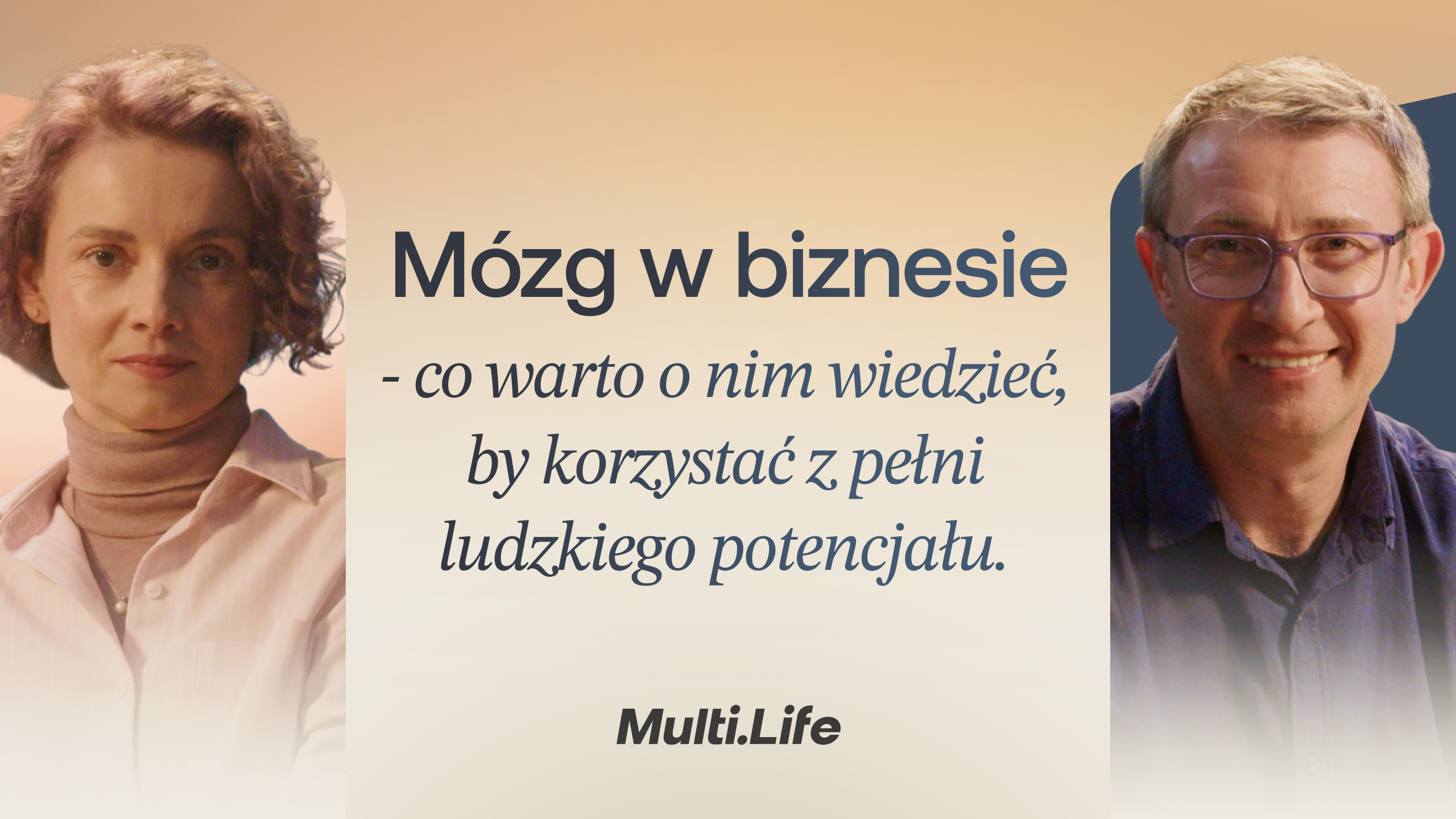
In this episode of our "Company That Supports" series, Dr. Ewa Hartman talks to Dr. Wojciech Glac—a neurobiologist, lecturer at the University of Gdańsk, and science communicator—about why what we think we know about our own minds often misses the mark on how they actually work. We discuss:

  • why the belief that "I am rational" is only true under certain circumstances—and what really drives our choices
  • how stress changes the way we think and when it stops helping us and starts sabotaging our actions
  • what the reward system really is and why dopamine is not the "pleasure hormone," but rather the engine of motivation
  • whether multitasking actually exists, or if we just like to believe it does
  • how neuroplasticity works throughout our entire lives—and what that means for mature employees in the job market
  • why sleep is the foundation—and how a lack of it strips us of exactly what we need most at work

The brain's potential is immense. The question is: do we know the user manual that allows us to make the most of it?

Check out: https://bit.ly/42Lvf7J | HR Demo: https://bit.ly/48Kn6nE00:00:00 I

00:01:57 Introduction and guest presentation - Dr. Wojciech Glac, neurobiologist

00:03:19 Myth #1: "I am completely rational and logical" - how does the brain really work?

00:04:49 Stress and rationality – when the cerebral cortex stops working

00:11:45 Myth #2: "Facts and logic are persuasive" - the role of emotions in processing arguments

00:14:34 Myth #3: "I don't get stressed" - is that even possible?

00:22:35 The brain as an energy calculator - short-term vs. long-term evaluation of consequences

00:26:07 The scrolling trap - why screens as instant gratification win over long-term goals?

00:29:00 Dopamine - what is it really and why does it matter? The reward system and how the brain measures value

00:32:46 Business failure from the perspective of the reward system – how can you leverage it?

00:41:50 Myth no. 4: "People are only motivated by money" – what else activates the reward system?

00:48:50 Myth no. 5: "I can multitask" – the truth about multitasking

00:56:23 Neuroplasticity and multitasking: what are we training our brains to do?

01:00:21 Myth no. 6: "Older people can't learn" – we learn throughout our lives, but the more experience we have, the more effort change requires

01:13:21 "A supportive company" according to Dr. Wojciech Glac – what really supports an employee's brain?

Opublikowano:
5/8/2026 13:46
.
Zobacz również
'Brain on steroids. How AI is changing the way we learn?' part 2 video cover
'Brain on steroids. How AI is changing the way we learn?' part 2 video cover'Brain on steroids. How AI is changing the way we learn?' part 2 video cover
Brain on steroids. How AI is changing the way we learn? - Róża Szafranek pt. 2

Microlearning, blended learning, gamification techniques, AI tools, new technologies, and even pop culture observation—today, anyone looking to develop themselves or their team has a powerful arsenal of resources at their disposal. What exactly do these involve, and how do they work?

404: Dobrostan nie znaleziony
'From Kalashnikov to the green pencil: the power of empathy' video cover
'From Kalashnikov to the green pencil: the power of empathy' video cover'From Kalashnikov to the green pencil: the power of empathy' video cover
From Kalashnikov to the green pencil: the power of empathy

In a world where everyone feels like an expert on someone else's life, maintaining your own backbone, your sense of self, and your peace of mind requires immense strength. In this episode of the "Well Said" series, Andrzej Silczuk talks to journalist Dorota Wellman about how to build inner resilience and self-worth without feeding on likes and hearts, and why valuable feedback—though sometimes difficult—is one of the most important tools for growth. In this episode, you will hear about: - why having privacy is the greatest treasure in today's world, - how to wisely distinguish constructive criticism that fosters growth from hate, which is usually just an expression of someone else's helplessness and frustration, - why online (pseudo)anonymity triggers the worst instincts in people and what to do about it, - why the "green pencil method" and focusing on what we do well is more valuable than pointing out mistakes with a red pen, - why accepting feedback from others, even after decades of experience, still makes sense and how to do it without taking offense at reality. Good feedback is creative; it can help us grow, change, and move forward. Hate is not its opposite. It is just noise. And the best thing you can do with it is ignore it.

Dobrze powiedziane
'Human 2.0 – will technology really heal us?' part 2 video cover
'Human 2.0 – will technology really heal us?' part 2 video cover'Human 2.0 – will technology really heal us?' part 2 video cover
Human 2.0 – will technology really heal us? - Crazy Nauka & Łukasz Sobkowiak part 2

For centuries, humanity has dreamed of a long—or better yet, eternal—life. Will technology help us get closer to this dream? What would such a life look like? Is the key biohacking, human-machine hybrids, or perhaps something else entirely? And finally, how can we take care of our health today by leveraging the latest medical advancements and AI technology? In the second part of this conversation, Artur Kurasiński’s guests—molecular biologist Dr. Łukasz Sobkowiak and science communicators Ola and Piotr Stanisławscy, creators of the Crazy Nauka blog—discuss how to live longer and better in the latest episode of 404: Well-being Not Found. Watch the first part of the conversation with Crazy Nauka & Łukasz Sobkowiak here: https://www.youtube.com/watch?v=1sv0RnyWUNg

404: Dobrostan nie znaleziony
'Do you know where your life energy is leaking?' video cover
'Do you know where your life energy is leaking?' video cover'Do you know where your life energy is leaking?' video cover
Do you know where your life energy is leaking?

How can you keep your "internal batteries" from running out long before retirement? And finally, why is this so important? Our guest today, Nikolay Kirov—an expert in leadership, negotiation, and personal energy management, as well as an academic lecturer and creator of proprietary development programs and scientific publications—will answer these and many other questions for Andrzej Silczuk.

Dobrze powiedziane
Pokaż więcej