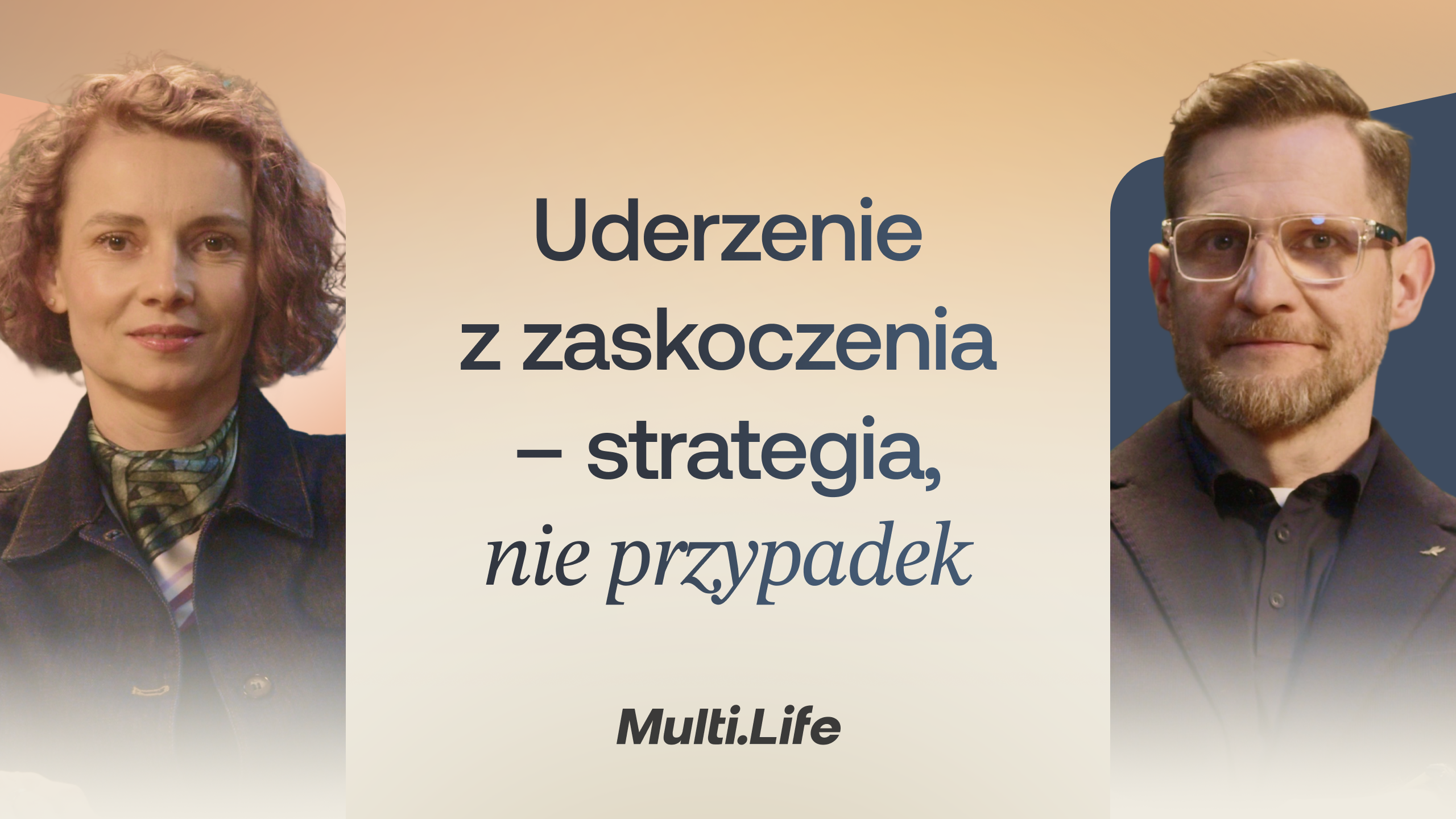
You can easily snap a single match, but ten together form an unbreakable structure. That is exactly how resilience is built in the most demanding environments: not alone, but through the strength of a team and a supportive environment.

In this episode of the "Company That Supports" series, Dr. Ewa Hartman talks to Wojciech Wereszka—a former officer of the GROM and Formoza special units, now a leadership expert and owner of True Leader—about what business can learn from special forces.

‍

We discuss:

  1. how to avoid meeting overload by using the "bring solutions, not problems" rule
  2. why a leader's authority based on a mask of omniscience crumbles when working with people for years
  3. how a "user manual for yourself" shortens the time it takes to figure out team members from months to days
  4. why mental resilience is not an individual superpower, but a quality of the environment that surrounds you

Technical expertise is necessary. But without the human component, it doesn't work. This is a lesson from a place where that principle costs lives.

  1. 00:00 - Introduction
  2. 01:27 - Guest introduction
  3. 02:18 - What do special units actually do?
  4. 07:00 - What can business learn from special units?
  5. 08:55 - Anticipation and contingency planning
  6. 10:20 - Meeting overload: how the military eliminates unproductive meetings
  7. 13:51 - No meetings for the sake of meetings – concrete decisions or it makes no sense
  8. 16:20 - "I am only as smart as the people I work with"
  9. 17:23 - The trap of the omniscient leader
  10. 18:36 - Transformational leadership: don't pretend, ask even if you know the answer
  11. 19:06 - Delegating decision-making space – the responsibility remains with you
  12. 20:03 - How to build a sense of agency in a team?
  13. 22:45 - "Houston, we have a problem" – bring solutions, not problems
  14. 24:35 - Strong ego, strong team – is it possible?
  15. 27:47 - 12 months of training that breaks down egos and builds brotherhood
  16. 31:50 - How to build self-regulating project teams
  17. 35:50 - Soft skills – the hardest and most important competencies
  18. 37:34 - A user manual for yourself
  19. 43:53 - Always explain the "why" – the brain needs to know the consequences
  20. 52:28 - Mental resilience: you are only as strong as your environment
  21. 57:03 - The leader as a moderator of team dynamics
  22. 01:03:30 - Comfort zone vs. zone of controlled discomfort
  23. 01:09:21 - "A supportive company" – what does it mean to Wojciech Wereszko?

More at https://multi.life/rozwoj-zespolu

‍

“
Published:
21/8/2026 15:08
See also
'AI technology in psychotherapy: support or obstacle?' part 2 video cover
'AI technology in psychotherapy: support or obstacle?' part 2 video cover'AI technology in psychotherapy: support or obstacle?' part 2 video cover
AI technology in psychotherapy: support or obstacle? - Andrzej Silczuk & Paweł Szczesny pt. 2

Is it possible that everything you need to support your mental health is right at your fingertips, in an app, available 24/7? Sounds too good to be true, right? As you might expect, the reality is much more complicated.

404: Wellbeing not found
'Chemical or human connections' video cover
'Chemical or human connections' video cover'Chemical or human connections' video cover
Chemical or human connections

Today, we are diving into the biochemistry of human relationships with Dr. Joanna Wojsiat—a biochemist and neurochemist at the Polish Academy of Sciences, neurobiologist, lecturer, educator, and author of podcasts, articles, and popular science books. We will explore the power of first impressions (and what influences them), how to build a team where people feel comfortable and thrive, and why mindfulness is essential for fostering lasting connections. I am Dr. Andrzej Silczuk, and I invite you to join me for the latest episode of Dobrze Powiedziane.

Well said
'The Slippery Slope of Feedback' video cover
'The Slippery Slope of Feedback' video cover'The Slippery Slope of Feedback' video cover
The Slippery Slope of Feedback – Rafał Cupiał

I want to talk about your work. The other person hears: "something went wrong." The conversation loses its meaning before it has even begun. In this episode of our "Company That Supports" series, Dr. Ewa Hartman speaks with Rafał Cupiał—a business trainer, consultant, and expert in collaboration and feedback—about why feedback so often backfires and how to change that. We discuss: - why every assessment is based on a fragment of reality and how that limits the effectiveness of development conversations, - what the social layer of feedback is and why it, rather than the content itself, often determines how feedback is received, - how a few sentences at the start of a conversation can turn an attack into a dialogue, - what psychological safety really is and why it has nothing to do with avoiding difficult topics. Feedback is not a technique. It is a daily decision: are you building an environment where people speak openly, or one where they learn to stay silent? This episode is from the Multi.Life channel—a wellbeing platform for companies. Check it out: https://multi.life | Demo for HR: https://multi.life/#formularz

finances
What to do if someone loses consciousness at work? – Adrenaltika

In this episode of the "Well said" series, Andrzej Silczuk talks to Ariel Szczotok - a paramedic, master of nursing, anesthetic nursing specialist and perfusionist - and Rafał Dobkowski - a paramedic, psychologist with specialization in clinical psychology and a WOPR water rescuer - about what pre-medical first aid is, why fear blocks us and how to start despite it act. We talk about: - why adrenaline naturally "freezes" us in the first seconds of a crisis - and how to take the first step anyway, - what the legal penalty is for failure to provide help - and when we are released from this obligation, - how to assess the safety of the scene, consciousness and breathing of the injured person step by step, in accordance with the principles of occupational health and safety and safety at work, - what cardiopulmonary resuscitation (CPR) and chest compressions look like in practice, - why medical incidents, it is worth calling 999, not 112, and how to talk to the dispatcher, - how to use an automatic defibrillator (AED in the office) - and why it is enough to just listen to it, - how to deal with the fear of seeing blood and why exposure is the best way to tame it, - how to react to an accident at work and take care of the safety of both yourself and the injured person, and what crisis procedures are worth implementing in the company, - how not to harm yourself after a difficult, crisis event - and why post-traumatic stress affects fewer people than we think, and why escaping into stimulants is the worst possible path. This conversation provides specific knowledge useful in building first aid training for companies and in everyday care for the well-being of employees and the employer's responsibility for the safety of the team. It won't get any worse - the situation can only get better. The question is: will you take that step forward? The recording comes from the Multi.Life channel - a wellbeing platform for companies. Check out Multi.Life: https://bit.ly/4ySkEGd Demo for HR: https://bit.ly/4yQOF9p

Well said
Show more