.svg)
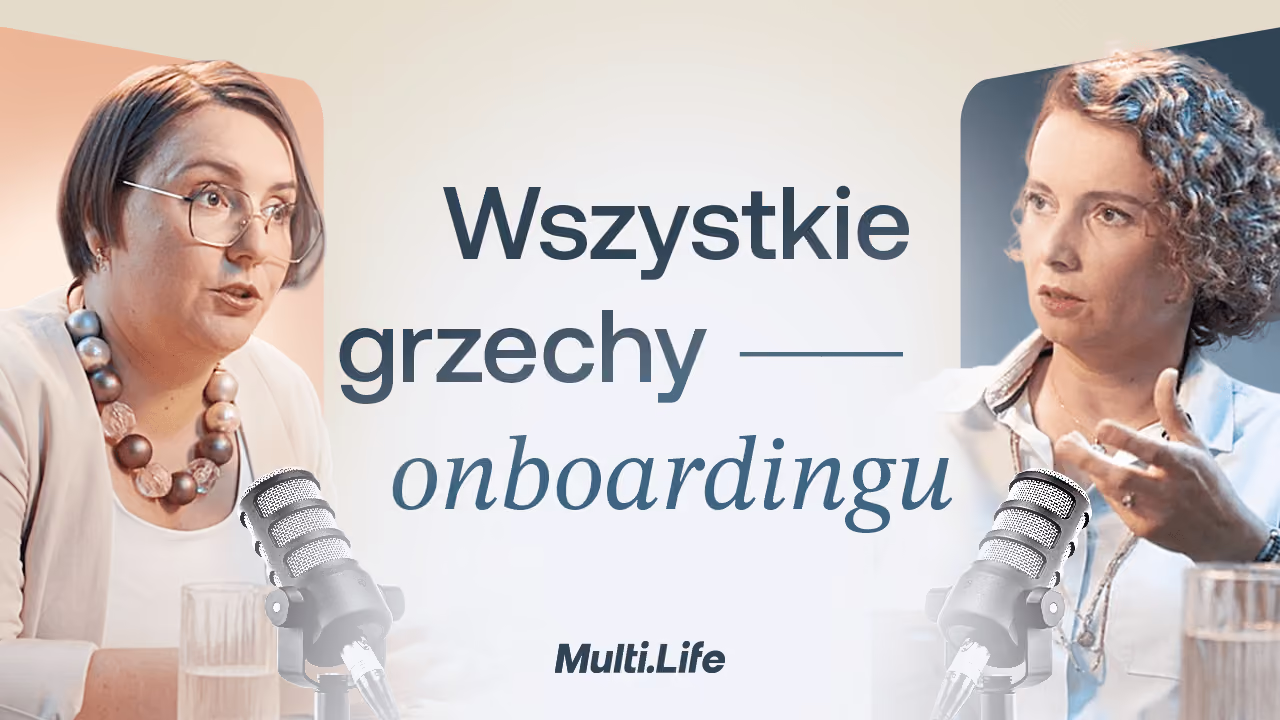


You find, recruit, welcome, and… say goodbye? It turns out that as many as ¼ of Polish employees consider changing jobs within… the first three months! A well-executed onboarding process can be the solution.
But what does that actually mean in practice?
⏺ Why is a simple welcome not enough?
⏺ What are concepts like preboarding and job-specific training?
⏺ Who should a work buddy be, and what is their role? And finally, when and how should the onboarding process end?
In the first episode of our new series, The Supportive Company, Dr. Ewa Hartman discusses proven methods for effective onboarding. Her guest is Maja Gojtowska, an HR trend observer, consultant, trainer, webinar host, and author of two bestselling HR books.
Transcript:
Dr. Ewa Hartman: My guest believes that companies should treat their employees at least as well as they treat their customers. She is an HR trend observer, consultant, trainer, and webinar host. She is also the author of two HR bestsellers: "Candidate Experience: Still a Candidate, or Already a Customer?" and "Employee Onboarding: So the Beginning Isn't the End." Maja Gojtowska.
Maja Gojtowska: Hello.
Dr. Ewa Hartman: Hello, Maja. I am very happy that you accepted the invitation to our series, "The Supportive Company." It’s clear what we’ll be talking about, given that Maja Gojtowska is here.
Maja Gojtowska: About the coolest HR process—onboarding a new employee—and how to introduce someone to an organization so that it’s as painless as possible for both the employee and the company.
Dr. Ewa Hartman: That’s beautiful. I’d like to start with a personal story related to this introduction, which I call "priming"—preparing the brain for what is to come.
The story goes like this: 20 years ago, I was applying for a visa at the American embassy. I was going to the United States for tourism. However, everyone I talked to about the process said it was terrible, that I would be asked awful questions, that I would feel very uncomfortable, and that they would try to prove the worst about me. I wasn't employed at the time, which only added to the stress. "You definitely won't get the visa," "They'll treat you like a potential illegal immigrant," and so on.
So, by the time I got to the consulate, I was so stressed that I couldn't get a word of English out, even though my English was at its best then, as I had just returned from the UK. I was so focused on looking for those negative experiences that, as I mentioned, I wasn't prepared for what actually happened. When the consulate representative told me to place my right index finger on the scanner, I asked, "Which hand?"
And why am I talking about this? Exactly, because it’s about mindset. In other words, what goes on in an employee’s head depending on whether their onboarding sets them up well—or poorly—for their employer?
Maja Gojtowska: You know, I think that to answer that question, we first have to realize that changing jobs is one of the most stressful moments in life. Right after divorce and the death of a loved one. That’s pretty much how it ranks. So, by definition, changing jobs is stressful. We’re leaving a familiar environment, and we know that the known is always better than the new—because a known enemy is better than an unknown one.
And we enter a completely new environment. The employee doesn’t know anything. On one hand, they’re optimistic because they likely got a raise. A job change might involve a promotion, but it’s also a fresh start. And that fresh start brings a certain hope, positive emotions, and the feeling that maybe this time it will be better, maybe this is the moment when I can really start over.
But on the other hand, it’s very stressful because there are so many doubts. Did I make the right decision? Will this organization actually deliver on what they promised? What will my boss be like? What will my team be like? Will they be who I think they are, or was that just a mask and they’ll be completely different?
And then there’s that "priming" you mentioned, which is also huge. You know, when we think about our own beginnings at new jobs—mine, yours, or what our listeners think of—unfortunately, we tend to view them through the lens of bad experiences. Because the vast majority of us didn’t have a good introduction or a good onboarding. At least once in our lives, we’ve all experienced that wonderful "thrown into the deep end" moment on our first day, followed by a simple: "Swim!"
If you don’t swim, it means you’re not cut out for it. It means it was a bad hire. It’s truly dramatic, but you know, on the one hand, it’s dramatic, yet on the other, it’s positive. It’s positive because, at the end of the day, the standard and the baseline of expectations are so low that the company, the manager, and the team don’t have to do much to create a "wow effect" and make a positive impression.
But on the other hand, we have to realize that managers themselves often don’t have good points of reference. They don’t know how to onboard an employee well because they were never onboarded well themselves. Since they were never onboarded properly, they onboard others the way they were onboarded—and since that was bad, they do it badly, and the cycle continues. That’s how it looks.
And that’s a shame, because the onboarding process is a strictly business process that costs a lot of money. From a purely business perspective, it’s a process that should be reasonably structured in organizations from start to finish. If it isn’t, it leads to huge physical and financial losses. HR is business, too; we have to talk about the financial aspect, even though it’s often overlooked.
Dr. Ewa Hartman: Exactly, you’ve touched on some very important points here. On one hand, regardless of what the onboarding is like—and please correct me at any time if you think I’m overstating this—it costs money, right? But if we do it poorly—tell me if I’m thinking about this correctly—can a bad onboarding process result in the person leaving sooner?
Maja Gojtowska: Of course it can. There are two interesting studies. One international study says that one in three employees decides to change jobs within the first six months of employment.
Dr. Ewa Hartman: That’s very fast, isn’t it?
Maja Gojtowska: Very fast. And you know, my take is that the easier it is to enter an organization, the easier it is to leave. So, the lower the requirements and the more basic the role we’re recruiting for, the faster that decision to leave will be, because the employee has invested less, making it easier for them to walk away. But, as recent years have shown, across various industries, even people in increasingly senior positions are declaring a greater willingness to leave an organization quickly if they feel it isn’t delivering on the promises made during the recruitment process.
So yes, one in three decides to change jobs within the first six months. On the other hand, we have the Polish GAMFIS study from February 2025, which shows that 25% of Poles thought about changing jobs within their first three months of employment.
Dr. Ewa Hartman: And could that be an effect of the onboarding?
Maja Gojtowska: In my opinion, in the vast majority of cases, this is an onboarding issue. We often label it a hiring mistake, but for me, we can only call it a hiring mistake if we are certain that every stage of the onboarding process was executed at 100% or 150%. We need to be sure that the employee was truly supported and that we did everything possible to help them reach full productivity as quickly as possible—ensuring they understood their role, what they were expected to do, and the tools they would be using.
They are introduced to the team and organizational culture, and yet, they still quit. My big question is: does that actually happen? Spoiler alert: no, it doesn't. Again, if we look at the research and ask people what they feel is missing most from their onboarding, one in three says it’s job-specific training. They simply don't know what they are supposed to do, why they are doing it, or how to do it.
Dr. Ewa Hartman: So it’s at that level? They don't know what they're supposed to be doing or why?
Maja Gojtowska: Exactly. You know, from my perspective, the biggest onboarding problem is the lack of job-specific training. That’s why people leave. Most often, people quit simply because they don't know what they are supposed to be doing.
Dr. Ewa Hartman: And you’d think that would be the starting point—something you just can't skip.
Maja Gojtowska: Yes, but you know, it’s very common—and I see this often when I talk to managers—that the logic is: "I’m hiring a specialist, so by definition, they should already know what to do."
So they start on day one, and sure, we give them a little time to settle in, but by day two, the expectation is that they should be acting as the specialist I hired them to be. It’s incredibly difficult to change that mindset. There is a huge amount of work to be done here because, for example, if a manager has changed jobs relatively recently, they have their own experience and they know it takes time.
But if we have a manager who has been with the same organization for several years or more, they honestly don't remember what it’s like to be the new person.
Dr. Ewa Hartman: They’ve lost that perspective. It’s hard for them to put themselves in the shoes of someone just starting out.
Maja Gojtowska: Yes, and research shows that the socialization period for a new employee takes between six and nine months. In fact, the more difficult and complex the role, the longer it takes.
So we can't just throw an employee into the organization and say, "Swim!" and expect them to just take off. It’s impossible, because even if they have the knowledge—and I go through this often when training employers—they still need to learn the specific tools, systems, and processes. Even if things look similar, they are always a little different. They need time to learn how to navigate this new reality. The truth is, the more we invest in a new employee at the beginning, the sooner we see the return on that investment. It’s that simple.
Dr. Ewa Hartman: I have one question about that, though I’ll have to circle back to it later. The question is: what is the point of onboarding? Is it about rapid integration and employee productivity? Or should it be about building attachment and loyalty? Or perhaps something else entirely? Or maybe all of the above?
Maja Gojtowska: You know, when I work with employers, I often hear a completely different alternative. I often hear that it’s all about welcoming a new employee. And don’t get me wrong, I’m an enthusiast of welcomes. Making a good first impression is important—you know that well, it’s obvious.
But what good is a first impression or employee satisfaction on day one if we don’t onboard them effectively? To me, onboarding is about preparing an employee so they can reach full productivity as quickly as possible and start delivering real added value.
If they deliver value, they will bond with the organization, build relationships, become much more loyal, and connect with their colleagues. But if we start from the other end and focus only on them having relationships and feeling good—I often see this in onboarding audits and surveys where there’s a question: "Did you like your first day?"
And the employee says, "Yes." And I think to myself, what does that even mean? What are we supposed to do with that? Of course they liked the first day. They didn't work, they were fed, they got coffee, and they’re getting paid for it. Of course they liked it. But let’s be clear: work isn't just about the employee liking it. The employee needs to understand what they are supposed to do. They need to feel supported. They need to know their tasks and what they will be held accountable for, and unfortunately, these are the biggest challenges of an employee's first three months.
Dr. Ewa Hartman: You’ve touched on something that really struck me—the fact that people simply don’t know what is expected of them. I intuitively felt that this was something I should have taken away from my first day—that’s been my experience, anyway. It reminds me of my workshops. I often ask, "What is feedback for?" and I get the answer, "To correct a mistake." It’s the same thing here. I ask you what onboarding is for, and you say managers think it’s just about a nice welcome.
Our brains work in such a way that if I frame myself as a manager whose job is just to "welcome" a new hire, I’ll actually forget that I need to explain why they are here in the first place, how we want them to work, and how we function as a company. So, I focus on the welcome, and the challenge for me becomes establishing that "point zero."
Maja Gojtowska: Absolutely, the challenge is establishing "point zero," but there’s another problem. On one hand, it’s about shifting the manager's mindset regarding the purpose of onboarding, but there’s another huge challenge with integrating a new hire. Look, a new employee doesn't just show up and give 100% from day one as a real support. For the first few days, weeks, or even months, they are actually a burden on the team.
Dr. Ewa Hartman: Exactly, exactly—you hear that often, don't you?
Maja Gojtowska: And that’s the tragedy of onboarding, because it means that I—as a manager or as a team—have to give more of myself during that initial period, doing my own work while also teaching "the new person." People rarely talk about this. In my opinion, this often leads to the manager saying, "Well, they’re a burden, so maybe we should just leave them to it and they’ll learn by observing."
Dr. Ewa Hartman: And at the same time, we’re convinced we’ve done everything right because we wanted to welcome them, and they were welcomed.
Maja Gojtowska: Yes, exactly. Then comes the "deep dive"—we know that if we dive into something, we experience it fully, and they’ll surely figure it out on their own. But we forget about feedback, we forget about correcting the employee, and we forget to ask them, "How are you doing?" or "What can I do to make your onboarding easier?" Often, the most crucial thing a manager can do is just listen. They probably won't be able to fix every process—in fact, there will be many things they can't change because that's just how the company works.
But even just creating the space to vent, asking, "Hey, I see you're struggling, is there anything I can do for you?"—if they say, "I have a problem with this, and this, and this," the manager can say, "Okay, I can't do anything about those, but for this one, I can reach out to someone else." When we think about onboarding, I often hear from clients, "What tools, what solutions do you recommend, Maja?"
HR teams—and I work with them very often—involuntarily look for bells and whistles, you know, amazing things that will look great when we talk about them at a conference or in an industry article. There are examples, like one of my favorite uses of new technology in onboarding: VR, which is used by companies like Biedronka for on-the-job training. They use VR to teach every store employee how to operate the baking oven.
Dr. Ewa Hartman: So, a person puts on the glasses and…?
Maja Gojtowska: Yes, and they virtually learn how to put it on, how to operate the oven in general. I use it myself; it’s absolutely amazing. For them, it actually stemmed from a simple business need – new employees were afraid to approach the oven right away.
Dr. Ewa Hartman: Right? That’s exactly what I was thinking. So, it’s safe, but at the same time, it realistically captures the actual experience.
Maja Gojtowska: Yes, it’s very safe because they can practice, which makes them more confident and leads to fewer accidents. So, it’s a very, very sensible use of such a flashy tool in onboarding. But at the end of the day, onboarding is about planning what we want to convey to the employee—basically, laying out everything they need to know on the table. Then, it’s about organizing it in a logical sequence and saying, "Okay, we’ll tell them this first, then that, then that," and planning how we’ll deliver that knowledge—whether it will just be theoretical or if we can do it in a more engaging way to make it truly effective. Finally, it’s about tracking progress, gathering feedback, and providing feedback on an ongoing basis.
Dr. Ewa Hartman: You know, to me, what you’re saying also relates to the brain—the story of working memory, declarative memory, and procedural memory. Working memory is what we’re using right now to have this conversation, but at some point, we’ll feel tired. That’s completely normal, right? Our brains will become overloaded with the need to process information. And that probably happens quite often in onboarding processes, doesn't it? I hear about it too—I don't run them myself, but during my workshops, I hear people say, "I sat there for three hours and they told me everything."
Maja Gojtowska: You know, I always bring up my husband’s story in moments like this. A few years ago, my husband changed jobs. He joined a large organization and had an onboarding program. It was two days of remote onboarding, two days of meetings from 9:00 AM to 4:30 PM, held on Teams. Great. That already sounds great…
Dr. Ewa Hartman: Sounds good already…
Maja Gojtowska: Sounds good already. So, on the second day, around 3:00 PM, I went into the kitchen to make some coffee, and my husband was sitting there in front of his computer. I wouldn't say he was sitting; he was more like hanging off his chair. I mean, to this day, I’m convinced he was asleep. He had this glazed look in his eyes, and I asked him, "How’s it going?" He shook himself awake and said, "Good, very interesting, very, very interesting." But the truth is, after two days of back-to-back meetings on Teams or Zoom, he didn't know a thing.
Dr. Ewa Hartman: He wasn't able to retain any of it.
Maja Gojtowska: That’s a story I often encounter. I hear, "No, no, Ms. Maja, we don't need to worry about the first day because we have it perfectly planned with lots of presentations; let’s talk about what comes after."
It’s not about overwhelming a person with a crazy amount of information they won’t be able to process anyway. It’s impossible for them to process it all. It’s about presenting that knowledge in a way that is digestible for the person, while also being as low-effort as possible for the organization.
Because, at the end of the day, why organize first-day training sessions that involve a ton of people from various departments? They have to show up and talk. Often, they don’t even want to do it. They often present in a very unappealing, boring way. Why take up their time? Why put them through that? Like, why are we even doing all this?
Dr. Ewa Hartman: Maja, would it make sense to spread out some of the elements of that onboarding you mentioned—the two days packed with presentations—over a longer period?
Maja Gojtowska: Absolutely. There are companies, like Netguru, that do hold training on the first day, but the bulk of their training happens later. Why? Because someone smart at Netguru realized they want people to attend these sessions when they actually have questions.
Dr. Ewa Hartman: Exactly, when they’re able to understand what’s being said, so they already know what they don’t know.
Maja Gojtowska: So they have some curiosity.
Dr. Ewa Hartman: And why is that?
Maja Gojtowska: Because the first day is a very comfortable day where the new employee doesn’t know anything. They don’t know what they don’t know. They don’t fully know what they do know. They arrive happy, but they aren’t in a position to ask any meaningful questions.
Dr. Ewa Hartman: Not yet, right?
Maja Gojtowska: It’s just not the right time. And you know, it’s also about what an employee’s needs are on their first day. On the first day, when an employee joins an organization, do they really need to learn about benefits, procedures, how to request time off, GDPR, legal stuff, and other obscure topics? No. On the first day, a new employee wants to meet their boss and team, see where their desk is, and find out what they’re actually supposed to be doing.
Dr. Ewa Hartman: So, to wrap up the key points on onboarding we’ve gathered so far—and obviously, this is at a very high level, as each of these elements could be explored in much greater depth—the first thing is: "Set a solid starting point." Don't think of onboarding as just a welcome; think of it as integrating the employee into their responsibilities. Does that sound right?
Maja Gojtowska: Absolutely.
Dr. Ewa Hartman: Second, don't overwhelm them with information—especially information they aren't ready to absorb yet. They don't know their responsibilities or how the organization works, so they won't remember it anyway. Whenever possible, space out the onboarding elements so they are introduced once the person actually knows what they don't know.
Maja Gojtowska: And vary the formats. Use different formats to deliver knowledge. You know, some things can be presentations you go over with the employee, some can be shadowing, some can be short e-learning modules, some can be information stored on the intranet, and some can be infographics. But when someone has to sit through back-to-back meetings where people are just talking at them for hours—it’s long, it’s boring, and they just lose focus. It’s bound to fail.
Dr. Ewa Hartman: No, it really can't work. That’s not how our memory functions. Our memory definitely needs those varied formats because we learn differently; we are all unique. At the same time, we remember things best when we can touch them, do them, and experience them. The mere act of talking and providing information is actually the least effective way to make it stick.
Maja Gojtowska: You know, as you’re saying that, another thought comes to mind. It’s very common for organizations to assign a buddy—a colleague or mentor—to help a new hire get up to speed. The concept itself is great, really. But the devil is in the details. The problem is that while we want to teach the new employee, very few companies actually teach the mentors how to teach or how to share knowledge effectively.
Dr. Ewa Hartman: Okay, that’s another interesting point.
Maja Gojtowska: It’s fascinating. I first encountered this quite strongly when I was gathering material for my book and spoke with a woman from a manufacturing company in the Podkarpacie region. She told me about how they were introducing mentors at a large production plant. They quickly realized that a major issue would be a new employee coming onto the floor and being assigned a mentor who knows the machine inside out. That mentor would be teaching someone who had only been looking at the machine for an hour.
The risk of being dismissive or saying things are "obvious" is huge. So, what did the company do? They selected mentors and took them to a training session. It wasn't a theoretical session; they started with a practical exercise. The trainer dumped beads on a table and asked them to make bracelets. Because she had done it many times, she was very fast, threading the beads and tying knots, saying, "Okay, next bead." But these guys—grown men, production mentors—had a terrible time with it. They couldn't keep up at all. They were frustrated and annoyed. At the end, she asked, "So, how did I teach you?" It was terrible, hopeless; they had no chance of making the bracelet the way they wanted. Then she asked, "Okay, how does this translate to your onboarding? How will you be training these new employees?"
Dr. Ewa Hartman: Right? I’m starting to understand that experience—what it’s like for someone for whom everything is completely new.
Maja Gojtowska: I know a really sad example of this. A company in the manufacturing sector—they produced cardboard. One of the teams working on a specific machine had been fighting for a year to get a new FTE approved so they could bring on a new employee.
They fought for a long time, finally succeeded, and started recruiting. Over the next year, 8 or 9 people cycled through that team. None of them could last; they were literally spat out by the team. The organism, you know, rejected the transplant. When asked why these people were leaving and what was going on, the team unanimously replied that the new hires didn't know the machines as well as they should have.
The thing is, the average tenure on the team was 15 years, and these people had been in the role for, I don't know, four weeks at most. You can't compare the two. But, you see, this is once again a matter of awareness.
Dr. Ewa Hartman: How can this be addressed?
Maja Gojtowska: Work with the team. Manage expectations. When we close a recruitment process—you know, closing a recruitment process is a truly fantastic moment. We’re happy. Yes, we’ve hired someone. They’re coming. They’ll help us. They’ll take some of the load off. What could be better than that? And I think this is where HR and the manager have a very important role to play: to step in and say, "Hey, yes, this person will eventually take the load off you."
Dr. Ewa Hartman: "Eventually"—that’s the key word, isn't it?
Maja Gojtowska: They will definitely take the load off you eventually, but before they do, you have to put in the work. It’s crucial to create space—two or three weeks before the new hire starts—to meet with the team and ask: "Okay, what do we want to pass on to them?", "In what order should we do it?", "What’s most important?", "Who can take responsibility for what?". You know, do the mental exercise and think through the what, how, when, why, and where.
Dr. Ewa Hartman: I see what you mean, and I think it’s our national trait of "it’ll work out somehow." And "it’ll work out somehow" really clashes with the onboarding process, doesn't it?
Maja Gojtowska: You know, I wouldn't go so far as to say it's just our national problem. It’s an absolutely global issue.
Dr. Ewa Hartman: "It’ll work out somehow"...
Maja Gojtowska: "It’ll work out somehow," let’s just throw them in at the deep end. How many times have I heard that it’s actually good to throw people in at the deep end because then the employee can, you know, fully discover the uniqueness of the organization and really show that they’re ready to take on the challenge?
Dr. Ewa Hartman: I also hear people say that "you don't need to explain things to adults."
Maja Gojtowska: Exactly, I didn't hire a specialist just to teach them, right?
Dr. Ewa Hartman: You really hit on something important there—the idea that we need to teach the people who are onboarding others how to actually teach. It’s so crucial, isn't it? We all tend to view the world through the lens of our own experiences. If something is simple and obvious to me, I naturally assume it’s simple and obvious to everyone else. I’ve heard stories like this time and time again during our workshops.
This is an open workshop, so we have people from various organizations. After one session, a manager came up to me and said, "You know, I had a similar experience. We were talking about onboarding, and it reminded me of something that happened in my own company. We had prepared everything for the onboarding process—the steps, the presentation, the Teams meeting, the buddy system, everything. The new hire went through the whole process and had support from their buddy, and we were very pleased. Then, three months later, the employee came to me and said they were quitting. I was in shock. Why? Everything had been done according to the guidelines. The only answer I got from him—it was a guy we’d hired—was that he unfortunately couldn't integrate into the company, and it was a huge source of stress for him. The manager was completely blindsided because he was absolutely convinced that everything was covered, including the buddy. He even went to the buddy and asked, 'Listen, our new employee is leaving because he couldn't integrate. Did he come to you and ask anything?' The buddy said, 'No, he didn't ask.' 'And did you ask him?' 'No, I didn't ask.'"
Maja Gojtowska: Because if he had any questions, he surely would have asked.
Dr. Ewa Hartman: If. And that was exactly how the story continued—because if he had questions, he would have come forward.
Maja Gojtowska: You know, this is one of the biggest mysteries to me when it comes to onboarding. Show me a new employee who walks into a new environment, a new organization, and wants to make a good impression—because that’s what we all want to do as new hires in a new team—who will voluntarily admit from day one that they don't know something or don't understand something. I don't know how incredibly specific, open, and self-confident a person has to be to do that...
Dr. Ewa Hartman: Exactly, a self-confident person...
Maja Gojtowska: ...who has the openness to admit they don't know something. Yes, those people certainly exist, but they are the exception that proves the rule. As a general rule, we want to show that we know what we're doing. That’s why mindfulness and vigilance on the part of the manager and the mentors are so important. That’s why these check-ins are so vital. You have to prioritize regular meetings and ask, "What can I help you with?", "How are you feeling?", "Where are you at right now?" You have to actively encourage that person to speak up.
Dr. Ewa Hartman: So, another point: it doesn't matter if the new employee comes to you or not—you have to make the move, go to them, and regularly ask where they are and what they need at that moment.
Maja Gojtowska: Yes, but remember, Ewa, there’s another problem here. It’s something I often hear from managers: "But Maja, you want us to coddle the new employee."
Dr. Ewa Hartman: See—coddle, baby them.
Maja Gojtowska: Right, but you know, I always tell myself that I’ve never heard of an employee quitting because they were too well taken care of. I mean, I don’t know of any such story. I’ve heard of people leaving because they weren’t looked after or because no one took an interest in them, but an employee leaving because they were “too well” cared for? No. I think if it ever gets to be too much hand-holding, the employee will just say: “Listen, I’ve got this...”
Dr. Ewa Hartman: “I’ve got it,” “I know what to do, I can handle it now.”
Maja Gojtowska: Exactly, that’s fine. It’s not like we’re going to smother them with kindness until they can’t breathe. That’s just not going to happen.
Dr. Ewa Hartman: I’ve been through a few onboarding processes in my life. Not many, since I’ve been a freelancer for years, but I once had the great pleasure of working for the European Commission. Beyond the classic “here’s the kitchen, here’s where it isn’t” routine—you know, the viral video style, “here’s where you go to the bathroom, here’s where you get a drink”—I was seated in an office with Henry, my buddy, desk-to-desk. The whole point was for Henry to be right there for me, and for me to be right there for him. I have to say, it was a wonderful experience because any issue that came up was resolved on the spot. And Henry had his own workload lightened during that time.
Maja Gojtowska: Exactly. You know, this is a question that comes up most often in sales teams, probably because their results are the most measurable, but it’s a topic that should be addressed in every team. If we entrust a new hire to a mentor, we can’t expect that person to hit 100% of their business targets while also onboarding someone new. That assumes they’ll be doing the onboarding in their spare time as a hobby.
If they’re faced with a choice between hitting their targets or onboarding a new hire, they’ll choose the targets, because that’s what they’re held accountable for at the end of the day. Companies handle this in many different ways; for instance, I know organizations that provide additional compensation for buddies.
I mean, setting aside the issue of reducing the mentor’s or buddy’s workload, I know companies that offer extra pay for buddies. They get a financial bonus or some other form of recognition for doing that specific job. But, and here’s the fine print, we have to remember to reward them only if they do it well, not if they do a terrible job. So, it has to be tied to an analysis or verification that the buddy actually did the work.
Dr. Ewa Hartman: And you also have to give that buddy the right tools, right? Or at least prepare them for the role.
Maja Gojtowska: Absolutely. To me, preparation—as an organization, as a manager, and as a team—is absolutely key. We don’t need fancy tools, AI, or anything like that. We need people, conversation, and time. That’s what onboarding is really about. And it’s the same with preboarding. We’ve been talking about the moment the employee is already in the organization, but let’s remember that for many companies, the business challenge is that employees don’t even show up on their first day.
Dr. Ewa Hartman: So they’ve gone through the whole process and that’s it.
Maja Gojtowska: They’ve gone through recruitment, received an offer, we’re waiting for them on day one, and they don’t show up. You know, these are huge costs associated with recruitment, not to mention the growing frustration of the manager and the team, which translates into lower engagement and, ultimately, lower business results. This is where you can use various technological tools to maintain contact with the new hire, though, again, nothing beats a good old-fashioned phone call. Calling the new hire a week before and asking: “How are you feeling? Have you managed to get everything done?” We’ve already done this, that, and the other. We’ve got your desk ready, your station set up, we’ve ordered your uniform. We’ve done so much, and you—I don’t know—“Have you filled this out, have you done that?” These are very simple things; it’s not rocket science.
Dr. Ewa Hartman: But that requires planning; it requires moving away from the "it'll work out somehow" attitude. Maja, and it's even harder – buddy systems in remote work, or onboarding in remote work in general.
Maja Gojtowska: You know, again, remote onboarding requires planning. I mean, onboarding always requires planning. Onboarding always requires planning, but remote onboarding requires even more planning because, well, if we see each other, we can use a bit of that "management by walking around" approach – we meet in the kitchen, we chat for a moment.
Dr. Ewa Hartman: Right? It's easier.
Maja Gojtowska: It is easier. But if we don't see each other... That regularity of meetings – they don't have to last an hour. They don't even have to last half an hour. But often, you know, a 15-minute check-in every day. I know companies, often in the IT industry, because that's the industry where remote work is probably most common in Poland, it's a kind of standard there.
For example, coffee with a new employee, every day, 15 minutes, at the start of the day. It's not mandatory. Whoever shows up, shows up. But let's talk, let's plan that time. Let's ask, "How are you feeling?", and perhaps we'll find out that we can help in some way, or that someone needs someone to talk to. But – plan, plan, plan. And the second important thing, because while the first element that new employees miss most is job-specific training, right behind it, when we look at the research, is building relationships with the team – that is, socialization with the team, socialization with the manager, and then company values. So, for me, a strategic element of onboarding is taking care of this soft, yet important, integration. And that integration can be an online coffee.
Dr. Ewa Hartman: It doesn't have to be anything big, right?
Maja Gojtowska: It doesn't have to be anything big, but it must be a space to talk to that new employee. Not just about professional matters, but above all about personal things. And it's not about total exhibitionism or interrogating them about topics they don't want to discuss. But, you know, work is also about relationships. I remember once doing an audit for a very large gaming company, and I was talking to one of the new employees who was supposed to tell me what the onboarding looked like. And from the very beginning, she said, no, the onboarding was great, it is great, she is very happy, it's fantastic. And I said, OK, "but"? And at some point, she said, "Well, okay," but she told me about her first day. The first or second day, it was the first meeting with the boss and the team. And she was incredibly excited because it was, you know, her dream job, creative, making games, just super, she was fulfilling her dreams, and she really wanted to make a good impression.
And the manager, they got on a call because it was remote work, and the manager said: "Hey team, this is Krystyna!", and the team said: "Hey, Krystyna!", and Krystyna said: "Hey, team!", and the manager said: "Alright, moving on to current matters – Zbigniew, how is your project going?". And she says: "You know, Maja, that was the one moment when I felt like, hey, seriously? Really? That's it? Is that the end?".
You know, months passed, he threw her in at the deep end, but she happened to swim, she built those relationships there. But how many people won't? Because, simply put, maybe it's harder for them. So it's worth looking for very simple tools that will somehow open things up and make the team get to know each other better.
It's not rocket science. It could be something like a cool thing I once saw in one of the companies, I think it was an IT company, which was making mind maps. The ritual was that when a new person joined the team, each team member plus the new employee would prepare a mind map about themselves. And then they would discuss them at a meeting. Like, Krystyna is going on vacation to Scotland and Japan, likes horseback riding, and would like to go skydiving someday. And Stefan would like something completely different. And sometimes they found similarities, sometimes they found opposites, but that simple exercise was a chance for them to build a relationship. And that is something that, for me, is an element we don't have time for because we are running so fast. There's a picture circulating online – two cavemen pulling a cart...
Dr. Ewa Hartman: Yes, a square wheel – whatever that might sound like.
Maja Gojtowska: ...yes, pulling a cart with a square wheel, and another caveman is standing there with a round wheel, and they say: "No, no, sorry, we're busy, don't interrupt us."
Dr. Ewa Hartman: Yes, I love that image too, I’m familiar with it.
Maja Gojtowska: That’s exactly how it is with onboarding. Often, there are people in an organization who say, "Hey, maybe we should do this differently, but we don't have the time, we don't have the time to stop and do it properly." And honestly, creating a "wow effect" isn't difficult because, again, the barrier to entry is so low that you don't need any fireworks here.
Dr. Ewa Hartman: Based on what you're saying, it doesn't seem difficult; it just comes down to that "zero point" again. If we assume that onboarding is just about welcoming an employee, then our minds might get the signal after a quick "Hi, Krystyna," "Hi, team," that "that's it," that nothing more is needed. And then comes the, "Is that it...?"
Maja Gojtowska: You know, I’m observing an onboarding process right now that is a very, very interesting case where, in theory, everything adds up. Maybe not everything, because the role-specific training wasn't quite there, but the welcome was. There is definitely a positive attitude, empathy for the new employee, and even an understanding—"We know it will take you time, take it easy, give yourself time, don't expect too much from yourself."
And just so you understand me correctly, this is a message that is very often missing. If you look at the onboarding curve, an employee enters a new organization with a very high level of enthusiasm, but with each passing day, that enthusiasm drops as they start connecting the dots and realize how much they don't know.
The new employee hits their biggest crisis roughly between the first and second month. They already know how much they don't know, the skeletons have already fallen out of the closet, and they are starting to understand what they’ve actually signed up for. This is a very important moment to reach out to the employee and say, "Hey, it’s okay that you don't know yet." They want to be working independently, but they just can't yet. And it’s a crucial moment to say, "Hey, take it easy. We know, just give yourself some time."
That is a very important message, but that message must be followed by role-specific training. Because if we are just nice to the employee, empathetic, and tell them, "Give yourself time, you'll figure it out eventually," well, you know, the onboarding will drag on so much that it won't be business-effective at all.
Dr. Ewa Hartman: And how would you, listen, clarify that? Role-specific training. What would you suggest to do that well?
Maja Gojtowska: You know, role-specific training is a very broad area, and it’s very difficult because it’s hard to standardize.
Dr. Ewa Hartman: Right, every company is different, organizational culture...
Maja Gojtowska: "Every company," I mean, you know, the company is one thing, but it’s not just about the company. "Every company" is different, but in every company, you have a variety of roles. Some of them are repetitive—great, then we can create a uniform process—but the majority of roles are very unique. And that means we have to create an onboarding plan tailored to the individual each time because, look, role-specific training is, in short: "What will you be doing?"
So, what will you be doing? We need to make sure we explain the projects, processes, and the people the employee will be working with on a given task. We need to train them on the tools. So that’s one typical role-specific thread. On the other hand, we have the team, so we need to introduce them to the team. Explain what language we use, whether we have any rituals or not. This is the thread of work rules. How do we work? What are the hours? What is important to us? What is not important to us? This is the thread of communication with the boss.
There is a simple tool called an entry interview. It is rarely used, which is a shame. It is nothing major—just a meeting lasting about an hour between a manager and a new employee, during which the manager talks about how they like to work and asks the employee: "How do you like to work?"
Dr. Ewa Hartman: OK, that doesn't sound difficult, but once again, it comes down to that famous lack of time, doesn't it?
Maja Gojtowska: Of course, but just think about how much easier our lives would be if we had the time to ask an employee: "How do you prefer to receive feedback?", "How do you prefer to communicate?", "Do you prefer me to message you on Teams, send an email, or send a text?" You know, those everyday things that make a difference. I recently had a conversation with a client—the contact person had changed—and the woman called me and asked straight out: "Maja, what do you prefer? Do you prefer things to be official, or do you prefer me to just message you directly on Messenger?" And I said: "No, no, I prefer Messenger. Don't worry, just catch me there and send me a quick note." And she said: "Great, I prefer that too, so that's how we'll talk."
Dr. Ewa Hartman: That immediately reminds me of one of the bosses I remember as the best I ever had in my career, back when I was a full-time employee. On his first day, he said straight out: "Listen, if my door is closed, it means I'm working on something and I ask you not to disturb me. If my door is open—such a simple thing, right?—feel free to come in without knocking." And listen, that one piece of communication saved so much second-guessing.
Maja Gojtowska: Or wondering why the door is open—maybe they're hiding something from us? These are absolutely super-simple things that we often don't think about. Because we have this wrong approach that we just need to welcome them, but no, we need to onboard them, and we must remember that everything is new to this person—even the file structure on the drive or the layout of the intranet.
Let's be honest, in many organizations, it's hard to find any logic in how certain systems and processes are set up. You could say a lot about it, but it's rarely logical. That's why it's so difficult, because, in fact, we have to build the onboarding plan for each person from scratch, but at the end of the day, the elements are very repetitive.
And the moment we close the recruitment process, hire the person, and send them an offer, that is exactly when we—as the manager, along with HR, the HR Business Partner, or the team—should sit down and think: "Okay, we have this person, so what do we need to do to transfer knowledge to them as quickly and efficiently as possible?" Let's put it all on the table and then organize it in order.
Dr. Ewa Hartman: In order, step by step. And we return to that "point zero." How much simpler would it be—I'm talking about an ideal business world—if onboarding were just about the welcome? We could record a nice video, probably with a company mascot waving and saying "Welcome!"
Maja Gojtowska: That's not what it's about at all. That is actually one of the biggest challenges in onboarding. When I was writing my book, I looked for many interesting examples and campaigns, and I even said openly: "Hey, if you have something interesting you want to show me, feel free to call or write; I'd love to hear about it."
I can't count how many times I met with HR representatives who told me about the first day. It was even nice, you know, it was fine, okay. I asked: "Right, and what next?" And then I heard: "No, that's it. That's it." But I said: "What do you mean, that's it?" No, it's not that it's over, but rather that the business takes over the employee, and we don't know what happens to them.
And that is a huge problem, because the first day is the least of our worries at the end of the day. That's not where the issue lies—on the first day, the employee will be happy anyway. Well, they will be happy, I know examples.
Dr. Ewa Hartman: That they might not be.
Maja Gojtowska: It might not be, that's true. I know stories where, for example, on their first day, an employee is required to read the company rules and regulations. They get sat down in an HR room and just have to read through a document like that. Where is the user experience in that?
Dr. Ewa Hartman: I mean, you know, the ability to absorb that much information when you don't have any experience yet is completely non-existent.
Maja Gojtowska: But you know, there's also the stress – HR is sitting right there over you, watching. "Are you done reading yet?" So no, we don't do things like that, but it still happens. It absolutely happens, it really does. These are cases from the last two years.
Dr. Ewa Hartman: If you could say what never to do, we already have one example: don't sit someone down in front of a book to read on day one and think that's enough.
Maja Gojtowska: Yes, that's the first thing. The second thing is, never, ever give an employee a huge document to read – whether it's company rules or a description of tools – with the assumption that they'll actually absorb anything. That's definitely one. I am a huge opponent of those back-to-back online meetings from 9:00 to 4:00, with just a lunch break, assuming the employee will remember anything or understand how the company works. That's the second thing. Definitely what you mentioned earlier, the meetings, or rather, the assumption that you have a buddy and that if you have a problem, you'll just come forward. "We're here" – it's an open-door policy that isn't really open. It assumes that if an employee has a doubt, they'll come forward on their own. Thirdly, cutting off contact entirely. Once we make a job offer and they accept it, sometimes we wait a week for them, but sometimes we wait a month, two, three, or even longer.
And that is the moment when we absolutely must stay in touch with the employee, because remember that things like "last-minute offers" from current employers are a real thing. And if we don't use that time – it's called preboarding – to stay in contact with the employee, there's a risk they'll get a last-minute offer from their current employer and decide, "Better the devil you know."
Dr. Ewa Hartman: And maintaining contact during that time between accepting the offer and the employee actually starting. How can you maintain that contact? What should you ask about then?
Maja Gojtowska: You know, it's not even so much about what to ask, but who should be maintaining that contact. From my perspective, it's worth creating many different touchpoints and doing it in various ways. The first and most important person who should maintain contact, from my perspective and the new employee's perspective, is the manager. A phone call once a month or an email. "How are you feeling? Can I help you with anything?" "Do you have any doubts? Is everything clear to you?" That's one part, but the other part is showing what we've already done, like, "I've just prepared your onboarding plan or I've already started working on it, so don't worry, we won't just throw you in at the deep end."
That's one thing. But you know, there are many companies, T-Mobile does this great, for example, that use those three months of waiting to send systemic messages automatically, which remind the employee: "Hey, 27 days to go – this is the time to fill out this and that. Click here," "Hey, one week to go. Let us explain how to get to our office on your first day," "This is our office, this is the entrance, here are some photos and videos." You know, those kinds of automated updates.
Dr. Ewa Hartman: Even if it's automated, it's still okay. It's still maintaining that relationship, building it.
Maja Gojtowska: They are building that relationship because the employee feels like they are already in the process. What happens very often, which is bad, is leaving the employee after they accept the offer and saying, "Okay, someone will be in touch with you."
Dr. Ewa Hartman: Or: "Okay, see you in three months."
Maja Gojtowska: Yes, and then, you know, someone will probably contact that person—well, someone definitely has to contact them, because HR needs to reach out, then someone has to tell them where to show up on their first day. But these are often just random people, and you never know when they’ll get in touch. Meanwhile, the employee is left with a lot of doubts, mostly revolving around the question: "Did I make the right choice?" So, if I’m not getting information like "What’s happening?", "What do I need to do?", or "What are the next steps?", that space starts to fill with thoughts like, "Did I really do the right thing? Oh boy, maybe..."
Dr. Ewa Hartman: Oh yes, that space grows.
Maja Gojtowska: That space grows and those thoughts pile up, because not knowing...
Dr. Ewa Hartman: ...yes, not knowing creates anxiety and stress—it fuels that stress. Besides, if I don't know for sure that this place is waiting for me—especially given all the stories we hear—I might just keep looking. Simple as that, right?
Maja Gojtowska: Of course, because you never know if a better offer isn't just around the corner.
You know, a simple example I love to share is the story of Lidl. As a huge retail company, they had a massive problem with new hires not showing up on their first day. They just wouldn't come in. It was a huge headache for them because it would throw the whole store's daily operations into chaos.
So, they introduced something very simple. They created a website—as straightforward as it gets. The page answers four questions in big, bold font: "What to expect on your first day?", "How to prepare?", "How will we onboard you?", and "What does the store look like from the inside?". Four totally simple questions that, frankly, could be adapted to any organization if you just swap "store" for "office." They would send this to the employee via text or email, and when signing the contract, the person even got a QR code they could scan.
It was a simple page, but it actually got those employees to visit it—the engagement rate for new hires was very high. They spent almost two minutes on it, and let’s be honest, in today’s world, two minutes of reading is a lot. It was a great example of a solution that serves as another touchpoint, keeping the employee engaged because they feel, "Okay, there’s a plan, things are happening, they’re already doing something."
If you add a phone call from the store manager saying, "Hey, are you coming? We’re ready and waiting for you," it builds a real connection to the organization. It makes it feel a bit awkward not to show up on the first day and just blow the company off, right?
Dr. Ewa Hartman: If we were to summarize—because we’ve covered a lot of super practical things here—what should be in preboarding?
Maja Gojtowska: Yes, let’s summarize. First, remember that preboarding exists and it’s important. Second, remember that the key to preboarding is explaining who will contact the new employee, when, and by what deadlines—and then actually following through. Third, make sure different people reach out to the new hire. On one hand, the manager; on the other, maybe a mentor who could introduce themselves on LinkedIn, send a text, or an email. And third, provide general organizational information—for example, HR can start onboarding the employee into the company culture. And the last, super important thing: explain to the employee what the first day will look like and what they should simply expect.
Dr. Ewa Hartman: We can do this either through automated messages, sending data or information successively over time, or, as you mentioned, via a website that addresses these main questions.
Maja Gojtowska: Or simply an email.
Dr. Ewa Hartman: Or a phone call, right? Just a casual call from time to time, or an email, or everything all at once.
Maja Gojtowska: From my perspective, the more the better, really, because communication in today's world—and not just onboarding—is the art of creating as many touchpoints as possible. We are all overstimulated, so assuming that sending one message will ensure it gets through and doesn't get lost along the way is a bit risky.
Dr. Ewa Hartman: Let's summarize—again, a summary—the most important things from our conversation today. Maybe three or four points—I'm not limiting you in any way, because it would be a shame to limit your absolutely fantastic and vast knowledge. How can we do this better, Maja? What should we never forget?
Maja Gojtowska: First, plan over time. Remember that onboarding is a long process that begins the moment a candidate accepts an offer and ends after three or even six months. We need to work with that perspective. That's the first thing.
Second, plan—plan exactly what will happen during preboarding. Plan what the first day will look like, but most importantly, take care of role-specific training. Ensure the manager knows what they want to convey, how they want to convey it, with whose help, and when. Preparing the manager and the team is absolutely crucial.
And the fourth thing, which we haven't mentioned yet but which I think is super important, is closing the onboarding process. You know, onboarding is an experience that often doesn't have an end; it just smoothly transitions into everyday work. "Figure it out. Yeah, you're fine, you're working normally now."
I think it's super important to remind our listeners that onboarding must have an end. And it's incredibly important, from the perspective of an employee's independence and how they feel in their role, to tell them: "Hey, this is the end, you've done it. We evaluate it like this, this, and this. You did well here, here, and here. There are areas for improvement—this, this, and this—but we are here, and our plan for you moving forward is this, but we now consider you a full-fledged employee." For me, that is absolutely key, and it happens far too rarely.
Dr. Ewa Hartman: And why is that?
Maja Gojtowska: Well, because we just transition so smoothly. There's often this mental shortcut where, since we're giving them—you know, the first contract an employee gets is often for three months, and then they get a second one—it's assumed that it's obvious they are one of us. Again, in communication with candidates and new employees, we very often assume that things are obvious and that they know them. But something is only obvious to us. For the other person, it's only obvious if we tell them it is. So it's worth summarizing, it's worth communicating, and it's worth closing that experience.
Dr. Ewa Hartman: Maja, let's imagine you are on the jury for a competition called "The Supportive Company." From your perspective as an outstanding onboarding specialist, what onboarding elements would you include in such a competition as criteria to be evaluated?
Maja Gojtowska: First of all, I’d like to see an analysis of the starting situation. That rarely happens. I want to see where we are, where the company is starting from, and why they wanted to tackle this in the first place. Was there a clear business need, or not? That’s the first thing.
Second, I’d like to see the plan itself. I want to see a "journey map" for the new hire, showing how we’ve scheduled things over time. I also want to know if the plan allows for variations—you know, different versions for production staff versus managers, because those are completely different onboarding processes.
I’d really like to see metrics, because they are definitely missing from onboarding processes. We just don’t measure it. If anything is measured, it’s satisfaction with the first day, which, frankly, doesn’t tell us much.
Dr. Ewa Hartman: It doesn't just tell us about that first day.
Maja Gojtowska: And about satisfaction, too. I have serious doubts about whether satisfaction is actually what we should be measuring on the first day. Let’s measure whether you, as a new employee, know where to find your benefits or how to submit a request, for example. Let’s check if they’ve actually absorbed the information we gave them on day one, rather than just asking if they’re happy. That’s about it.
Dr. Ewa Hartman: I suppose that’s it.
Maja Gojtowska: Yes, that’s what I’d like to see. I’d also like to see who is involved in the process and how we work with those stakeholders. What are we doing to ensure the trainers are prepared? What are we doing to prepare the manager? The team? The buddy? At the very least, we need to make sure they aren't doing any harm or getting in the way of the onboarding. You know, often these people aren't supportive at all, and worse, their attitude can actually be a hindrance.
Dr. Ewa Hartman: Thinking about your own experiences or those of your clients, could you share one specific event where you can truly say, "Yes, the company provided fantastic support to me or someone else"?
Maja Gojtowska: Oh, you know, I have plenty of good examples. There’s the one using VR to give employees a "dry run" before they start a very demanding job on the shop floor. Then there’s Future Processing, a company that does an excellent job with shadowing; they really provide a great space for new hires to shadow their mentors, and it’s all done systematically. But the onboarding that always sticks in my mind is the one at Boulder. It’s interesting because Boulder is a teal organization, which is fascinating in itself, but what’s really great there is something they call the "onboarding circle."
The "onboarding circle" is an institution—an element where all new employees in the company meet regularly. It’s great because it includes people who have been there for three months, one month, and two days, so it creates a space for all new hires to exchange experiences.
Let’s be honest, the catalog of a new employee’s experiences is quite repetitive. The list of challenges they face and the questions they have are also repetitive. So, by creating a space where they can talk to each other, we not only integrate them but also enable them to solve some of their own problems.
Dr. Ewa Hartman: Exactly, they learn from each other.
Maja Gojtowska: They teach themselves, because, you know, the questions new employees have are repetitive, so they keep asking the HR team the same things over and over. The HR team gets annoyed because it’s frustrating to answer the same questions constantly. But this way, they have a place where they can go and ask, "Hey, listen, how do I fill out a leave request?" And then someone else says, "I had the exact same problem last week, let me explain it to you."
Dr. Ewa Hartman: Great. And we’re immediately addressing the issue of workload, right?
Maja Gojtowska: Workload, but also that sense of being useful, because the new employee can share the knowledge they’ve just gained, and they grow a bit, you know? They feel like they can contribute. We’re taking the pressure off the HR team, but it’s also a place where ideas for improvements often emerge. Because at the end of the day, who can tell you best what isn't working in onboarding? A new employee who has just gone through it.
Dr. Ewa Hartman: Exactly, because they’re encountering it for the first time; they don’t have that ingrained, old mindset of "that’s how it’s always been, so that’s how it will always be."
Maja Gojtowska: Yes, there’s this American company called Levels. It’s a very interesting organization. They operate entirely remotely, but they’re also a company that works very heavily asynchronously—there are practically no meetings, they do everything asynchronously. The meeting maximum is, you know, one or two meetings a week. It’s super interesting, but getting back to onboarding, one of the first tasks new employees have there is to find errors or outdated information in presentations. Because they’re looking at it with fresh eyes.
Dr. Ewa Hartman: Great.
Maja Gojtowska: And they’ll check things like, "this doesn't work," "this is misaligned," or "there's a typo." They’re reading it for the first time; they don’t yet know that "it can't be done" or that "it's already perfect," so they’re the ones who can provide feedback and make improvements. It’s fantastic that the company is, first of all, open to receiving that feedback, and second, that it actually engages the people who are going through the process. It’s a brilliant approach.
Dr. Ewa Hartman: Wonderful. Maja, thank you so, so much. This was a fantastic conversation. So much practical information. For me personally, there were many "aha" moments—if I’m onboarding new employees, I definitely won’t start by just welcoming them and nothing else.
Maja Gojtowska: We’re in touch.
Dr. Ewa Hartman: Once again, a huge thank you for being here and for sharing your fantastic expertise.
MajaGojtowska: Thank you as well, and I’m rooting for your onboarding processes and those of our listeners.