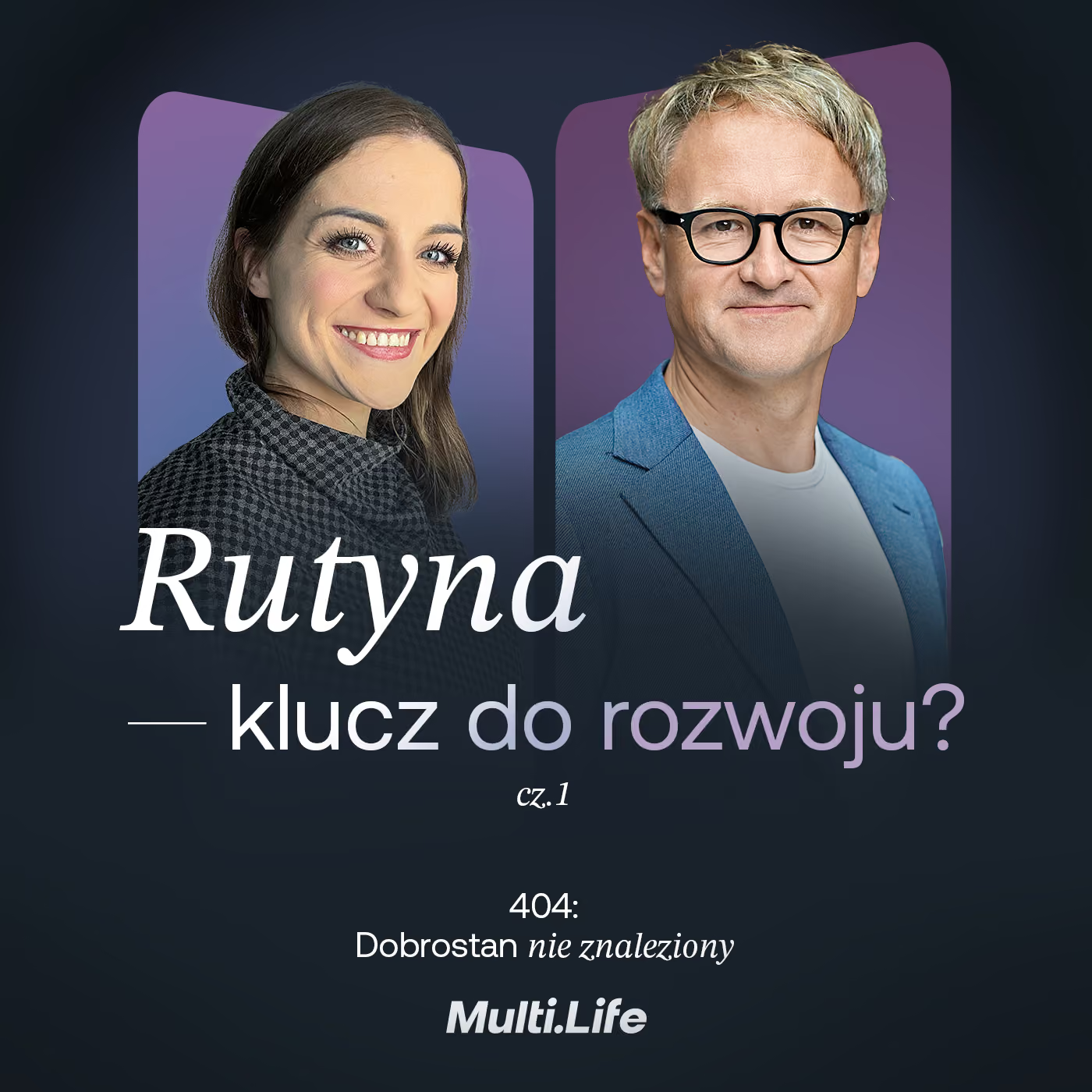
Could routine actually be the key to growth? The world constantly bombards us with stories of geniuses creating in bursts of intuition or inspiration, and companies that manage to reinvent themselves in times of change. Meanwhile, Róża Szafranek, a leader and expert in organizational efficiency, joins us. In the latest episode of 404: Wellbeing Not Found, she discusses how routine helps in developing a company and team, how to leverage new technologies in management and education, and explores microlearning, blended learning, and gamification in training. Artur Kurasiński (@artur_kurasinski) and Róża Szafranek answer these questions in the first part of our conversation. Enjoy!

  1. 00:00:00 Introduction
  2. 00:02:32 AI as a tool for leadership self-assessment
  3. 00:09:57 AI as support for transformation
  4. 00:14:55 The devaluation of knowledge in the age of AI
  5. 00:19:59 Synthetic thinking - the competence of the future
  6. 00:23:07 Authorities in the age of AI
  7. 00:38:25 Building habits
  8. 00:44:14 Knowledge acquisition over time
  9. 00:47:19 Gamification in the development process
“
Published:
23/10/2026 1:21
See also
'Your brain decides before you do. What business doesn't know about people' video cover
'Your brain decides before you do. What business doesn't know about people' video cover'Your brain decides before you do. What business doesn't know about people' video cover
Your brain decides before you do. What business doesn't know about people

In this episode of our "Company That Supports" series, Dr. Ewa Hartman speaks with Dr. Wojciech Glac—a neurobiologist, lecturer at the University of Gdańsk, and popularizer of brain science—about why what we think we know about our own minds often misses the mark on how they actually function. We discuss: why the belief that "I am rational" is only true under certain circumstances, and what really drives our choices; how stress changes the way we think and at what point it stops helping us and starts sabotaging our actions; what the reward system actually is and why dopamine is not a "pleasure hormone," but rather a motor for motivation; whether multitasking is real or if we just like to believe it is; how neuroplasticity works throughout our entire lives and what that means for mature employees in the job market; and why sleep is the foundation—and how a lack of it strips us of exactly what we need most at work. The brain's potential is immense. The question is: do we know the user manual that allows us to make the most of it?

finances
'Scroll, analyze, panic. The new era of digital health' part 2 video cover
'Scroll, analyze, panic. The new era of digital health' part 2 video cover'Scroll, analyze, panic. The new era of digital health' part 2 video cover
Scroll, analyze, panic. The new era of digital health - Damian Parol part 2

Information about healthy eating is at our fingertips today – yet we often still feel lost. Choosing what, how, and when to eat can be more difficult than ever. This is where AI technology and apps come to the rescue.

404: Wellbeing not found
'Surviving the Future: AI and the Human Workforce' video cover
'Surviving the Future: AI and the Human Workforce' video cover'Surviving the Future: AI and the Human Workforce' video cover
Surviving the Future: AI and the Human Workforce

Will the job market turn into a race where humans compete against AI? Or is the future more about collaboration? Which skills are worth building today? How can we avoid the threat of deskilling? And what is the role of HR in all of this? In the next episode of the "Company That Supports" series, hosted by Dr. Ewa Hartman, Dr. Iwo Zmyślony will pull back the curtain on the future.

finances
'Deskilling – how we forgot what we are capable of' video cover
'Deskilling – how we forgot what we are capable of' video cover'Deskilling – how we forgot what we are capable of' video cover
Deskilling – how we forgot what we are capable of

Reading, writing, memorizing, and perhaps even… thinking—are we at risk of slowly "outsourcing" all these skills to increasingly advanced technologies? And if so, what comes next? How can we protect ourselves from losing fundamental competencies? Or perhaps we can let some of them go without regret, gaining new ones in their place? We are asking all these questions today, feeling that while change is inevitable, its direction is not necessarily clear. In the next episode of our series, The Supportive Company, I will discuss development in the age of AI, the risks of deskilling, and the technological revolution with Dr. hab. Bartosz Żukowski, professor at the University of Lodz, a philosopher, cognitive scientist, and researcher of the human mind.

finances
Show more