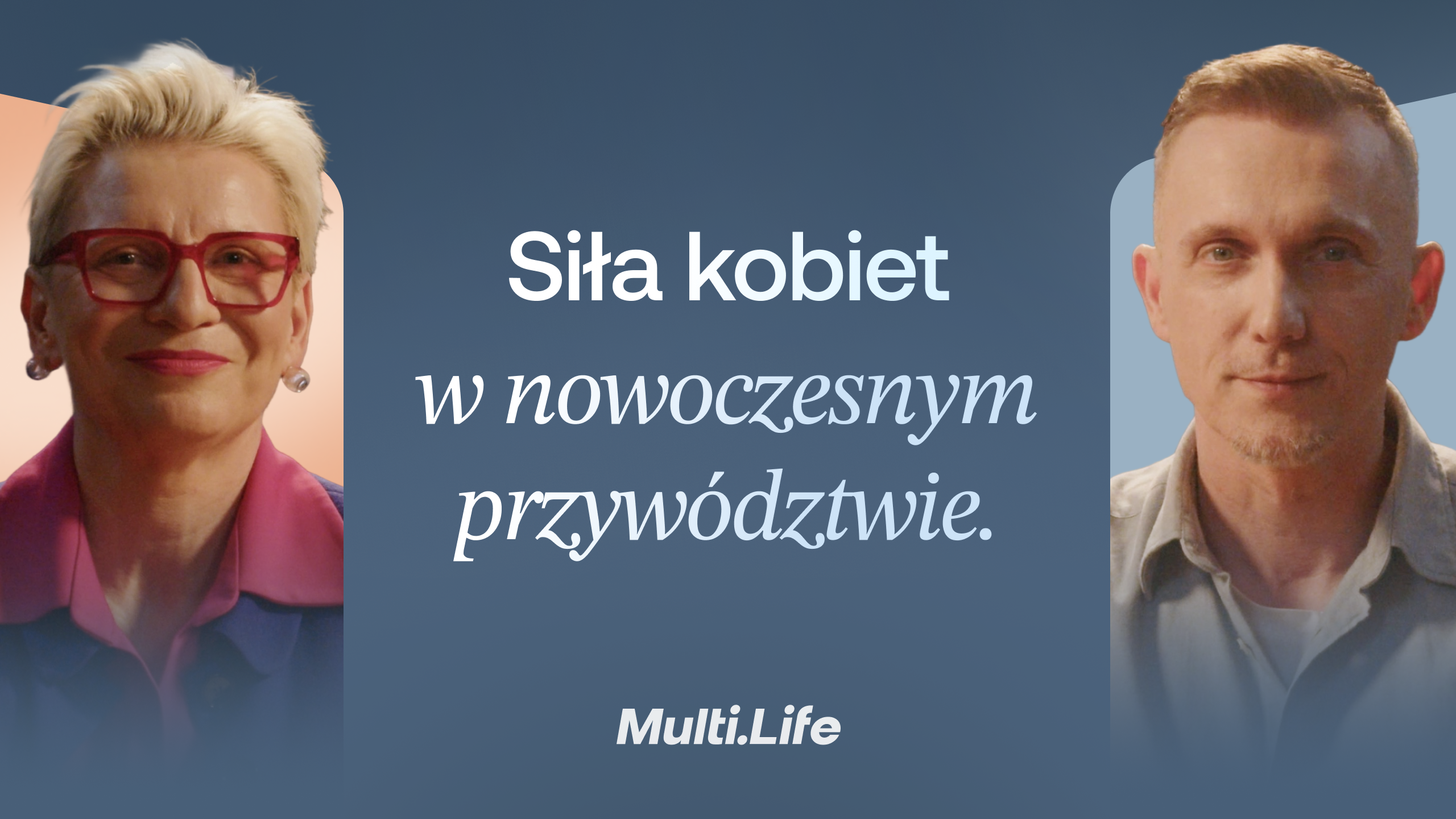
In this episode of the "Well Said" series, Andrzej Silczuk talks to Tina Sobocińska—an HR advisor, university lecturer, and long-time HR director in international organizations—about why the future of leadership requires diversity, what holds women back from promotion, and how organizations can change this here and now.

We discuss:

  1. why diversity in leadership is not a matter of fairness, but a hard business case—and what the data says about it,
  2. who a female leader is—and why the metaphor of an orchestra conductor describes modern leadership better than a charismatic soloist,
  3. how female perfectionism—understood as a fear of judgment—becomes one of the biggest traps on the path to promotion,
  4. why a culture of learning from mistakes builds trust better than any benefit, and how to implement it in practice,
  5. where imposter syndrome comes from and why women decline promotions that men accept without hesitation,
  6. how socialization into gender roles begins at home and what we can do about it as parents, leaders, and colleagues,
  7. where women disappear from organizational pyramids—and why this most often happens after maternity leave,
  8. what the difference is between a mentor and a sponsor—and why we need the latter most of all today,
  9. how to prepare for the second half of your career before change becomes a necessity rather than a choice,

One hundred and thirty-two years to full equality of opportunity—that is the estimate from the World Economic Forum. What can organizations do today to accelerate this change and not wait another generation for it?

This recording is from the Multi.Life channel—a wellbeing platform for companies.

Check it out: https://bit.ly/42Lvf7J | Demo for HR: https://multi.life/#formularz

  1. 00:01:50 - Can leadership have a feminine face? On the need for diversity in management
  2. 00:02:57 - Women on management and supervisory boards
  3. 00:04:00 - The EU directive and "critical mass"—women on company boards?
  4. 00:05:32 - The nature of female leadership – collaboration, trust, and delegation over control
  5. 00:06:34 - Leadership in a world of crises – pandemic, war, technology, and the skills of the future
  6. 00:08:49 - The female leader as an orchestra conductor – managing without power struggles
  7. 00:10:28 - Women and hard skills – the "soft skills" trap and the importance of financial literacy
  8. 00:11:44 - Female perfectionism as a threat – when the drive to be the best leads to burnout
  9. 00:15:53 - LeaderShe and a culture of learning from mistakes – how to build organizations based on trust
  10. 00:19:36 - Why do women still have to prove their competence? Two main reasons
  11. 00:21:59 – Overcoming imposter syndrome and practical advice for women – courage, comfort zones, and support groups
  12. 00:25:16 - Dialogue between women and men – joint meetings instead of closed bubbles
  13. 00:27:17 - Why women turn down promotions while men accept them without hesitation
  14. 00:29:31 - Career barriers for women – organizational culture, domestic roles, and discriminatory interview questions
  15. 00:35:34 – The role of sponsorship in women's career development – how it differs from mentoring and how it works in practice
  16. 00:39:55 The example of Malwina – don't wait for the perfect moment, seize opportunities even in unexpected circumstances
  17. 00:42:08  - Upbringing patterns for boys and girls and the ability to accept positive feedback
  18. 00:47:00 - Reskilling in later life – how to prepare
  19. 00:51:31 - A career Plan B – relationships, mindset, and energy management as pillars of professional security
  20. 00:54:55 - Financial education for women and the employer's role in comprehensive employee support
  21. 01:00:00 – Demographic labor market challenges and the role of employers in preparing for the future
  22. 01:03:21 - How HR can support women considering a career change after fifty – a practical guide
“
Published:
21/8/2026 15:08
See also
'What happens when a company truly listens to its employees?' video cover
'What happens when a company truly listens to its employees?' video cover'What happens when a company truly listens to its employees?' video cover
What happens when a company truly listens to its employees?

In this episode of the "Well Said" series, Andrzej Silczuk speaks with Piotr Sokół—HR Director at Michelin Polska and an HR management practitioner with over 23 years of experience in an organization employing nearly 5,000 people—about how to systematically build employee wellbeing in a manufacturing company. We discuss: - why psychosocial risks are becoming as critical to strategy as physical safety or compensation, and what this means for employers today, - how COVID-19 accelerated the decision to implement systemic solutions and what lessons have remained, - what the ISO 45003 standard is, why Michelin was one of the first companies in Poland to implement it, and why a 93% compliance score is just the starting point, - how to measure workload in conversations with employees and why subjective assessment is key, - where an employer's responsibility for mental health ends, and whether it should have a limit at all. The journey from initial preventive campaigns to a certified system took nearly a decade. The question is: where do you start if you are just taking your first steps? This recording is from the Multi.Life channel—a corporate wellbeing platform. Check it out: https://bit.ly/42Lvf7J | Demo for HR: https://bit.ly/48Kn6nE Multi.Life is a data-driven wellbeing platform that supports employee health and development. Courses, online consultations, partner services, analytics, and an AI assistant in one platform for HR.

Well said
Why the brain loves simple recipes and why they fail - Bartosz Żukowski

In this episode of the series "A company that supports", Dr. Ewa Hartman talks to Dr. hab. Bartosz Żukowski, prof. University of Łódź, philosopher and cognitive scientist, researcher of the mechanisms of thinking and cognition, about why we so willingly believe in simple recipes for complex problems and how this tendency affects management, decision-making and organizational culture. We talk about: why we love tricks and how the culture of rush and the "factory" language of optimization, efficiency and time management make us start to treat ourselves as a tool, what cognitive ease is and why our brain automatically recognizes what is simple, coherent and familiar as true, how System 1 and System 2 work described by Daniel Kahneman and why a trick promises to solve complex business problems with a tool that is not intended for that purpose, why getting up at 5 a.m. will not make anyone a millionaire and what is not said in popular success stories, such as Michael Phelps' visualization, why no scheme or formula can replace practice and experience, or why you can't become a chess grandmaster from a textbook, whether rituals in the company build community and a sense of security, whether they become a tool of discipline, and why it is worth developing them together with the team, why managers are looking for one sentence that will "do" the matter with the team, and why such a sentence does not exist, such as lack of time, no margin for error and the expectation of immediate perfection push employees towards shortcuts, and what a truly supportive company can do about it. "There is no trick that will protect you against a trick" - says prof. Bartosz Żukowski. What will you do today to ensure that there is room in your organization for time, errors and flexibility, and not just for quick recipes? The recording comes from the Multi.Life channel - a wellbeing platform for companies. Check out: https://bit.ly/4rHCwkP Demo for HR: https://bit.ly/4z2GFSO

finances
'Maybe your boss is afraid of psychologists?' video cover
'Maybe your boss is afraid of psychologists?' video cover'Maybe your boss is afraid of psychologists?' video cover
Maybe your boss is afraid of psychologists?

Why office yoga or meditation pods are often just a band-aid for serious problems, the causes and effects of burnout, and the difference between misinformation and genuine psychological support (both inside and outside the workplace).

Well said
'Wellbeing in the workplace. How to do it wrong?' video cover
'Wellbeing in the workplace. How to do it wrong?' video cover'Wellbeing in the workplace. How to do it wrong?' video cover
Wellbeing in the workplace. How to do it wrong?

How can you nurture well-being in a way that delivers real results? What mistakes do even experienced managers make? And how can you ensure your team truly appreciates your efforts? Maciej Żylewicz, an experienced business consultant and trainer specializing in well-being and technology, answers these questions and many more.

Well said
Show more